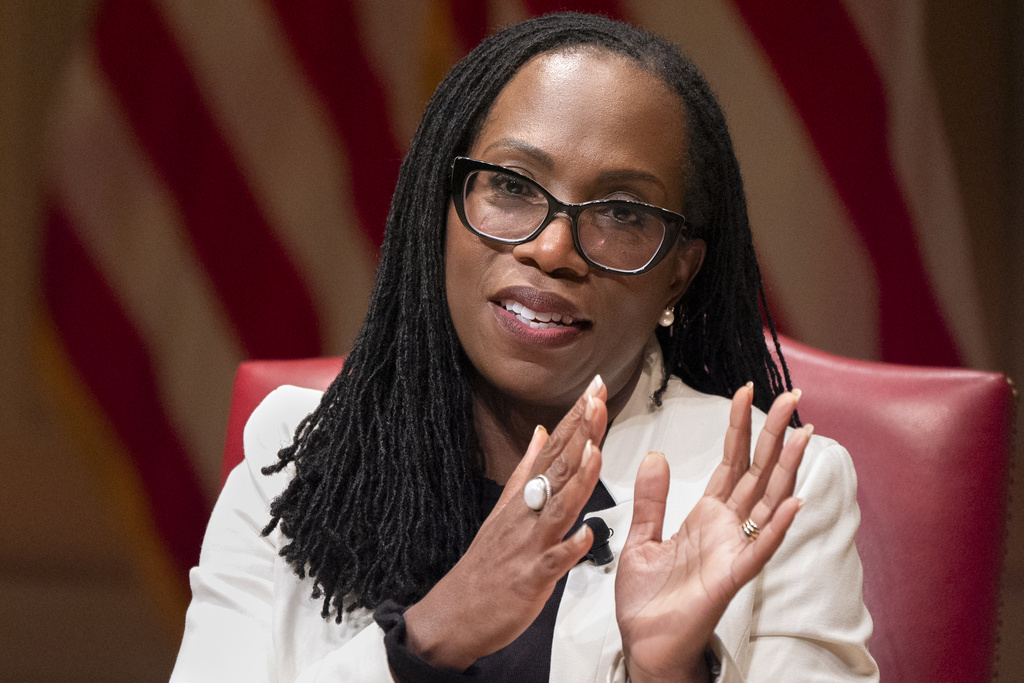
Justice Ketanji Brown Jackson raised significant concerns regarding a recent ruling by the United States Supreme Court that permits Representative Michael Bost, a Republican from Illinois, to proceed with a lawsuit challenging the counting of mail-in ballots received after Election Day. This decision allows Bost and two other political candidates to argue that counting these ballots contravenes federal law, stirring debate about the implications for electoral integrity.
The ruling, which emerged on March 6, 2024, overturns a previous dismissal by a district court. The 7th Circuit Court of Appeals had upheld that the petitioners lacked standing to bring the case, but the Supreme Court’s decision has now reversed that judgment. Under Illinois law, mail-in ballots that are postmarked by Election Day and received within two weeks can still be counted, effectively complicating the legal landscape around election disputes.
In her dissent, Jackson warned that the Court’s decision opens the door to extensive election-related litigation, stating, “Alarmingly, today’s ruling also has far-reaching implications beyond Bost’s election, since dispensing with our usual standing requirements opens the floodgates to exactly the type of troubling election-related litigation the Court purportedly wants to avoid.” Justice Sonia Sotomayor joined Jackson’s dissent, emphasizing the potential ramifications of the ruling.
Chief Justice John Roberts, who authored the majority opinion, defended the decision by asserting that candidates possess a direct interest in the rules governing vote counting. He stated, “Candidates have a concrete and particularized interest in the rules that govern the counting of votes in their elections, regardless whether those rules harm their electoral prospects or increase the cost of their campaigns.” This perspective allows candidates to challenge electoral rules without needing to demonstrate personal harm, a shift that Jackson argues undermines established legal precedents.
Roberts further noted that alternative approaches to determining standing could lead to a surge in election disputes emerging just before or even after elections, creating a chaotic legal environment. “Even if they could do so, this approach would still channel many disputes into postelection litigation,” he wrote.
Justice Amy Coney Barrett, appointed by former President Donald Trump, agreed with the majority on Bost’s standing but disagreed with the rationale behind it. Barrett contended that Bost’s standing stemmed from a traditional financial injury rather than his status as a candidate, stating, “I cannot join the Court’s creation of a bespoke standing rule for candidates.” She emphasized the importance of holding candidates to the same legal standards as other litigants.
Jackson responded to Barrett’s concurrence by acknowledging that while Barrett’s rejection of the candidate-standing rule was justified, her reasoning based on a financial injury was inadequate to substantiate Bost’s standing. “Bost has plainly failed to allege facts that support an inference of standing under our established precedents,” Jackson stated, warning that the ruling complicates and destabilizes both standing law and electoral processes in the United States.
The Supreme Court’s decision has raised alarm about the potential for increased litigation surrounding elections, with critics concerned that it may lead to a proliferation of challenges based on the nuances of voting laws. The case has been remanded to a lower court for further proceedings in line with the Supreme Court’s findings.
As the legal ramifications of this ruling unfold, the implications for future elections and the integrity of the electoral process remain a pressing concern for lawmakers and citizens alike.