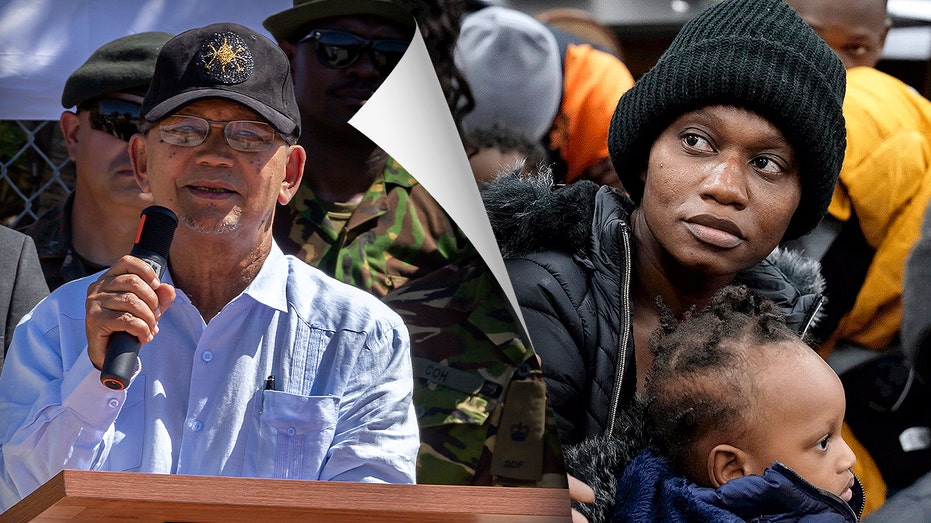
URGENT UPDATE: Haiti’s transitional government leader, Leslie Voltaire, has declared that the nation is “helpless” without the crucial support of the United States’ Temporary Protected Status (TPS) program. In an exclusive interview with Fox News Digital, Voltaire emphasized the dire economic implications if TPS is abruptly terminated, potentially impacting up to 400,000 repatriated citizens.
As the February 7, 2024 deadline approaches for the transitional council to hand over power to elected leaders, Voltaire’s warning resonates louder than ever. He stated, “We cannot do anything about it – just accommodate them, give them money to go back to their provinces… but it’s very painful due to the small budget that we have in the government.” This statement underscores the urgency of the situation as thousands of Haitians could soon be sent back to a country ill-equipped to support them.
Recent developments have heightened tensions in Haiti. Just hours before Voltaire’s remarks, three U.S. warships arrived offshore, signaling an escalated U.S. military presence as the Caribbean nation grapples with ongoing violence. The United Nations, backed by U.S. support, has also approved a new Gang Suppression Task Force to address the spiraling unrest.
Voltaire described Haiti’s reliance on remittances from the diaspora in the U.S., Canada, and France, which generate between $3 to $4 billion annually. He pointed out that the nation’s economy is heavily dependent on these funds, stating, “We don’t have an economy that has the capacity to produce the kind of dollars that [migrant workers] are generating.”
The situation is exacerbated by political instability and lack of investment. Voltaire argued that without significant improvements in security and economic infrastructure, Haiti will remain vulnerable. “The problem of security in Haiti is mainly to have jobs. There are no jobs because there is no investment right now,” he lamented.
Earlier this week, a preliminary injunction was issued by U.S. District Judge Ana Reyes, blocking the Trump administration’s attempt to end TPS for Haiti, citing potential bias against non-white immigrants. This ruling offers a temporary reprieve, but the future of TPS remains uncertain.
Voltaire’s warnings extend beyond immediate economic concerns. He pointed to historical U.S. involvement in Haiti, including a military occupation that he believes contributed to the country’s current struggles. “I think one of the historic problems is that when the U.S. occupied Haiti between 1915 and 1934, they chose to use the Dominican Republic and Cuba as the sugarcane producers,” he explained, highlighting the long-term ramifications of U.S. policies.
As Haiti faces this crossroads, Voltaire remains hopeful yet realistic about the path forward. He believes that while repatriation of Haitians could be beneficial in the long run, essential political and economic development must precede such a move.
The urgency of the situation cannot be overstated. With the clock ticking down to the transitional council’s deadline, the international community’s attention on Haiti is critical. Voltaire’s call for support from the U.S. government is clear: without continued aid and investment, Haiti risks plunging deeper into crisis.
As developments unfold, all eyes will be on the evolving political landscape in Haiti and the implications for its citizens, both at home and abroad.