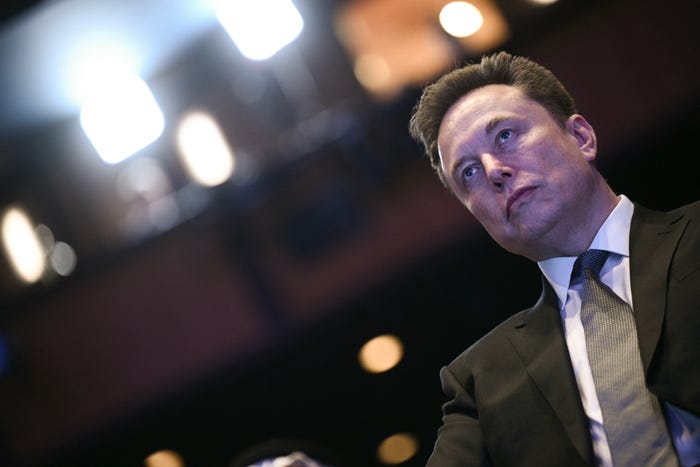
URGENT UPDATE: Elon Musk claims that artificial intelligence (AI) will be the key to resolving America’s escalating debt crisis within the next three years. Speaking in a conversation with investor Nikhil Kamath, Musk emphasized that AI and robotics are the only viable solutions to address the nation’s fiscal challenges.
The current national debt stands at a staggering $38.34 trillion as of November 26, 2023, more than double its value from a decade ago, according to the U.S. Treasury. Musk asserts that the productivity gains from AI will soon outpace inflation, allowing for significant economic recovery.
“That’s pretty much the only thing that’s going to solve for the U.S. debt crisis,” Musk stated. He predicted that within three years, “goods and services output will exceed the rate of inflation,” potentially causing a notable deflationary effect.
Musk’s optimism isn’t unfounded. He has been vocal about the transformative potential of his Optimus robot, which he claims could eliminate poverty and reduce the necessity of human labor. “In the next two decades, we could reach a point where working is optional,” he declared, envisioning a future where productivity is so abundant that basic needs are easily met.
During a recent Tesla shareholder event, Musk reinforced his vision, saying, “There’s actually only one way to do that, and that’s with the Optimus robot.” He suggested that advances in AI would lead to a scenario where money itself may become irrelevant, with resources like electricity and mass becoming the new constraints.
This perspective aligns with a broader conversation about AI’s potential to reshape the global economy. Google CEO Sundar Pichai recently echoed these sentiments, stating that while AI carries significant benefits, it will also bring about substantial societal disruptions requiring careful consideration and adaptation.
Investor Vinod Khosla has pointed out that AI could ultimately handle 80% of the work in 80% of jobs, which he believes will necessitate a universal basic income to prevent worsening inequality. However, not all experts share Musk’s optimistic outlook. Geoffrey Hinton, known as the “godfather of AI,” warned that while AI could generate considerable profits, it may also lead to increased wealth concentration among a small elite, leaving many behind.
The urgency surrounding Musk’s predictions is palpable as the U.S. grapples with rising debt and inflation. With a compelling vision for a future driven by AI, Musk’s remarks have ignited discussions about the potential for technological advancements to address pressing economic issues.
As this story develops, the impact of AI on the economy, labor, and wealth distribution will be critical areas to watch. Will Musk’s ambitious predictions come to fruition? Only time will tell, but the implications for the U.S. economy and global society could be profound.