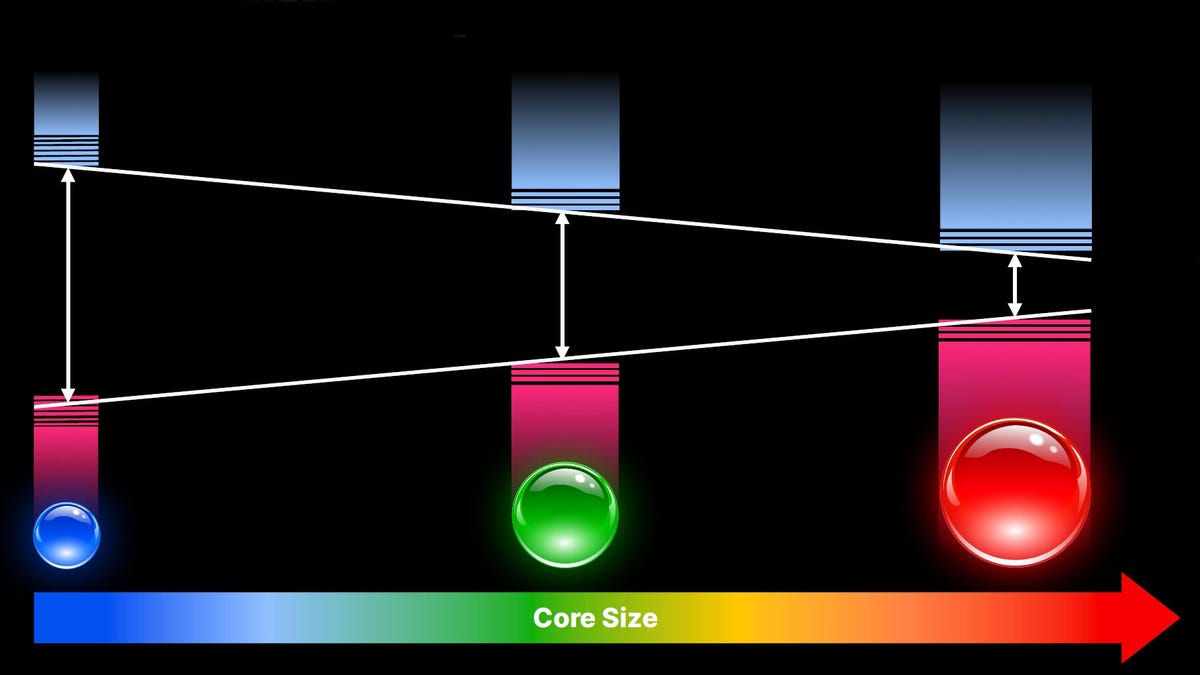
Companies like TCL are heralding the arrival of super quantum dots (SQDs) as a transformative advancement in television technology. These next-generation components promise to enhance color accuracy and overall performance in TVs, building on the already impressive capabilities of traditional quantum dots. While some skepticism exists about marketing claims, the potential improvements in manufacturing and color reproduction are noteworthy.
Understanding Quantum Dots
At the core of this technology are quantum dots, which are microscopic particles capable of converting one color of light into another with remarkable efficiency. The size of each quantum dot determines the color emitted when energized by blue light, typically sourced from blue LEDs or OLEDs. Smaller quantum dots emit blue light, medium-sized dots produce green, and larger ones generate red.
Currently, the most common application for quantum dots is in LCD and OLED TVs, where they convert blue light into red and green, thus creating a full spectrum of colors. Future innovations may allow quantum dots to convert electricity directly into light or utilize ultraviolet light for visible color production.
Advancements with Super Quantum Dots
The manufacturing process for super quantum dots has evolved significantly, particularly with advancements from manufacturers like Nanosys. They can now produce quantum dots in precise sizes, down to the nanometer. This level of accuracy allows TV manufacturers to fine-tune their color filters and designs, leading to enhanced color gamut and performance.
Super quantum dots represent a refined version of standard quantum dots, requiring specialized equipment for production. The manufacturing process resembles that of brewing, involving multiple stages to achieve the required size for optimal light conversion. If a quantum dot is either too large or too small, it may not function effectively, impacting the overall quality of the display.
While slight variations in size can average out to acceptable color reproduction, the push for super quantum dots aims to provide higher efficiency and more vivid colors. The objective is to ensure colors are pure and distinct—red appears as red, green as green—maximizing brightness and minimizing energy loss during color production.
Despite the promising advancements, there is a challenge to overcome: deeper colors do not inherently appear brighter, which remains a primary concern for TV manufacturers. To achieve both, super quantum dots must be produced with exceptional precision, minimizing any impurities that could dilute color quality. For instance, if green quantum dots have a yellowish tint, it can affect the vibrancy of other colors in the display.
For budget TVs, these variations may not be critical, as the average consumer may not discern the differences. However, for high-performance televisions, the purity of color reproduction becomes essential.
Market Impact and Future Prospects
While super quantum dots may not revolutionize the industry in a dramatic way, they represent a significant incremental advancement. TCL claims a potential increase of up to 33% in color gamut with their SQD technology, although further testing will be necessary to validate these claims in laboratory settings.
As other manufacturers explore similar technologies, they may not adopt the SQD label but will undoubtedly aim for brighter, more vibrant screens. The development of improved quantum dots could pave the way for a new era in television technology, focusing on enhanced visual experiences.
In summary, super quantum dots signify a promising step forward in the quest for more vibrant and accurate displays. As manufacturers like TCL and Nanosys continue to refine their techniques, consumers may soon enjoy televisions that deliver richer colors and improved overall performance.