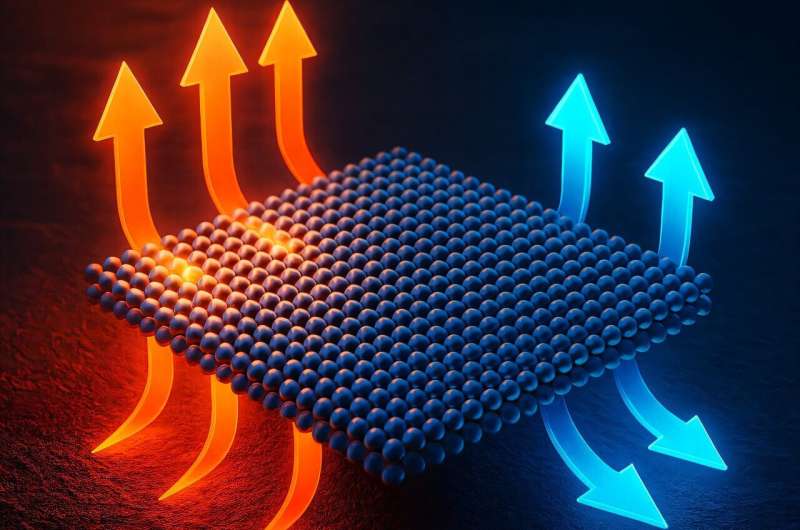
Researchers have uncovered intriguing insights into the behavior of heat flow in ultrathin materials, specifically silicon films, revealing a surprising reversal in thermal conductivity as the material approaches atomic thickness. This breakthrough, detailed in a paper by Alessio Zaccone published on December 14, 2025, in the Journal of Applied Physics, challenges long-held assumptions in thermal physics.
In conventional materials, thermal conductivity is expected to decrease as thickness diminishes due to the limited movement of phonons—vibrational energy carriers within a material. However, simulations conducted by a team at Carnegie Mellon University indicated that silicon films exhibit a distinct minimum in thermal conductivity at thicknesses of approximately one to two nanometers, corresponding to just a few atomic layers. Surprisingly, conductivity increases again as the films become even thinner, defying traditional theories such as the Boltzmann transport equation.
Zaccone’s research sought to explain this nonintuitive behavior by approaching the problem from a geometric perspective. He proposed that as films thin, phonons whose wavelengths exceed the film’s thickness cannot exist along that direction. This restriction creates “forbidden regions” within the phonon momentum space, leading to a distortion of the typical Debye sphere, which describes phonon behavior in bulk materials.
As confinement increases, these forbidden zones expand, reshaping the vibrational landscape. This geometric alteration causes a shift toward lower frequency, long-wavelength phonon modes, which are more effective at transporting heat. Zaccone’s analysis demonstrates that the density of states for phonons changes in a way that enables greater heat conduction, thus accounting for the observed minimum and subsequent increase in thermal conductivity.
By integrating this new understanding of phonon behavior with established formulas for thermal conductivity, Zaccone found that theoretical predictions aligned closely with the simulation results. This correlation validates the significance of geometric constraints at the nanoscale, emphasizing that traditional assumptions may not apply in such extreme conditions.
The implications of this research extend beyond silicon films. Similar phenomena have been observed in silicon nanowires, where the effects of confinement are even more pronounced. Understanding heat flow in nanoscale materials is increasingly crucial as electronic components continue to shrink. Effective thermal management is vital to prevent overheating in modern devices, while in quantum computing, even minor heat fluctuations can disrupt coherence.
Looking ahead, Zaccone expressed excitement about expanding this framework to include additional scattering mechanisms and apply it to various thin films and materials. He envisions potential applications in superconducting devices and quantum information technologies, where understanding phonon transport will be essential.
In conclusion, Zaccone’s work not only addresses a long-standing mystery in thermal physics but also highlights the broader significance of investigating material behavior at the nanoscale. As researchers push the boundaries of material science, the unexpected surprises encountered may lead to new technologies and deeper insights into the fundamental nature of materials.