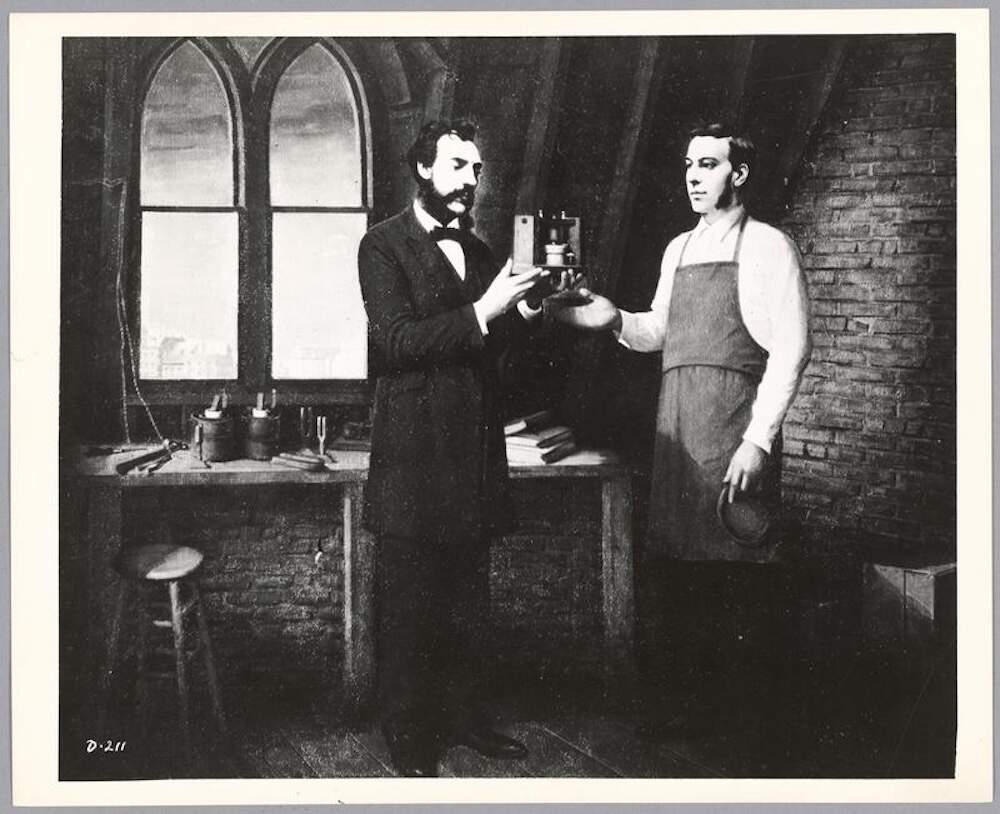
The first successful telephone call took place on March 10, 1876, in Boston, marking a pivotal moment in communication history. Alexander Graham Bell famously transmitted the words, “Watson, come here. I want to see you,” to his assistant Thomas A. Watson, signaling the dawn of a new era in human interaction. Today, the precise location of this groundbreaking event has changed, but two plaques in downtown Boston commemorate Bell’s remarkable achievement.
As pedestrians pass by the markers, many remain unaware of the significant legacy that unfolded in their city. One passerby, Tori Gralla, reflected, “I don’t know a lot about Alexander Graham Bell. My guess is that he invented something? Wait, was it a telephone?” Her surprise at learning about the telephone’s origins in Boston highlights a common gap in public knowledge about technological milestones.
Innovation in Context
Bell was born in Scotland, where his family background influenced his future pursuits in sound and communication. His mother was hearing impaired, and his father taught elocution, which shaped Bell’s dedication to helping the deaf. After relocating to Boston in the 1870s, he became a speech professor at Boston University while simultaneously exploring inventions related to sound.
During the late 19th century, Boston was a hub of innovation, reminiscent of a Victorian-era Silicon Valley. Inventors were focused on improving communication technologies, especially in the realm of telegraphy. At that time, sending telegrams through Western Union was slow and costly. Bell’s initial goal was not to create a telephone but rather to enhance the telegraph.
According to Florencia Pierri, associate curator of science and technology at the MIT Museum, Bell and Watson worked diligently to develop a speaking telegraph. They achieved early success with a gallows transmitter before ultimately innovating a liquid transmitter. “It’s an object that, at first glance, you would not peg as a telephone,” Pierri remarked, showcasing a historical replica from the museum’s collection.
A Legacy of Communication
The invention that Bell and Watson developed transformed how people communicated. The addition of acid to their liquid transmitter played a crucial role in their success. The moment Bell successfully called Watson from another room marked the first intelligible speech transmitted over a wire, a milestone in communication history.
Despite the initial success, Bell’s early models faced limitations, and he eventually returned to his induction model. This model was the basis for the formation of the Bell Telephone Company. Despite its shortcomings, the company leveraged a more effective carbon transmitter patented by inventor Thomas Edison.
Bell’s journey was not without challenges, including a notable patent dispute with fellow inventor Elisha Gray. Nevertheless, Bell and Watson’s partnership changed communication forever, leading to significant advancements in technology and substantial financial success.
Pierri emphasizes that Bell was not an isolated genius; his accomplishments built upon the work of others, and subsequent inventors continued to refine and develop the telephone. The evolution from early devices to modern smartphones illustrates how communication technology has become increasingly integrated into daily life.
As the world celebrates 150 years of telephone innovation, one can only speculate how Bell would react to today’s multifaceted smartphones, which serve as cameras, computers, and communication devices all in one. “He might ask, ‘But where are the wires? How does it work? What is this screen?'” Pierri suggested, underscoring the vast strides in technology since Bell’s time.
In conclusion, Alexander Graham Bell’s historic call not only transformed communication but also paved the way for the technological landscape we navigate today. The legacy of his work continues to resonate, reminding us of the profound impact of innovation on our daily lives.