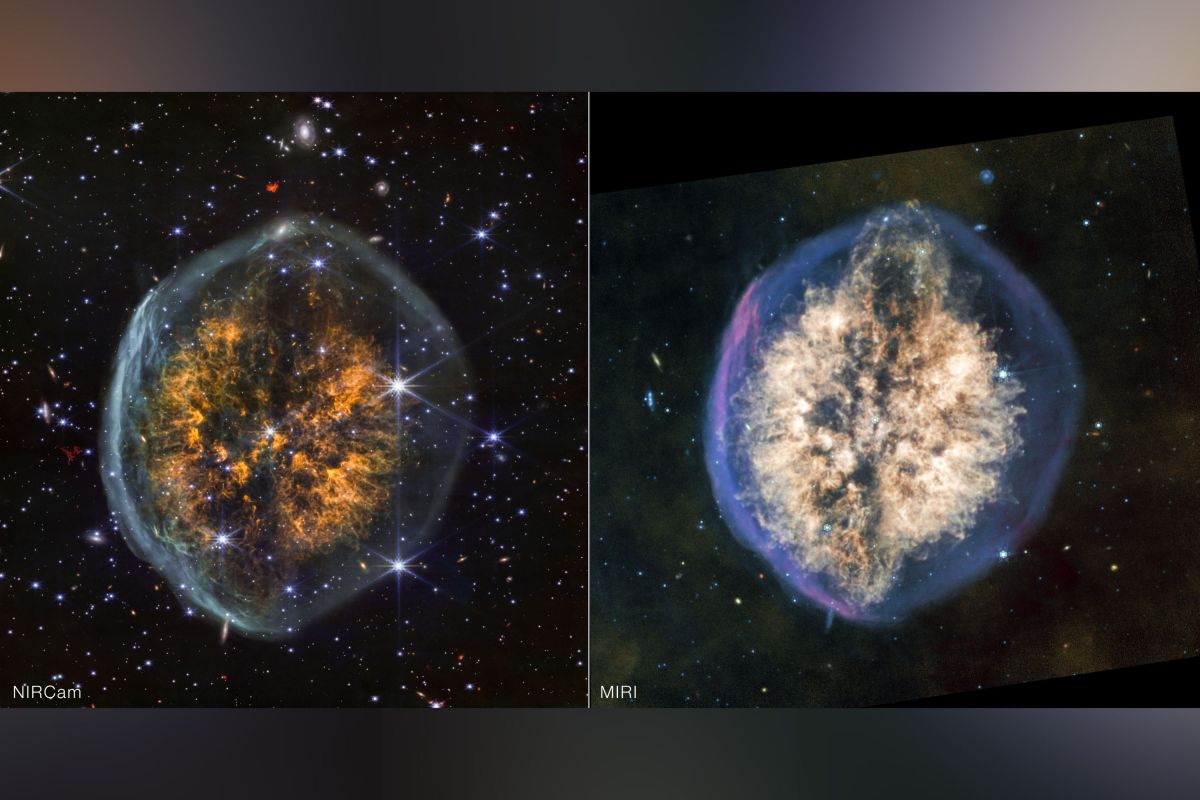
NASA has released breathtaking images captured by the James Webb Space Telescope of a lesser-known nebula, designated as PMR 1. This nebula, nicknamed the “Exposed Cranium,” features split hemispheres and a dark central lane that strikingly resembles a transparent skull encasing a brain. These new insights provide valuable information about the lifecycle of dying stars.
The images from Webb illustrate a brief yet significant phase in a star’s evolution, shedding light on how stars eject their outer layers as they approach the end of their life. Observations indicate that PMR 1, located in the Vela constellation approximately 5,000 light-years from Earth, displays a complex structure. The nebula showcases an outer shell predominantly composed of hydrogen, which was expelled first, while a denser inner cloud consists of various gases.
Scientific Significance of PMR 1
Webb employed both near-infrared imaging with the NIRCam and mid-infrared imaging with MIRI to capture this nebula’s intricate details. The central dark lane may be linked to an outflow or twin jets from the star at the heart of PMR 1. According to NASA, the MIRI images reveal apparent ejections at the nebula’s upper region, while the NIRCam images provide a clearer view of surrounding stars and distant galaxies.
The composite image produced by Webb spans roughly 3.2 light-years and represents a critical step in understanding stellar evolution. The mass of the central star remains undetermined, leaving open questions about its ultimate fate. It may either evolve into a dense white dwarf similar to our Sun or culminate in a dramatic explosion as a supernova if it possesses sufficient mass.
More than a decade ago, NASA’s retired Spitzer Space Telescope first identified the planetary nebula in infrared light, marking the beginning of interest in this celestial object.
Upcoming Astronomical Events
In addition to this remarkable discovery, NASA has announced an upcoming total lunar eclipse set to take place on March 3. This event will be visible across the Pacific region, with timing varying for different areas. The agency has provided a detailed timeline for the eclipse:
– Penumbral eclipse begins at 12:44 a.m. PST / 3:44 a.m. EST / 08:44 UTC, indicating subtle dimming as the Moon enters Earth’s penumbra.
– The partial eclipse starts at 1:50 a.m. PST / 4:50 a.m. EST / 09:50 UTC, with a noticeable darkening on the lunar surface.
– Totality begins at 3:04 a.m. PST / 6:04 a.m. EST / 11:04 UTC, during which the Moon will take on a coppery red hue.
– Totality concludes at 4:03 a.m. PST / 7:03 a.m. EST / 12:03 UTC, as the red color fades and the shadowed area reappears.
– The partial eclipse ends at 5:17 a.m. PST / 8:17 a.m. EST / 13:17 UTC, leaving only slight dimming.
– The penumbral eclipse will finish at 6:23 a.m. PST / 9:23 a.m. EST / 14:23 UTC, marking the end of the event.
These astronomical occurrences not only capture the imagination but also serve as a reminder of the dynamic processes at play in our universe. As NASA continues to explore and document these celestial phenomena, the insights gained could deepen our understanding of the cosmos and its many wonders.