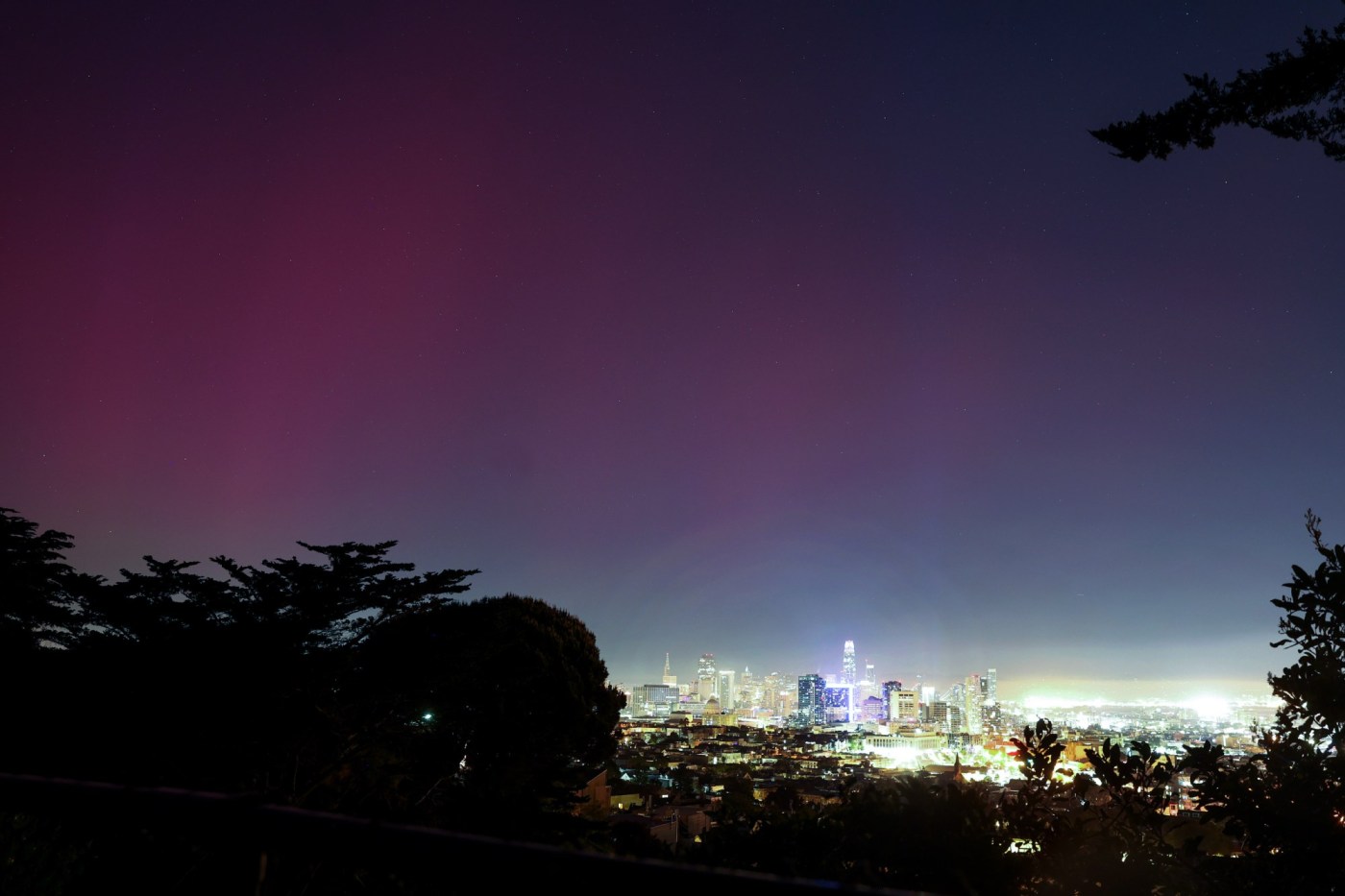
Jason Press, a graduate of Marin Catholic High School, is leveraging artificial intelligence to improve the scientific understanding of the aurora borealis. Currently a senior at Pepperdine University in Malibu, Press is engaged in a data research project aimed at enhancing the accuracy of data collected about this natural phenomenon, which is often obscured by clouds.
Press explained that obtaining clear data on the aurora borealis can be challenging due to the limited number of clear-sky nights. “When clouds roll in, that data is usually lost,” he noted. His project focuses on creating a model capable of “seeing through the clouds” to recover valuable information.
Last summer, Press and his research team successfully processed 90 minutes of satellite footage, recovering images that had been discarded due to cloud interference. Their findings led to an invitation to present at the upcoming American Geophysical Union conference in December, highlighting the significance of their work.
Scientific Impact of Improved Data Collection
Press’s academic advisor, Fabien Scalzo, who teaches computer science, expressed enthusiasm for Press’s innovative approach. “I’m thrilled by the work Jason has done,” he stated. “His curiosity and hard work at the intersection of computer vision and AI are opening vast areas of research in the analysis of Auroras.”
The aurora borealis, created by the interaction of solar-charged particles and the Earth’s magnetic field, has been monitored via satellite for over a decade. Yet, according to Press, at least half of the data collected has been rendered useless due to cloud cover.
His primary mentor, Gerard Fasel, a physics professor at Pepperdine, emphasized the importance of accurately interpreting auroral data. Improved monitoring could enable scientists to predict catastrophic events linked to solar flares or solar wind emissions. Historical examples include the 1859 solar wind event that caused extensive damage to telegraph systems and a 1989 solar storm that led to a significant power grid failure in Quebec.
Fasel highlighted the practical applications of their research: “We’d like to be able to predict these storms so that we can power our spacecraft down to prevent damage to electrical circuits.” He has studied the aurora borealis since 1995, advocating for the integration of more reliable auroral data with spacecraft observations to enhance our understanding of solar-terrestrial interactions.
Background and Community Recognition
Press, who grew up in Mill Valley, is the middle child in a family of five, with parents Mary and Curtis Press, both veterinarians. The family relocated from Mill Valley to Belvedere when Press was 18.
The principal of Marin Catholic, Chris Valdez, recognized the Press family’s academic legacy at the school, noting, “Each of them has balanced academic excellence with involvement in service, sports, and music.” Valdez praised Jason’s blend of intellectual rigor and creativity, stating, “It is no surprise that he is using his gifts and curiosity to explore this data recovery project.”
As Press continues his work, he stands at the forefront of integrating AI with environmental science, potentially transforming how researchers study the aurora borealis and its implications for understanding solar activity.