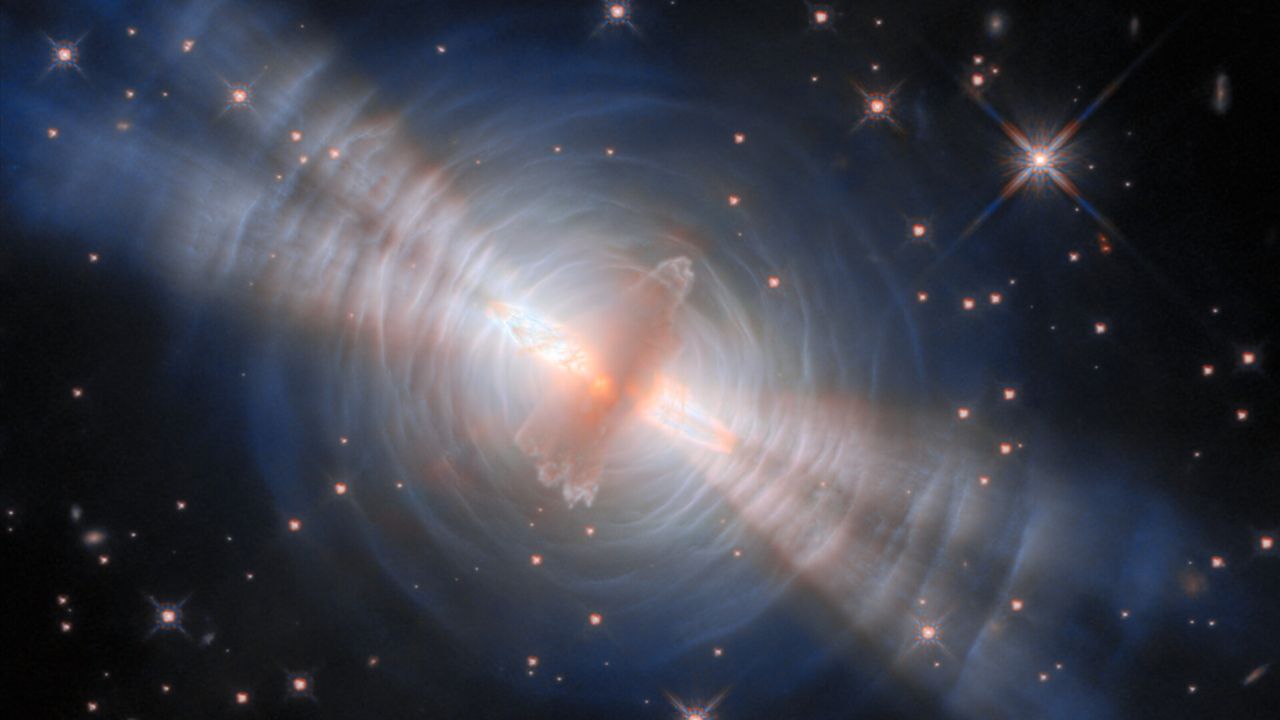
A remarkable new image from the Hubble Space Telescope showcases the Egg Nebula (CRL 2688), the closest pre-planetary nebula to Earth, located approximately 1,000 light-years away in the constellation Cygnus. This stunning photograph, released on February 10, 2026, offers a unique glimpse into the life cycle of sunlike stars as they reach the end of their existence.
The Egg Nebula is distinguished as the first, youngest, and closest example of a pre-planetary nebula ever discovered. This classification is somewhat misleading, as planetary nebulas have no direct connection to planets. The term originated from 18th-century astronomers, who noted that these nebulas resembled planets when viewed through telescopes. In reality, they are expanding shells of ionized gas and dust expelled by dying stars, ultimately leaving behind dense remnants known as white dwarfs.
Insights from Hubble’s Latest Observation
The recent image captures a striking view of concentric circles of fresh stardust ejected by the dying star at the center of the Egg Nebula. This visual representation provides vital evidence of the processes that occur as stars exhaust their hydrogen and helium fuel. The Egg Nebula stands out among its peers, such as the Helix Nebula and the Butterfly Nebula, by allowing astronomers to observe a critical transitional phase that lasts only a few thousand years.
As the egg-shaped nebula evolves, it transitions into a fully developed planetary nebula, dispersing its gas and dust. The brief existence of pre-planetary nebulas means that very few are observable at any given time, making the Egg Nebula a rare subject for study. Its relative dimness also contributes to the difficulty in observing such phenomena.
This latest image marks another chapter in Hubble’s exploration of the Egg Nebula, which has been observed multiple times, including in 1997, 2003, and 2012. The combination of data from these earlier observations with new findings has resulted in this striking portrayal of the nebula in its early stages.
The Dynamics of Stellar Evolution
In the current phase of its life cycle, the star at the center of the Egg Nebula has expelled a dense disk of dust relatively recently, just a few hundred years ago. As dust now obstructs the star’s light, it escapes through polar openings, creating twin beams that illuminate the surrounding material. The patterns observed, including concentric arcs and symmetry, suggest that the star regularly releases mass, contradicting the notion of a chaotic supernova explosion.
The findings from the Hubble Space Telescope not only enhance our understanding of stellar evolution but also provide a visual narrative of the processes that govern the life cycle of stars. As astronomers continue to study the Egg Nebula, they hope to unravel more mysteries related to the formation and evolution of planetary systems in our universe.