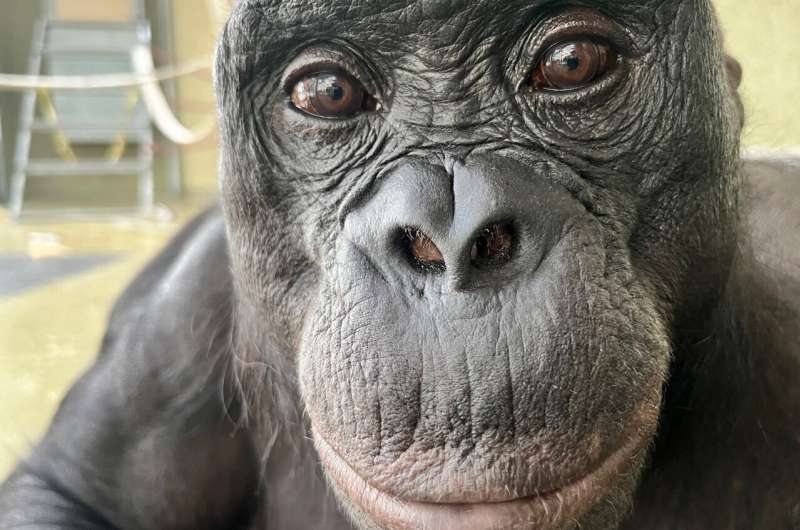
Researchers at Johns Hopkins University have unveiled significant findings suggesting that apes possess the ability to engage in imaginative play, a trait previously thought to be exclusive to humans. In a series of innovative experiments, one bonobo named Kanzi demonstrated the capacity to interact with imaginary objects, such as pretend juice and grapes, challenging long-held beliefs about animal cognition.
Across three carefully designed experiments, Kanzi participated in activities reminiscent of a child’s tea party. The studies aimed to assess whether apes could comprehend and respond to pretend scenarios. The results were striking: Kanzi consistently recognized and indicated the presence of imaginary juice and grapes, suggesting a level of cognitive function previously unrecognized in nonhuman animals.
The first experiment involved two transparent cups on a table set with empty pitchers. An experimenter pretended to pour juice into the cups and then asked Kanzi, “Where’s the juice?” Remarkably, he pointed to the correct cup most of the time, even when the experimenter altered its position. To eliminate any confusion regarding real and pretend juice, a second trial included a cup of actual juice alongside the imaginary one. In this case, Kanzi almost always pointed to the real juice, indicating he understood the difference between the two.
In the third experiment, the focus shifted to grapes. The experimenter pretended to sample a grape from an empty container and placed it in one of two jars. Kanzi again identified the location of the pretend grape, demonstrating his ability to engage with concepts that do not physically exist.
Christopher Krupenye, co-author and assistant professor in the Department of Psychological and Brain Sciences, highlighted the implications of this research. “Imagination has long been seen as a critical element of what it is to be human, but the idea that it may not be exclusive to our species is transformative,” he stated. This study adds to the growing body of evidence that apes, particularly those who are enculturated, may have cognitive abilities that parallel those of humans, dating back approximately 6 to 9 million years to our common ancestors.
The findings, published on February 5, 2026, in the journal Science, prompt a reevaluation of what constitutes unique human traits. Jane Goodall‘s earlier research revealed that chimpanzees use tools, which changed perceptions of animal intelligence. This new evidence encourages a similar reassessment of mental capabilities across species.
The research team, which included Amalia Bastos, a former postdoctoral fellow at Johns Hopkins and current lecturer at the University of St. Andrews, noted the potential for future studies. “It’s extremely striking and very exciting that the data seem to suggest that apes, in their minds, can conceive of things that are not there,” Bastos remarked.
Kanzi’s performance, while not perfect, was consistently accurate, reinforcing the idea that apes can imagine and interact with objects that are not present. This breakthrough opens avenues for further investigation into the cognitive lives of other apes and even different animal species, probing their abilities to engage in pretend play and understand abstract concepts.
As the research progresses, the implications extend beyond the scientific community. Krupenye emphasized the importance of recognizing the rich mental lives of these creatures. “We should be compelled by these findings to care for these creatures with rich and beautiful minds and ensure they continue to exist,” he asserted.
The study marks a significant advancement in our understanding of animal cognition and imagination, urging a reconsideration of the boundaries that have traditionally separated humans from other species. As researchers continue to explore the depths of animal intelligence, the line between human and nonhuman cognitive abilities may increasingly blur.