Ukraine has detailed a recent military operation that involved a drone strike targeting a Russian submarine. The operation was executed by the Security Service of Ukraine, known as the SBU, which revealed that it first disabled Russia’s only maritime anti-submarine aircraft, the Il-38N, before launching the main attack on the submarine itself.
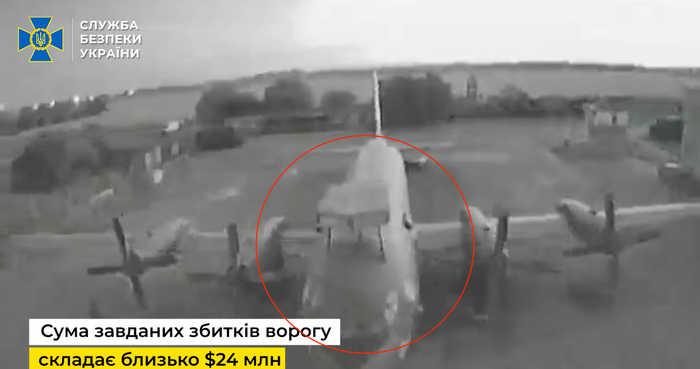
On March 5, 2024, the SBU reported using a drone equipped with an airburst warhead capable of dispersing over 2,000 fragments to successfully strike the Sea Dragon aircraft. This critical operation took place at the Yeysk air base, located on the eastern shore of the Sea of Azov, across from the Russian-occupied city of Mariupol.
In a video released by the SBU, the drone can be seen approaching the Sea Dragon on the runway. The SBU stated, “The detonation occurred directly above the compartment housing the main equipment and radars and also damaged the engine.” Despite the release of this footage, independent verification of the timing and location remains unconfirmed.
Disabling the Sea Dragon was essential for Ukraine’s subsequent strike on the Russian submarine. The SBU emphasized that this aircraft was crucial in detecting underwater threats and had been actively working against operations conducted by Ukraine’s maritime drones. Notably, the SBU remarked, “In the Black Sea, the Russians had only one aircraft of this class capable of detecting the ‘Sub Sea Baby’ underwater drone as it moved toward its target.”
The SBU’s attack on the Sea Dragon set the stage for a later strike against a Kilo-class submarine, which Ukraine previously targeted in the port of Novorossiysk. This submarine, valued at approximately $400 million, is designed to carry up to four Kalibr cruise missiles, a type of missile comparable to the US Tomahawk, frequently employed by Russia in its assaults on Ukrainian cities.
The SBU had previously stated that the attacked Kilo-class submarine was stationed in Novorossiysk after retreating from Crimea due to Ukrainian military actions. The Russian Black Sea Fleet has denied that the attack resulted in significant damage to the submarine.
Ukraine, despite lacking an official navy, has effectively employed drones and missiles to engage with Russia’s Black Sea Fleet. This strategy has often succeeded in driving these naval forces away from their operational areas, demonstrating Ukraine’s adaptability in maritime warfare.
As the conflict continues to unfold, these developments underscore the ongoing tensions in the Black Sea region and the innovative tactics employed by Ukraine to counter Russian military capabilities. The use of advanced drone technology marks a notable evolution in Ukraine’s defense strategy as it seeks to reclaim control over its maritime borders.