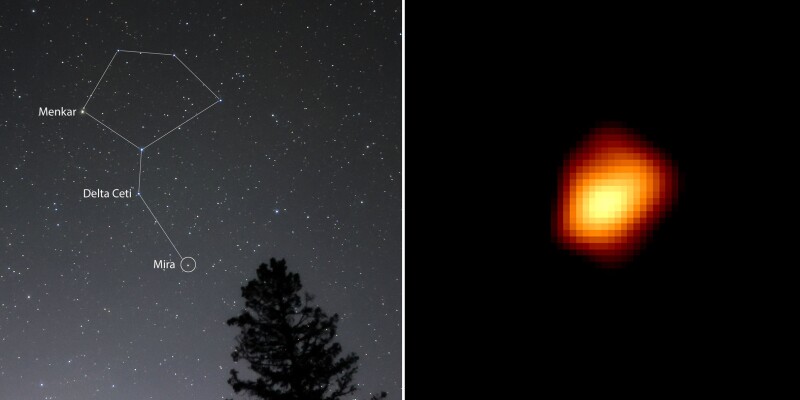
Astronomers have observed an increasing brightness in the star Mira, located in the constellation Cetus, marking a notable return after its dim phase. The star, known for its significant fluctuations in brightness, is expected to reach its peak illumination in early February 2024. This phenomenon is due to Mira’s pulsating nature, which is a result of physical changes in its size and temperature.
Historically, Mira, which means “wonderful” in Latin, was named by Polish astronomer Johannes Hevelius in 1662. It has the distinction of being the first pulsating variable star ever identified. Over a cycle lasting approximately 332 days, Mira can vary from being nearly invisible to the naked eye to shining as brightly as stars in the Big Dipper.
As of January 4, 2024, Mira was recorded at a magnitude of 3.5, approximately two and a half times fainter than the stars in the Big Dipper. Observers noted its gradual brightening, making it easier to spot, particularly after the recent full moon has moved from the evening sky. For optimal viewing, stargazers are advised to find a location away from city lights.
The Dynamics of Mira’s Brightness
The unique behavior of Mira stems from its expansive lifecycle. During its expansion phase, the star grows to about 700 times the size of the sun, while contracting, it shrinks to around 300 times the sun’s size. This cycle resembles the process of human respiration, where Mira expands and contracts, leading to temperature and brightness changes.
The current observations of Mira provide a glimpse into the future of our own sun. Like Mira, stars similar in size undergo changes as they age. Initially, they burn hydrogen, but as this fuel depletes, they begin to consume heavier elements, leading to instability and expansion. This is a process that can take billions of years, and Mira serves as a relevant example of what may eventually occur with our solar system’s star.
The star’s expansion phase also results in the shedding of billions of tons of gas and dust into space, contributing to the surrounding cosmic environment. As gravity reasserts itself, Mira collapses back into a dense, hot state, ready to commence the cycle anew.
In the coming weeks, observers will witness Mira’s brightness fluctuate, offering a rare opportunity to reflect on both the beauty and the fate of stars in our universe. Capturing these changes not only enhances our understanding of stellar life cycles but also invites contemplation on the future of our own sun.