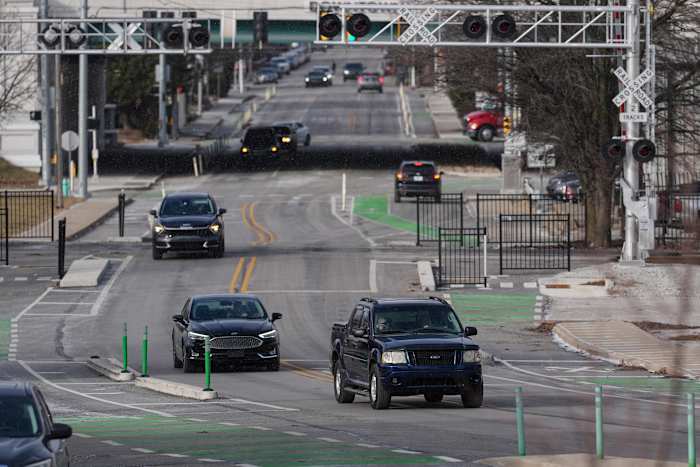
Cities across the United States are increasingly reversing the trend of one-way streets, opting instead for two-way roadways to enhance safety and foster a sense of community. In Indianapolis, the recent conversion of Michigan and New York streets back to their original two-way configurations marks a significant shift in urban planning aimed at improving local traffic conditions and revitalizing neighborhoods.
The decision to redesign these streets stemmed from concerns about excessive speeding along the routes, previously dubbed a “racetrack” by local residents. Originally two-way roads, they were converted to one-way in the 1970s to accommodate thousands of RCA workers commuting to the electronics plant. After RCA closed in 1995, the roads became less congested but increasingly dangerous for pedestrians and cyclists.
James Taylor, director of a nearby community center, remarked on the transformative impact of the redesign: “The opening and conversion of those streets has just been transformative for how people think about that corridor.” This sentiment echoes a broader trend observed in midsize cities throughout the U.S. where transportation planners are embracing two-way streets as a safer and more inviting alternative.
Understanding the Shift in Street Design
According to Dave Amos, an assistant professor of city and regional planning at California Polytechnic State University, one-way streets were never the original design for major thoroughfares in the U.S. Historically, two-way streets facilitated better downtown walkability. The shift towards one-way streets emerged during a period when suburban migration prioritized quicker commutes over urban accessibility.
“One-way streets are designed for moving cars quickly and efficiently,” Amos explained. “So when you have that as your goal, pedestrians and cyclists almost by design are secondary, which makes them more vulnerable.”
Moreover, the misconception that one-way streets are inherently safer for pedestrians is being challenged. Wade Walker, an engineer with Kittelson & Associates, noted that the confusion arises when one-way streets intersect with two-way streets. This complexity can increase the risk of accidents, as pedestrians may face numerous potential vehicle movements at intersections.
Rebuilding Communities Through Street Conversions
Cities such as Louisville, Kentucky, are also undertaking similar initiatives to restore the connectivity lost to earlier one-way designs. The city is currently working on converting sections of Main Street back to two-way traffic, a move that is revitalizing local businesses and enhancing accessibility to landmarks like the Louisville Slugger Museum.
In the predominantly Black western area of Louisville, where one-way streets were introduced in the 1970s, the effects of these changes have been profound. Michael King, the assistant director of transportation planning, emphasized the detrimental impact that these changes had on local businesses. “All those mom-and-pop shops and local businesses over time kind of faded because that connectivity got taken away,” King said.
In Chattanooga, Tennessee, the unintended consequences of converting two-way streets into one-way routes have been stark. After such changes, business vacancies surged, and the University of Tennessee faced accessibility issues. Walker noted that it took nearly two decades for the campus to expand across a previously dangerous road, demonstrating the long-term impact of street design on urban life.
In Lynchburg, Virginia, the conversion of Main Street back to two-way traffic faced skepticism from local business owners. Rodney Taylor, a restaurant owner, initially feared that the changes would hinder deliveries but later acknowledged that the redesign positively affected foot traffic and accessibility.
The success stories extend to Austin, Texas, where residents have embraced the reconversion of one-way streets into two-way pathways. Adam Greenfield, executive director of Safe Streets Austin, noted that the community quickly recognized the benefits of these changes. “It just worked,” he said, advocating for further conversions throughout the city.
Conversely, a recent decision in Chicago to convert some two-way streets back to one-way sparked confusion among local residents. Alderman Bill Conway expressed concern over the lack of community consultation, highlighting the importance of engaging local stakeholders in such significant urban planning decisions.
Indianapolis is not stopping with Michigan and New York streets. The city has plans for ten additional street conversions, with an estimated total project cost of $60 million, of which $25 million comes from a federal grant awarded in 2023. As these changes unfold, the long-term effects on local businesses and community engagement remain to be fully seen.
As Taylor reflected on the transformation of his neighborhood, he acknowledged the shift in perspective: “I’ve been driving around that neighborhood for 30 years. It’s all kind of familiar, but you’re coming at it from a whole different perspective.” This evolving view underscores the potential of urban street redesigns to reshape not just traffic patterns, but the very fabric of community life.