








































U.S. stocks closed predominantly lower on Friday, with the Dow Jones Industrial Average decreasing by approximately 0.2% during the trading session. This downward trend reflects a broader decline throughout the week, with the S&P 500 and Dow recording losses of 0.4% and 0.3%, respectively. The Nasdaq Composite also faced a decline of 0.7% over the same period.
Market Reactions and Earnings Reports
Despite the overall negative performance, there were noteworthy earnings announcements. M&T Bank (NYSE:MTB) reported strong fourth-quarter earnings on Friday, which provided some positive momentum. Additionally, shares of Micron Technology Inc. (NASDAQ:MU) surged by around 8% after board member Mark Liu purchased approximately $7.8 million worth of company shares.
The economic landscape showed signs of improvement, with the Federal Reserve Bank of New York’s general business activity index rising to -16.1 in January, an increase from -20.0 in December. Furthermore, U.S. industrial production saw a month-over-month increase of 0.4% in December, matching the previous month and surpassing market expectations of 0.1%.
Most sectors within the S&P 500 ended the trading day positively, particularly energy, industrials, and real estate. However, communication services and health care stocks did not follow suit, closing lower amidst the broader market downturn.
The Dow Jones closed down approximately 83 points to finish at 49,359.33. The S&P 500 experienced a marginal decline of 0.06%, settling at 6,940.01, while the Nasdaq Composite also fell by 0.06%, ending the day at 23,515.39.
Investor Outlook and Market Sentiment
Investors are keenly awaiting earnings results from major companies such as 3M Co. (NYSE:MMM), D.R. Horton Inc. (NYSE:DHI), and Netflix Inc. (NASDAQ:NFLX), which are expected to impact market direction moving forward.
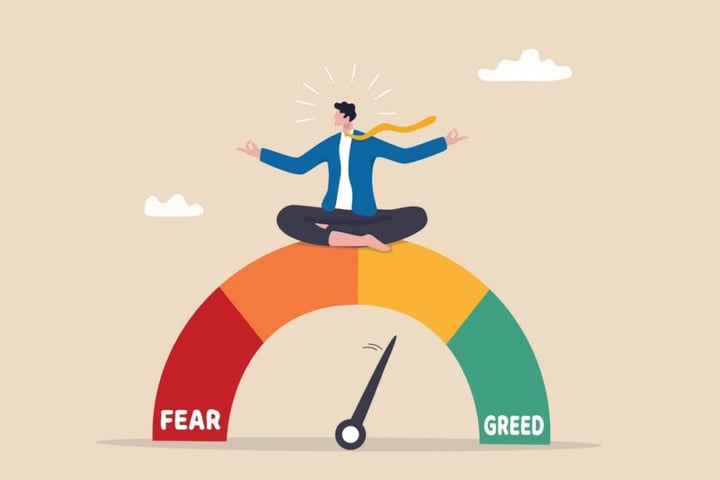
The CNN Money Fear and Greed Index indicated a slight improvement in market sentiment, remaining in the “Greed” zone with a reading of 62, up from the previous 61. This index measures market sentiment based on the notion that heightened fear can push stock prices down, while increased greed tends to have the opposite effect. The index is derived from seven equal-weighted indicators, with a range from 0 to 100, where 0 indicates maximum fear and 100 signifies maximum greed.
As investors navigate these market dynamics, the balance of sentiment and economic data will likely play a critical role in shaping future market movements.
























