








































URGENT UPDATE: Russia is rapidly advancing the expansion of the International North-South Transport Corridor (INSTC), a crucial multimodal trade network linking Russia, Central Asia, Iran, and India. This strategic initiative aims to provide Moscow with a vital trade route to bypass increasingly insecure maritime paths through the Black Sea and Suez Canal.
The latest developments confirm that Russia and Iran are accelerating efforts to complete the INSTC, with a key meeting taking place in Tehran earlier this week. Ali Larijani, secretary of Iran’s Supreme National Security Council, and Vitaly Savelyev, Russia’s Deputy Prime Minister for Transport, discussed the urgent need to finalize the corridor, marking a significant step in enhancing trade links between the two nations.
Why does this matter RIGHT NOW? Russia’s export routes are heavily constrained due to geopolitical tensions. Currently, Russian goods must navigate through Turkey-controlled waters before reaching the Mediterranean—a route that is both lengthy and fraught with risk. The INSTC offers a faster and safer alternative: cargo can travel by rail to Baku, Azerbaijan, cross the Caspian Sea, and then proceed via the Rasht-Astara railway directly to Bandar Abbas on the Persian Gulf. From there, goods can efficiently reach India and South Asia, significantly reducing transport times.
During discussions, Larijani emphasized that the INSTC is a “strategic priority,” underlining Iran’s commitment to the project. Savelyev echoed this sentiment, stating that the corridor is essential for quicker and safer Russian exports to South Asia, a region of increasing importance amid Western sanctions.
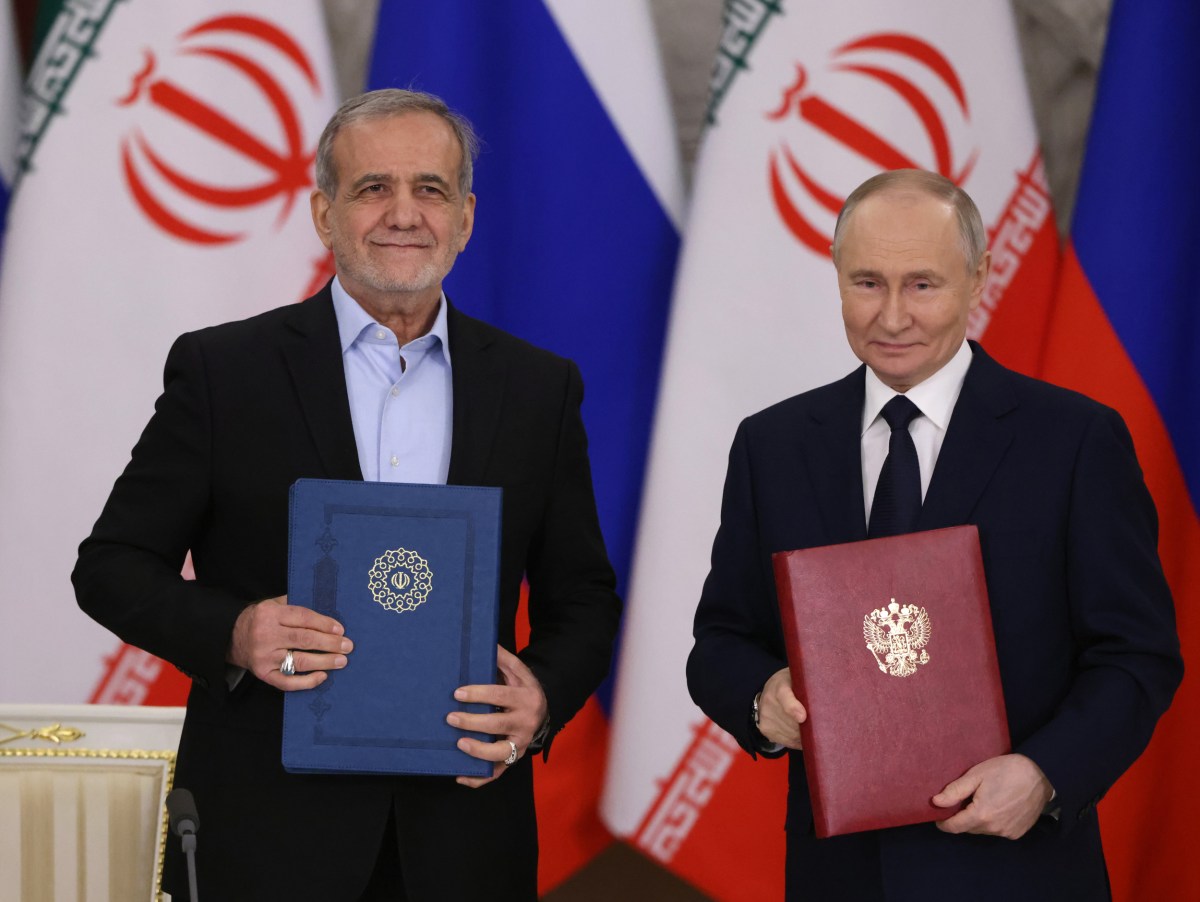
In a separate dialogue, President Vladimir Putin engaged with Iranian Parliament Speaker Masoud Pezeshkian regarding the progress of the Rasht-Astara railway, a critical 162.5-kilometer segment linking Russia’s rail network directly to Bandar Abbas. Pezeshkian assured Putin, “I follow this project every week,” highlighting its strategic significance for both nations.
The INSTC combines rail, road, and maritime routes, connecting Russia’s northern cities with Indian ports like Mumbai. This route has the potential to cut transit times nearly in half compared to traditional Suez Canal pathways, making it an attractive option for Russian trade.
However, the corridor has faced delays in the past due to an overreliance on oil revenue and geopolitical resistance from nations wary of Iran’s growing influence. Currently, more than 106 kilometers of the Rasht-Astara line are complete, with leaders in Moscow and Tehran closely monitoring its progress.
U.S. officials have expressed concern over the INSTC’s expansion, warning that increased Iranian control could weaken sanctions enforcement and shift regional dynamics. As sanctions remain, Washington is closely monitoring these developments as they unfold.
Looking ahead, the INSTC could eventually connect with east-west routes to China and Europe, forming a fully integrated Eurasian rail and shipping network. For Russia, this corridor offers a durable alternative to constrained maritime routes, while for Iran, it transforms geographical positioning into power, providing significant revenue and strategic influence.
As the situation develops, the implications of the INSTC on global logistics and regional power dynamics will be profound, posing new challenges for the U.S. and other Western powers. The world watches closely as Russia and Iran redefine trade routes and alliances.
























