








































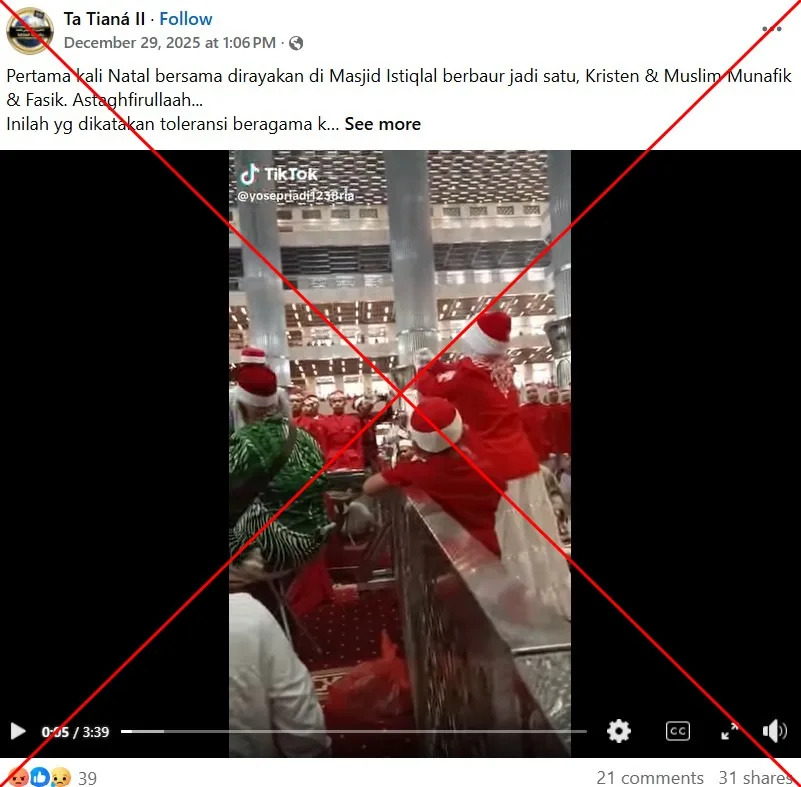
A video falsely claiming to show a Christmas celebration at the Istiqlal Mosque in Jakarta has sparked controversy on social media. The footage, originally recorded during an event marking Indonesia’s independence, has been mischaracterized as evidence of “religious tolerance going too far.” Officials from the mosque have publicly refuted these claims, emphasizing the true purpose of the gathering.
The nearly four-minute video surfaced shortly after Christmas Day, with misleading captions suggesting it depicts Christians celebrating the holiday in a predominantly Muslim space. One Facebook post from December 29, 2025, stated, “For the first time, Christmas was celebrated at the Istiqlal Mosque. Christians and Muslims were mixed together, hypocrites and wicked.” Such comments reflect a growing concern among some users, with remarks about waiting for divine retribution unless such “transgressions” are addressed.
According to data from the Pew Research Center, Christians make up approximately 11 percent of Indonesia’s population, making the nation’s religious landscape particularly complex. Despite constitutional guarantees of religious freedom, the US Commission on International Religious Freedom reported in September 2025 that many religious minorities continue to face systematic discrimination.
In response to the circulating video, Abu Hurairah Abdul Salam, a senior official at the Istiqlal Mosque, clarified that the claims are unfounded. Speaking to AFP on January 6, he stated, “It is impossible that there was a Christmas celebration at Istiqlal Mosque.” He also confirmed that the footage was taken during an event on August 31, 2024, which commemorated Indonesia’s independence, not a Christmas celebration.
The event was organized by the Jagat ‘Arsy International Boarding School and featured attendees dressed in red and white, the colors of the Indonesian flag, symbolizing love for their country. The gathering included religious sermons, prayers, and a performance of the national anthem. A statement from the school, released on September 3, 2024, emphasized that the occasion was a celebration of national pride, not a religious holiday.
The video, which was initially live-streamed on the school’s YouTube channel, has since been removed. Despite this, similar posts on TikTok and Instagram have continued to circulate, perpetuating the false narrative.
Local media outlets have documented the challenges faced by religious minorities in Indonesia, highlighting ongoing societal tensions. The misleading portrayal of the Istiqlal Mosque event not only misrepresents the gathering’s intent but also contributes to the broader discourse on religious tolerance and coexistence in this diverse nation. As the situation unfolds, it underscores the importance of verifying information before sharing it in a digital age where misinformation can spread rapidly.
























