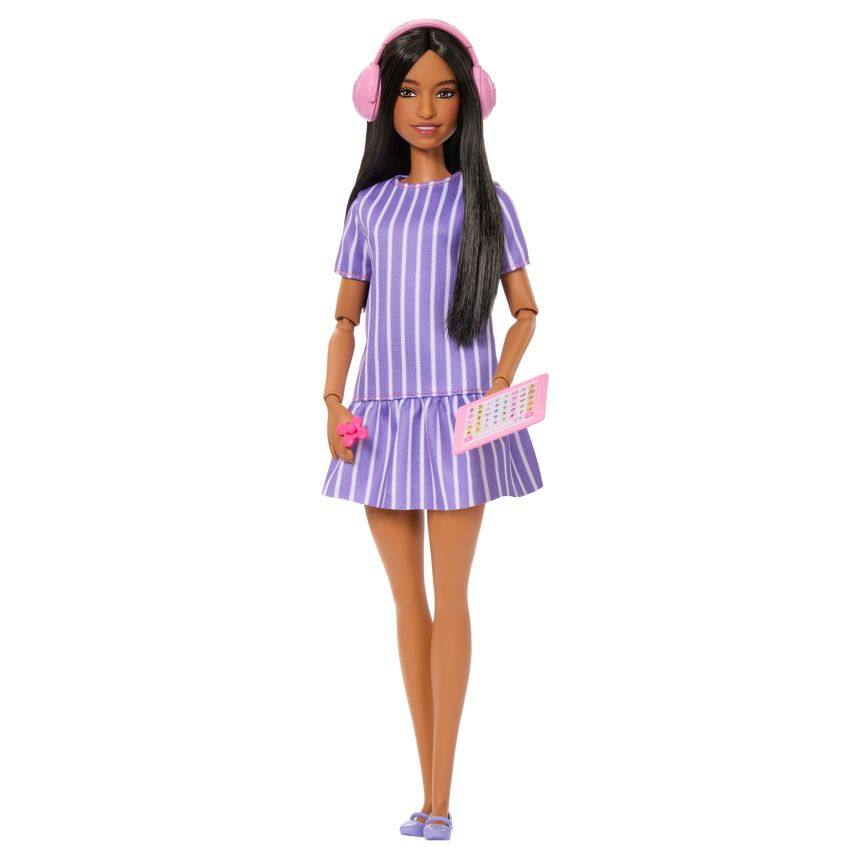
Barbie has taken a significant step forward with the launch of its first-ever doll representing autism, a move celebrated by advocates and families around the world. Released on March 4, 2024, the new Barbie features elements that resonate with the autism community, including a pink fidget spinner, noise-cancelling headphones, and a tablet representing an augmentative and alternative communication (AAC) device.
The doll’s design reflects the experiences of those on the autism spectrum. Five-year-old Mikko, who is nonverbal, found joy in the doll’s familiar accessories. Her mother, Precious Hill, based in Las Vegas, expressed her delight: “The moment was almost magical. Autism is such an invisible disability at times, and to see that it’s being represented through Barbie—everybody knows who Barbie is—it felt really good.”
Representation Matters
The doll has features that acknowledge how some individuals with autism may avoid direct eye contact, showcasing a gaze that shifts slightly to the side. The choice of a flowy, loose-fitting purple pinstripe dress caters to sensory sensitivities, which many individuals on the spectrum experience. Hill emphasized the importance of representation, stating, “It really matters to me that she’s not alone.”
Mattel collaborated with the Autistic Self Advocacy Network to ensure that the doll authentically represents the autistic community. According to Colin Killick, executive director of the organization, “It is so important for young autistic people to see authentic, joyful representations of themselves, and that’s exactly what this doll is.” This initiative aims to represent the approximately 1 in 31 children diagnosed with autism by age eight in the United States.
Personal Stories and Broader Implications
Mikko’s mother, who also has autism, discovered her own diagnosis after her daughter’s. “When I first learned about Mikko being autistic, I spoke with my aunt—she noticed similarities between Mikko and me growing up,” Hill shared. Many individuals, especially women, often remain undiagnosed until later in life.
Eileen Lamb, senior director of social media and marketing at Autism Speaks, also did not receive her diagnosis until her twenties. She highlighted the significance of the new Barbie, stating, “Autism can look different in girls, and the fact that Barbie is a girl is powerful in some way.” Lamb reiterated that while the doll cannot encapsulate the entire spectrum of autism, it serves as a valuable conversation starter and promotes understanding.
The introduction of this Barbie aligns with the broader goals of Mattel’s Fashionistas collection, which aims to include a diverse range of dolls representing various skin tones, body types, and health conditions. The company has previously included dolls with features such as type 1 diabetes, Down syndrome, and blindness.
As the community embraces this new representation, it is clear that toys play a crucial role in shaping perceptions. “Toys matter. Representation matters, and it’s really good for children to see themselves in a toy,” Lamb concluded. The new Barbie not only provides visibility but also sends an empowering message that being different is something to celebrate, rather than conceal.