








































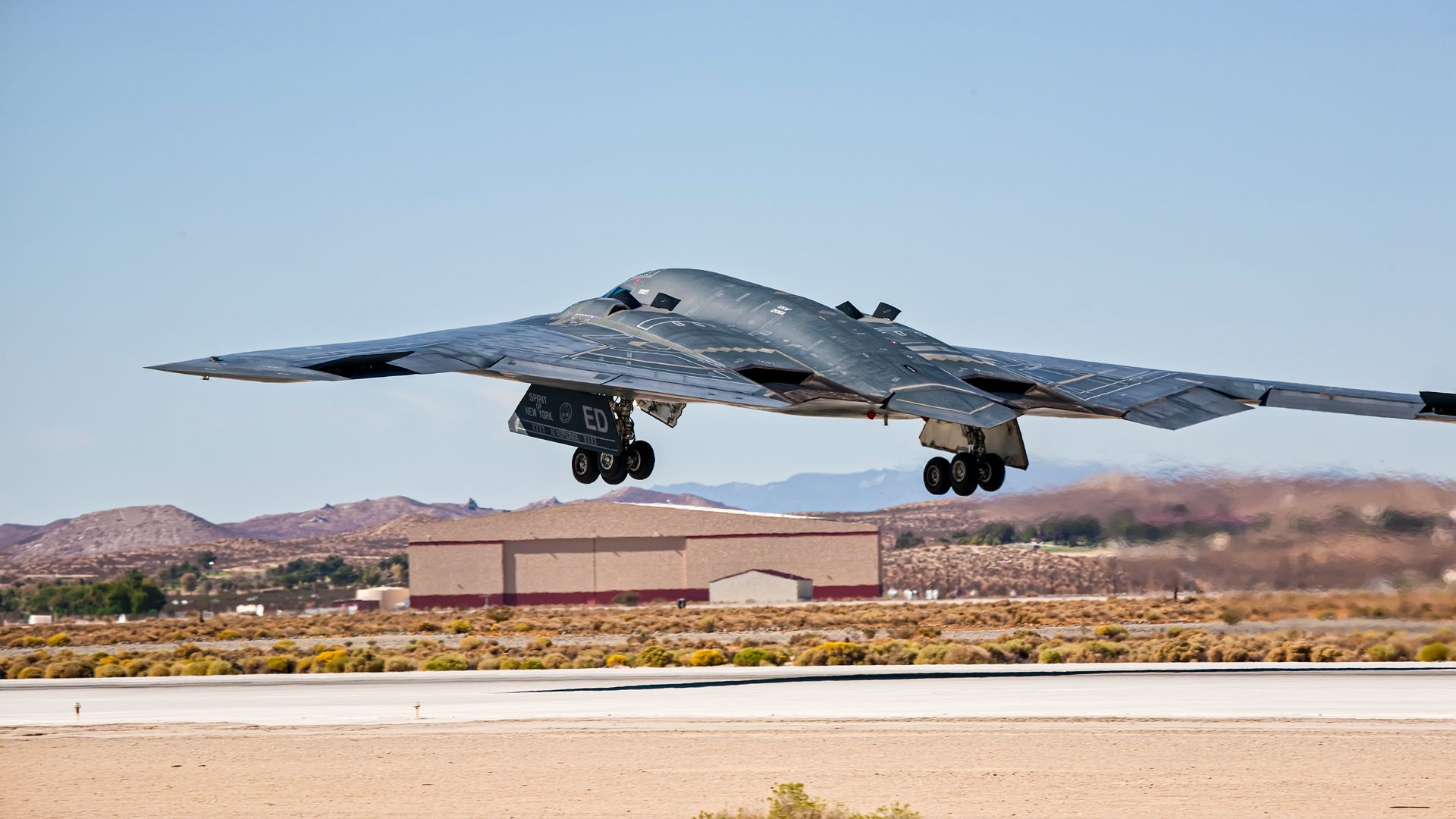
The absence of a tail on the Northrop B-2 Spirit bomber has become a defining feature, influencing both contemporary and future aircraft designs. This tailless configuration, which enhances stealth capabilities, will be retained in the upcoming B-21 Raider and is already visible in new fighter jets and drones emerging from China.
The B-2 Spirit, commissioned into service in 1997, stands as the first post-war strategic bomber for the United States Air Force to maintain operational relevance aligned with its original design doctrine. Unlike its predecessors, including the B-52 Stratofortress and B-1 Lancer, which saw their roles evolve away from initial expectations, the B-2 has successfully executed missions as intended, demonstrating the effectiveness of its innovative design philosophy.
The Evolution of the Flying Wing Design
As the world’s first operational “flying wing” strategic bomber, the B-2 Spirit is engineered for stealth. Its design minimizes radar cross-section (RCS) by creating a smooth, uninterrupted surface that effectively scatters radar signals. By omitting a tail, the B-2 significantly reduces the radar returns that would otherwise arise from vertical surfaces, thereby enhancing its survivability in hostile environments.
The B-2 is built for endurance, operating at subsonic speeds while flying at high altitudes. Its primary mission objective is to penetrate enemy air defenses undetected. This focus on stealth has influenced Northrop Grumman’s subsequent designs, including the RQ-170 Sentinel and the anticipated RQ-180.
Despite its advantages, the elimination of tail stabilizers comes with drawbacks. The B-2’s design sacrifices natural aerodynamic stability, relying on advanced fly-by-wire systems to maintain control. These systems make continuous micro-adjustments to compensate for the inherent instability caused by the lack of a tail. While this configuration allows the B-2 to perform effectively during its intended missions, it limits its maneuverability compared to traditional fighter jets, which are designed for agility and dogfighting.
Future Aircraft and the Shift in Design Philosophy
The next-generation B-21 Raider, scheduled for introduction in 2027, will continue the B-2’s design legacy. Northrop Grumman emphasizes that the B-21 will provide the U.S. military with a strategic advantage, combining range, payload, and survivability. The aircraft will be capable of executing precision strikes in heavily defended areas.
In contrast, the Lockheed Martin F-22 Raptor retains tail surfaces, prioritizing the need for maneuverability and control in air-to-air combat. The F-22’s design allows it to supercruise and perform high-speed, dynamic maneuvers, which are essential for its role as an air dominance fighter. While the F-22 also incorporates stealth features, it cannot afford to sacrifice tail surfaces without compromising its operational effectiveness.
Emerging fighter prototypes, such as China’s J-36, indicate a trend towards tailless designs that prioritize all-aspect stealth. The U.S. Air Force’s planned F-47 fighter may also follow this direction, as it is believed to be designed for extreme stealth and long-range engagements, potentially incorporating advanced technologies that enhance maneuverability without the need for traditional tail surfaces.
The B-2 and B-21’s tailless philosophy reflects a broader shift in military aviation towards stealth and range, with implications for future combat strategies. As technology advances, the balance between agility and stealth is likely to redefine the characteristics of next-generation aircraft.
With only 19 B-2 units remaining, the U.S. Air Force is focused on accelerating the B-21 program, including a recent investment of $4.6 billion announced in February 2026. This funding aims to increase production capacity by 25%, thereby shortening delivery timelines and ensuring that the U.S. maintains its strategic edge in aerial combat.
The B-2 Spirit’s innovative design has proven effective, yet as newer systems are developed, the U.S. military is evaluating how to best integrate these advancements into their future air combat strategies. The ongoing evolution of aircraft design, particularly the balance between stealth and maneuverability, will continue to shape the landscape of military aviation in the years to come.
























