








































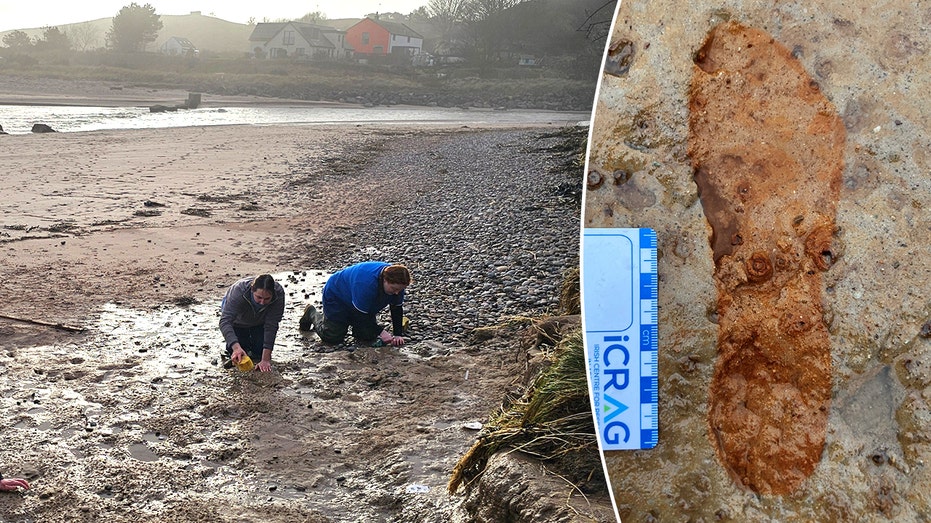
UPDATE: A remarkable archaeological discovery has been made at Lunan Bay in Angus, Scotland, where dog walkers uncovered 2,000-year-old footprints on the beach. This unexpected finding has triggered an urgent response from archaeologists, who raced against time to document the site before it could be lost to winter storms.
The footprints were revealed after shifting sands during recent storms exposed them. Local residents Ivor Campbell and Jenny Snedden were out walking their dogs, Ziggy and Juno, when they noticed the unusual markings. They quickly contacted Bruce Mann, the council archaeologist, who recognized the significance of the discovery and promptly alerted the University of Aberdeen.
A team led by Professor Kate Britton arrived at the scene, even stopping to pick up Plaster of Paris on the way in a desperate attempt to preserve the footprints. The archaeologists faced fierce winds of up to 55 miles per hour as they battled the elements to document this archaeological emergency.
Authorities confirmed that the footprints date back to the early first century A.D., a time marked by significant historical figures such as Boudicca and Jesus. Although the footprints are now lost to time, the team successfully recorded, mapped, and created 3D models of the site, as well as physical casts.
Britton emphasized the rarity of this find, explaining that similar footprints have only been discovered in a few locations in England, making this the first of its kind in Scotland. The semi-fossilized clay and the unique way the prints cut into sediment layers confirmed their ancient origins.
“We were all very conscious this truly was an archaeological emergency,” Britton stated. The team worked tirelessly under extreme conditions, even battling sandstorms to properly document the footprints. “Working on the site was like being sand-blasted — truly the worst conditions I have ever worked in,” she added.
After three days of intensive work, the archaeologists completed their documentation. However, they returned the following week to find that the sea had significantly eroded the site, leaving only a few features visible. “The sea had claimed the site,” Britton reported, highlighting the urgency of their efforts.
This discovery provides crucial insights into ancient human life and the environment of the area. The footprints indicate that the region was once a muddy estuary, rich in resources that attracted both animals and humans alike. Britton noted that the public’s role in reporting such finds is vital, especially given the ongoing threat of coastal erosion.
Both Campbell and Snedden engaged enthusiastically with the archaeologists, offering support and helping with the fieldwork. Their involvement underscores the importance of community awareness in preserving archaeological treasures.
Britton urged the public to remain vigilant, stating, “Keep an eye on known sites at risk, but also report new sites as they emerge before they are lost forever.” This urgent call to action emphasizes the critical role that local residents play in protecting their heritage.
As archaeologists continue to uncover the past in a race against time, the significance of this discovery cannot be overstated. It not only sheds light on human history but also serves as a reminder of the fragility of our archaeological heritage.
























