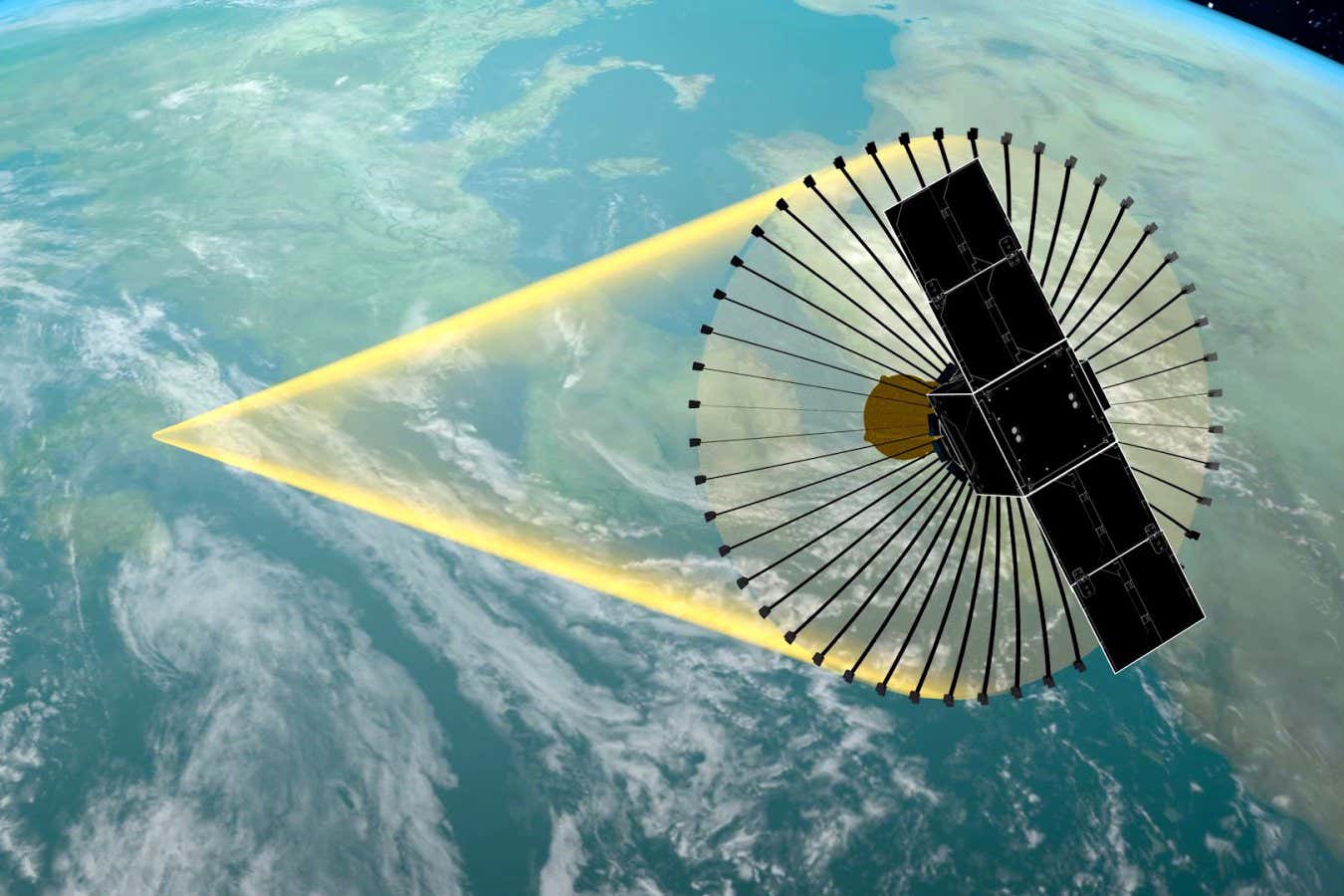
A new satellite named CarbSAR is set to launch on March 17, 2024, marking a significant advancement in Earth’s surface monitoring technology. Developed by Oxford Space Systems in collaboration with Surrey Satellite Technology Limited, this innovative satellite will utilize a unique mesh radar antenna, crafted using techniques typically associated with the textiles industry.
The antenna, produced on a standard industrial knitting machine, is designed to deploy in orbit, allowing CarbSAR to capture high-resolution images of the Earth’s surface. According to Amool Raina, production lead at OSS, the machine has been adapted to stitch ultra-fine tungsten wire, coated in gold, into sheets that form a parabolic dish essential for radar imaging.
CarbSAR’s design features a groundbreaking approach to antenna deployment. The structure comprises 48 carbon-fibre ribs that can collapse to just 75 cm in diameter for launch. Once in orbit, the stored strain energy in the ribs will allow them to unfurl and create the necessary parabolic shape with remarkable precision. “For the imaging we want to do, we also need to unfurl with precision – to get that perfect parabolic shape,” explained Sean Sutcliffe, chief executive of OSS. Testing has shown that the mesh remains accurately shaped within a millimetre of the ideal contour.
Reasserting the UK’s Position in Space Technology
The launch of CarbSAR is crucial for the UK’s ambitions in the space radar sector, especially as the demand for Earth observation capabilities continues to grow. With small radar satellites gaining popularity for their ability to image the Earth under all weather conditions and at night, the UK aims to regain its competitive edge in an arena where it once led. The satellite’s performance could pave the way for a constellation of similar systems for the UK Ministry of Defence known as Oberon, as part of the broader ISTARI programme.
The anticipated capabilities of CarbSAR include the ability to detect objects as small as 50 cm, a specification that meets the needs of military applications, including surveillance of tanks and aircraft. Andrew Cawthorne, managing director at SSTL, noted, “We’re getting a lot of interest from foreign governments about the possibility of providing a radar concept for them.” The successful deployment of CarbSAR will be a crucial first step in demonstrating the satellite’s imaging capabilities.
Monitoring and Future Prospects
Once launched, the satellite will undergo a deployment process approximately two days after reaching orbit. UK Space Command, overseen by the Royal Air Force, will monitor the satellite’s operational performance closely. “CarbSAR is a testament to the innovation and collaboration of one of the UK’s most forward-thinking space companies,” stated Major General Paul Tedman, commander of UK Space Command. His enthusiasm reflects the potential integration of CarbSAR’s advanced instruments into the Oberon constellation and the wider ISTARI satellite programme.
As the space industry evolves, the successful launch and operation of CarbSAR may not only enhance the UK’s capabilities but also contribute significantly to global Earth observation efforts. The intersection of cutting-edge technology and innovative engineering exemplified by this project represents a promising future for space exploration and utilization.