








































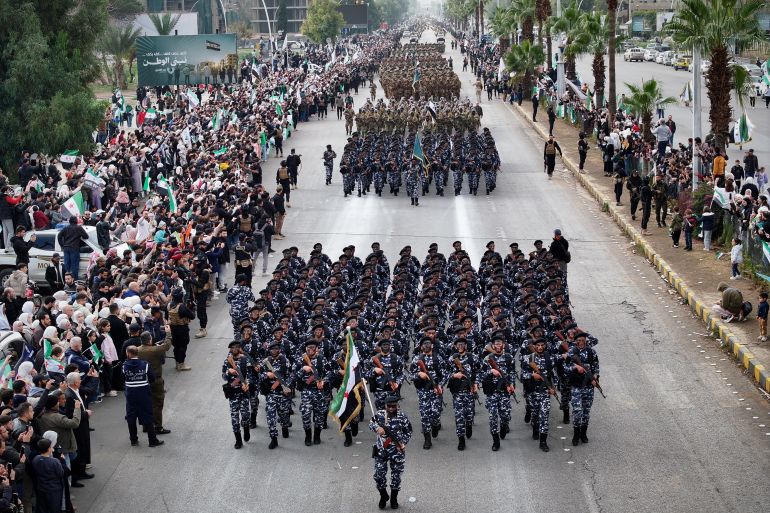
UPDATE: Syria’s interim government has just announced an urgent initiative to rebuild its armed forces, a year after the overthrow of former President Bashar al-Assad on December 8, 2024. As the nation grapples with the aftermath of civil unrest, authorities are prioritizing the formation of a national army that reflects loyalty to the country rather than the regime.
During a pivotal ceremony in Aleppo, Defense Minister Murhaf Abu Qasra declared, “We started the process of restructuring our military and army … to build an army that represents Syria and is able to face the challenges.” This announcement comes amid critical security concerns as Syria attempts to stabilize and create a unified military presence.
The restructuring effort is complicated by the need for extensive vetting of recruits and the integration of various factions, including those from the Hay’at Tahrir al-Sham (HTS), which has around 40,000 fighters. Analysts warn that the rapid recruitment process, initiated to quickly bolster manpower, may overlook essential vetting protocols, potentially leading to security risks.
“The delicate balance to keep Syria’s security glued together is at stake,” stated Samy Akil from the Tahrir Institute. He emphasized that the lack of a proper vetting process could undermine the army’s effectiveness. With an alarming number of young men seeking military positions due to limited economic opportunities, the situation remains precarious.
The challenges extend beyond recruitment. Following al-Assad’s fall, Israel launched a series of airstrikes, reportedly hitting 80 percent of Syria’s military capabilities, with over 600 attacks in the past year alone. The new government, led by President Ahmed al-Sharaa, faces the daunting task of rebuilding a military that has been significantly weakened and fragmented.
As the interim government restructures, it is essential to address the integration of former opposition forces and the concerns of minority groups. Caroline Rose from the New Lines Institute warned that without the unification of armed groups, Syria risks a return to civil conflict. “Failing to integrate all armed forces poses an existential challenge of fragmentation,” Rose explained.
Additionally, the government must navigate its complex relationship with international powers. While Russia remains a traditional ally, recent shifts have seen Syria gain support from nations like Saudi Arabia and Qatar. In a historic move, al-Sharaa became the first Syrian leader to visit the White House, indicating a potential thaw in relations with the United States.
Despite foreign backing, the Syrian army must also confront internal distrust stemming from past sectarian violence, particularly among minority communities. “Many see the Syrian Arab Army not as a protector but as a sectarian militia,” noted Rob Geist Pinfold from King’s College London. This perception poses a significant barrier to domestic legitimacy.
As new recruits begin training, Turkey has signed a defense deal to support Syria’s military, with reports confirming that 49 Syrian cadets have started undergoing training in Turkish military academies. This international cooperation is crucial as Syria prepares to face potential threats from ISIS, with expectations of increased US involvement in military intelligence and training.
The urgency of these developments cannot be overstated. With Syria at a crossroads, the success of the armed forces is vital for the country’s stability and ability to attract foreign investment. The world will be closely watching how the interim government navigates these challenges in the coming months.
























