








































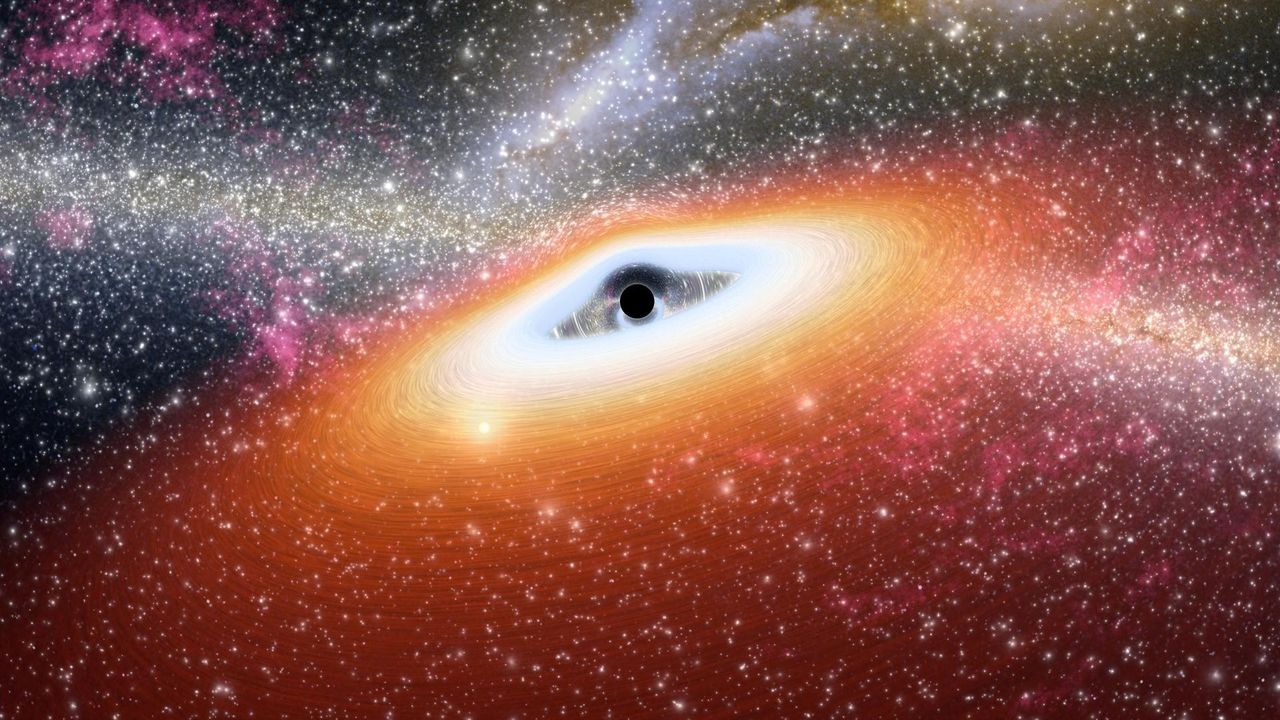
BREAKING: New insights from Stephen Hawking‘s groundbreaking paper, published on March 1, 1974, have transformed our understanding of black holes, revealing a complex interplay between black hole evaporation and quantum mechanics. This revelation, which has profound implications for the future of physics, is gaining renewed attention as scientists revisit Hawking’s legacy.
Hawking’s paper, titled “Black hole explosions?“, challenged the long-held belief that nothing can escape a black hole’s grasp. He suggested that black holes emit tiny amounts of heat, a phenomenon now known as Hawking radiation. This discovery sparked a major debate in the scientific community regarding the fate of information that falls into black holes.
According to Hawking’s research, black holes could eventually evaporate due to this radiation, leading to their potential “explosion” — an event he humorously compared to a blast equivalent to 1 million 1 Mton hydrogen bombs. This notion suggests that black holes are not the eternal prisons once thought, but rather, they can release information back into the universe.
The implications of Hawking’s theory are profound. If black holes evaporate, then the information contained within them might not be lost forever, contradicting a core principle of quantum mechanics that states information cannot be created or destroyed. This paradox has puzzled physicists for decades, and recent studies suggest that information may be recovered from the subtle ripples in space-time surrounding black holes, detected via gravitational waves.
As physicists continue to explore this groundbreaking theory, the James Webb Space Telescope has made significant strides in detecting potential primordial black holes, providing new avenues for research that could validate Hawking’s predictions. Scientists are hopeful that as they investigate these cosmic phenomena, they may uncover evidence supporting the existence of primordial black holes formed from “quantum fluctuations” at the universe’s dawn.
While definitive proof of Hawking radiation and black hole explosions remains elusive, the scientific community is abuzz with excitement. The ongoing quest to resolve the black hole information paradox is more urgent than ever, as researchers strive to understand the true nature of these enigmatic entities.
Looking ahead, scientists will continue to monitor developments in black hole research, particularly as new technologies like the James Webb Space Telescope allow for unprecedented observations of the universe. As we move into 2024, the search for answers surrounding black holes and their surprising properties remains at the forefront of astrophysical research.
Hawking’s influence continues to resonate, challenging our understanding of the cosmos and the fundamental laws governing it. As new discoveries unfold, the legacy of Stephen Hawking and his revolutionary ideas about black holes will undoubtedly shape the future of theoretical physics for generations to come.
Stay tuned as we bring you the latest updates on this captivating journey into the depths of space and time.
























