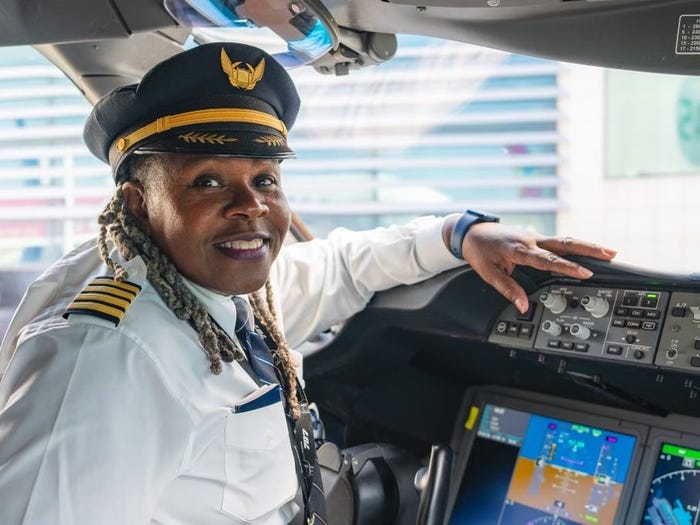
UPDATE: A viral TikTok video has thrust retired United Airlines captain and USAF veteran Theresa Claiborne into the spotlight, highlighting her groundbreaking achievements at a time when diversity in aviation faces serious challenges. Claiborne, who served as the first Black woman pilot in the Air Force, flew nearly every Boeing aircraft during her illustrious career from 1990 to 2024.
The video, which garnered millions of views, showcases Claiborne’s inspiring journey, resonating with a younger audience largely unaware of her significant contributions to aviation. As discussions about diversity and inclusion escalate, Claiborne’s story emerges as a beacon of hope for aspiring pilots from underrepresented backgrounds.
Claiborne’s aviation career began after being commissioned as an Air Force second lieutenant in 1981. She flew the Boeing KC-135 Stratotanker before transitioning to United Airlines. Throughout her 34 years with the airline, she shattered stereotypes in a male-dominated industry. Claiborne’s words carry weight amidst a troubling narrative around diversity in aviation, particularly as Data from Zippia reveals that only 7% of U.S. airline pilots are women, and a mere 1 in 40 are Black.
As recent political discussions have questioned the effectiveness of diversity, equity, and inclusion (DEI) programs, Claiborne expressed concern over the damaging rhetoric. “No airline is going to hire people just because; there’s too much responsibility,” she stated. Her hope is that her story will inspire confidence among future aviators, emphasizing that qualifications should be the primary focus in the cockpit.
Claiborne co-founded the nonprofit organization Sisters of the Skies in 2017, aimed at mentoring young women of color in aviation. Currently, fewer than 150 Black women hold any form of pilot license in the U.S. The organization hopes to change this by providing support and scholarships.
Reflecting on her challenging path, Claiborne noted that only a limited number of women were accepted into Air Force pilot training each year. “They were testing out women to see if we could handle it,” she explained, highlighting ongoing biases women face in aviation. Despite her achievements, she often felt the need to prove herself on every flight.
As of May 2024, the U.S. Air Force had approximately 700 female pilots. Claiborne retired from active duty in 1988, continuing her service in the Air Force Reserves until her retirement as a lieutenant colonel in 2003. Transitioning to commercial aviation, she joined United Airlines as a flight engineer in 1990 and flew various Boeing models, including the 747 and 787 Dreamliner.
Claiborne’s final years at United were marked by her desire to increase representation within the airline. “When I retired, I wanted there to be at least 10 women who look like me at United, and we’ve accomplished that,” she said proudly.
Her journey serves as a powerful reminder that representation matters. Despite the challenges, Claiborne urges young women to pursue their dreams in aviation, reminding them, “If you can see it, you can be it.”
As the aviation industry grapples with a shortage of pilots and ongoing diversity issues, Claiborne’s legacy continues to inspire and challenge the status quo. With her story gaining traction, the hope is for a more inclusive future in the skies.