








































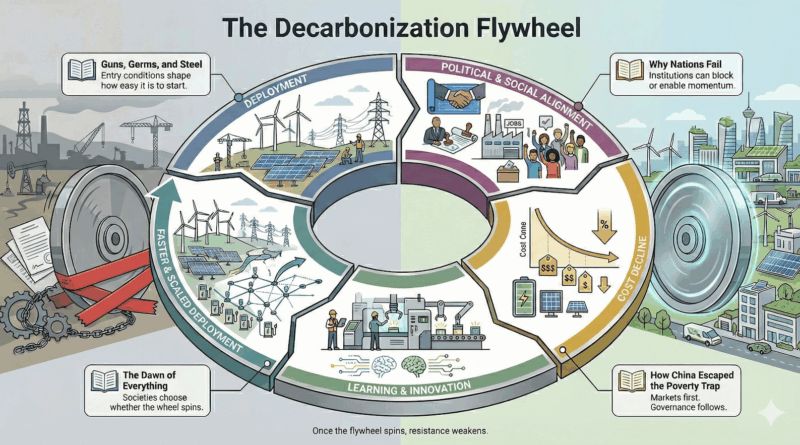
The past year has shifted the perspective on climate action towards the dynamics of markets. This transition highlights that addressing climate issues is not merely about implementing policies but also about creating effective market frameworks. Scholars such as Jared Diamond, Daron Acemoglu, James Robinson, Yuen Yuen Ang, David Graeber, and David Wengrow provide insights that suggest decarbonization should be viewed first through the lens of market creation, then institutional reform, and finally cultural shifts.
One of the foundational texts in this discourse is Diamond’s “Guns, Germs, and Steel.” While often interpreted as a narrative of historical inevitability, it emphasizes the significance of early market conditions in shaping societies. The domestication of plants and animals led to surpluses that encouraged specialization, which in turn fostered trade and innovation. This historical perspective underscores that climate technologies do not develop in isolation; rather, they evolve through production, sales, and improvements at scale.
The aftermath of European contact with Indigenous societies in the Americas illustrates this point. The introduction of European goods transformed local economies rapidly. While the initial interaction brought disease and devastation, the subsequent market dynamics allowed for a swift integration of new technologies, such as metal tools and horses, which were adopted because they proved more effective. This example serves as a reminder that market forces can reshape societies more efficiently than institutional mandates.
Acemoglu and Robinson’s “Why Nations Fail” builds on this idea by exploring the role of institutions in market development. They argue that inclusive institutions promote market growth, while extractive ones stifle it. Their analysis of North and South Korea reveals how divergent political economies can lead to vastly different outcomes despite similar starting conditions. This framework helps explain why some nations struggle to develop clean energy markets, as entrenched fossil fuel interests distort market dynamics, leading to slow progress in decarbonization.
Yet, there is a risk in interpreting their work as suggesting that good institutions must precede market development. This viewpoint can lead to paralysis, as seen in the ongoing debates over carbon pricing and regulatory frameworks that delay meaningful action. The European Union, in particular, faces the challenge of avoiding analysis paralysis that hinders timely climate initiatives.
Yuen Yuen Ang’s “How China Escaped the Poverty Trap” presents a contrasting perspective, emphasizing the importance of markets over ideal institutional conditions. Since 1978, China has demonstrated that markets can thrive under imperfect governance. Local governments competed for investment, allowing for experimentation and adaptation. This approach led to significant advancements in clean technology, including solar panels and electric vehicles, long before global markets stabilized.
The rapid rise of solar manufacturing in China serves as a concrete example. Initial inefficiencies in factories led to thin margins and bankruptcies; however, these challenges facilitated a competitive market that dramatically reduced prices—approximately 90% over fifteen years. Such success was not the result of ideal institutional frameworks but rather the outcome of market dynamics.
Graeber and Wengrow’s “The Dawn of Everything” adds further depth by illustrating that markets have existed long before modern governance structures. They highlight extensive trade networks among early societies that operated without centralized authority. The interactions of Indigenous diplomats with European elites underscore that societies can reimagine their economic structures when presented with alternatives.
This historical context reveals an uncomfortable truth: societies often choose not to adopt beneficial systems, despite having the capacity to do so. The persistence of fossil fuels, despite their environmental impact, is a choice made by societies that favor existing arrangements.
Bringing these insights together indicates that decarbonization primarily represents a challenge of market creation. While institutions and culture influence the pace of change, they do not dictate the outcome. The cumulative works of Diamond, Acemoglu, Robinson, Ang, and Graeber illustrate that markets can amplify advantages and expand opportunities, while institutions can either facilitate or hinder that growth.
In recent climate actions, strategies that expanded markets proved more effective than those aimed at perfecting them. Initiatives that focused on building transmission infrastructure unlocked private investments, while electric vehicle mandates created demand certainty, prompting manufacturers to respond swiftly. Industrial policies that prioritized scale over sophistication yielded faster advancements in clean technologies.
Despite the urgency surrounding climate action, the prevailing narrative often frames decarbonization as limited by physical constraints, costs, or social acceptance. Historical examples suggest a different narrative, one where market dynamics reshape societal beliefs regarding what is feasible. As clean technologies become cheaper and more accessible, political resistance diminishes, and cultural narratives adapt to new realities.
Ultimately, the lessons drawn from historical analyses indicate that delays in climate action are often choices justified by flawed reasoning. While the challenges posed by climate change are unprecedented in scope, the frameworks necessary for addressing them are not. Historical patterns reveal that societies have repeatedly responded to existential threats by expanding markets, adapting institutions, and adjusting cultural narratives.
As stakeholders in climate action contemplate the path forward, it is vital to recognize that waiting for consensus before enabling market development can hinder progress. Embracing the lessons from history may provide a clearer pathway toward effective and timely climate solutions.
























