








































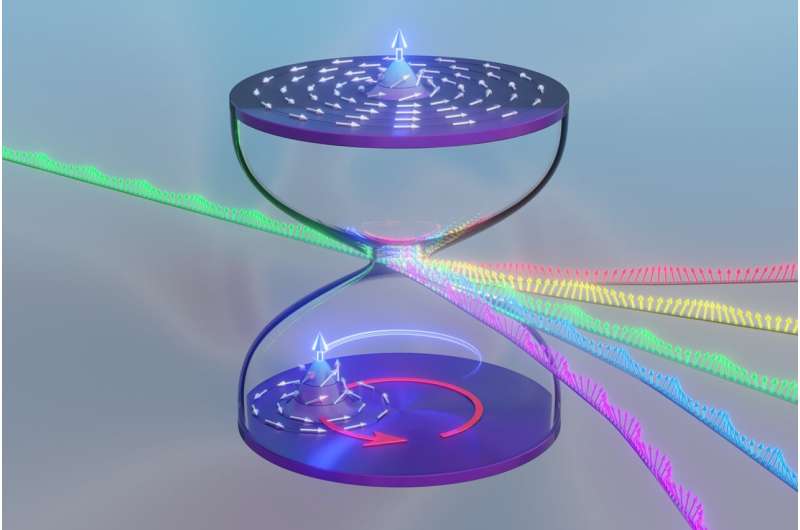
Researchers at the Helmholtz-Zentrum Dresden-Rossendorf (HZDR) have identified previously unobserved oscillation states in magnetic vortices, which could pave the way for advancements in electronics, spintronics, and quantum devices. The findings, published on January 8, 2026, in the journal Science, reveal that these new states, known as Floquet states, can emerge through subtle magnetic wave excitations rather than the high-energy laser pulses typically required.
Magnetic vortices are formed in ultrathin disks of materials such as nickel-iron. Within these vortices, tiny magnetic moments arrange into circular patterns. When disturbed, they propagate waves through the system, akin to a stadium wave, where each magnetic moment transfers its impulse to the next. These collective excitations are termed magnons. According to project leader Dr. Helmut Schultheiß from HZDR’s Institute of Ion Beam Physics and Materials Research, “These magnons can transmit information through a magnet without the need for charge transport,” making them significant for future computing technologies.
The research team initially focused on small magnetic disks, reducing their diameters to a few hundred nanometers to explore applications in neuromorphic computing. While analyzing the data, they observed unexpected frequency combs—series of finely split resonance lines—indicating new physical phenomena. “At first we assumed it was a measurement artifact or some kind of interference,” Dr. Schultheiß recalled. “But when we repeated the experiment, the effect reappeared. That is when it became clear we were looking at something genuinely new.”
The underlying principle of this phenomenon is based on the work of the French mathematician Gaston Floquet, who demonstrated that systems subjected to periodic driving could develop new states. Traditionally, generating Floquet states required significant energy input, but the HZDR team discovered that these states can self-emerge in magnetic vortices when magnons are sufficiently excited. This results in a minute circular motion of the vortex core, enabling rhythmic modulation of the magnetic state and producing a frequency comb.
The efficiency of this process is particularly noteworthy, requiring only microwatt-level energy—a fraction of what is needed for traditional laser setups. This low energy requirement suggests the potential for synchronizing disparate systems, linking ultrafast terahertz phenomena with conventional electronics and quantum components. “We call it the universal adapter,” Dr. Schultheiß explained, comparing it to a USB adapter that allows different devices to work together.
Looking ahead, the team plans to investigate whether this principle applies to other magnetic structures, which could lead to new computing architectures. The ability to couple magnonic signals with electronic circuits and quantum systems may provide valuable tools for interconnecting various domains in technology. Dr. Schultheiß emphasized the dual significance of their discovery: “On the one hand, our discovery opens new avenues for addressing fundamental questions in magnetism. On the other hand, it could eventually serve as a valuable tool to interconnect the realms of electronics, spintronics, and quantum information technology.”
The research utilized the Labmule program at HZDR, a lab automation tool that facilitated all measurements and data evaluations. The results not only deepen the understanding of magnetic phenomena but also hold promise for future technological innovations. For more information, see the full study by Christopher Heins et al. in Science (2026).
























