








































A recent study from Kyoto University has identified a brain pathway that may contribute to understanding the lack of motivation often associated with mental health disorders such as depression and schizophrenia. The research, led by Ken-ichi Amemori, PhD, highlights a mechanism termed the “motivation brake,” which plays a crucial role in the difficulties individuals face when initiating tasks, particularly those perceived as stressful or unpleasant.
The study, published in Current Biology in March 2024, explores the phenomenon of avolition, a condition where individuals recognize the tasks they need to complete but struggle to begin them. This challenge is not due to laziness but is a neurological issue often observed in conditions like major depressive disorder (MDD) and schizophrenia. Dr. Amemori and his team utilized chemogenetics on trained macaque monkeys to pinpoint a specific neural pathway between the ventral striatum (VS) and ventral pallidum (VP) that acts as a “brake” on motivation.
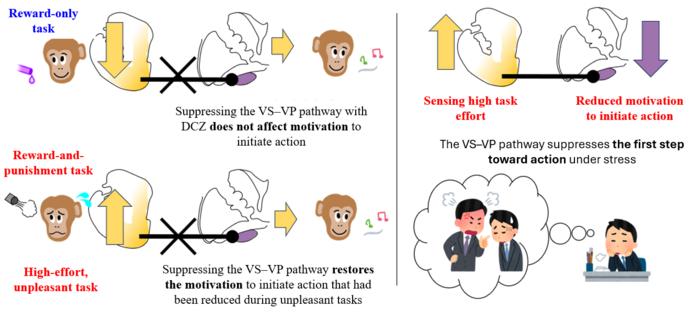
The researchers conducted experiments where the monkeys performed two distinct types of tasks: one where they received a reward without any negative consequences and another where the reward was accompanied by an unpleasant air puff. They aimed to determine how this VS–VP pathway influenced the monkeys’ willingness to start tasks that involved a penalty. The results revealed that when the VS–VP pathway was suppressed, the animals were more inclined to initiate tasks that previously seemed daunting.
Dr. Amemori explained that the VS is crucial for processing rewards and motivation, while the VP is involved in encoding the value of goals and shaping behavior. “Our findings indicate that the VS–VP pathway mediates motivational suppression in aversive contexts,” he noted. This discovery provides valuable insights into how brain networks evaluate the effort required for tasks and make decisions on whether to act.
The research team trained the monkeys to complete either an approach-approach task, which only provided a reward, or an approach-avoidance task, which included a punishment. The results showed that the motivation to act remained stable in the reward-only scenario. However, when faced with the unpleasant task, motivation significantly increased following the suppression of the VS–VP pathway, demonstrating its role as an inhibitory mechanism.
The study’s findings suggest that existing motivational deficits in individuals with mental health disorders may stem from the brain’s inability to overcome this internal brake, especially under stress. By understanding this mechanism better, future interventions could be developed, such as deep brain stimulation or targeted pharmacological treatments, to help individuals regain their motivation.
While the potential for new treatment strategies is promising, Dr. Amemori cautioned against over-manipulating this motivation brake. He emphasized that a balance is essential; an overly suppressed motivational response could lead to dangerous behavior or risk-taking. “Careful validation and ethical discussions will be necessary to determine how and when such interventions should be used,” he stated.
In a broader context, the findings challenge the traditional view of motivation as solely a matter of willpower. They suggest that societal support in managing stressful situations could play a critical role in helping individuals cope with avolition. The study encourages a reevaluation of how motivation is perceived, particularly in a time when mental health challenges are increasingly prevalent.
In conclusion, the identification of the VS–VP pathway presents significant implications for understanding motivational deficits in psychiatric conditions. The research not only sheds light on the neurological underpinnings of motivation but also opens doors to potential therapeutic avenues that could transform the management of depression and schizophrenia.
























