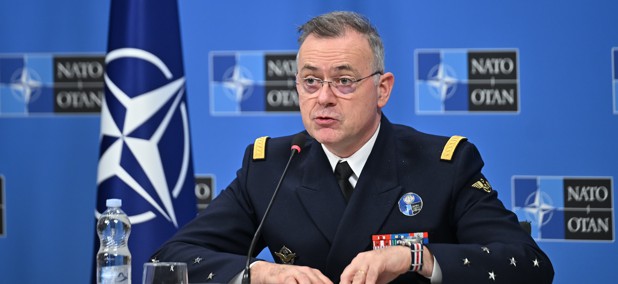
Adm. Pierre Vandier, the leader of NATO’s Allied Transformation Command, emphasized the urgent need for the alliance to enhance its technological capabilities to deter potential aggression from Russia. Speaking in Washington on Tuesday, he highlighted that the effectiveness of NATO’s military forces relies not only on their size but also on their ability to integrate and deploy new technologies as swiftly as their adversaries. Vandier’s remarks come amid ongoing shifts in military strategy highlighted by the conflict in Ukraine.
Adapting to the Modern Battlefield
During his address, Vandier pointed out that Ukrainian forces have demonstrated the critical importance of not just acquiring advanced technology but also continuously evolving it to meet the demands of combat. He noted that Russia has adopted a similar approach, rapidly advancing in areas such as space-based imaging and drone warfare. “If Russia perceives NATO as lagging, there is a risk of a miscalculation akin to its actions in 2022 when it escalated its war in Ukraine,” Vandier stated.
The ongoing war has underscored significant challenges facing NATO, particularly the slow and cumbersome processes involved in weapon procurement and development. “Even the most advanced drones become obsolete much quicker than defense manufacturers anticipate,” Vandier remarked. He stressed the necessity of having engineers and technicians close to the front lines to swiftly devise effective solutions.
Transforming NATO’s Image
Vandier acknowledged NATO’s historical reputation for bureaucratic sluggishness but asserted that this perception is changing. He cited the successful REPMUS 24 (Robotic Experimentation and Prototyping using Maritime Unmanned Systems) exercise held in Portugal in April 2024, where NATO members deployed over 70 autonomous systems in less than three weeks. The previous iteration of this exercise involved more than 276 unmanned systems.
In the near future, NATO plans to conduct similar experiments in Romania and Latvia, focusing on counter-drone systems and their integration into a comprehensive defense strategy referred to as “layered defense.” This approach aims to create overlapping protective measures that enhance overall security.
Furthermore, NATO is exploring the application of artificial intelligence for crucial early warning tasks. The project, named SINBAD, aims to leverage satellite imagery to monitor military activities efficiently. As the alliance prepares to expand its operations into the Arctic region, Vandier indicated that the Allied Transformation Command will focus on developing satellite services to address existing shortfalls.
Another initiative launched in April 2024 aims to streamline the complex process of advanced wargame planning. Vandier explained that creating a large-scale scenario currently requires 18 months of effort from 60 personnel. The goal is to reduce this timeline to under two months with half the workforce, significantly increasing NATO’s responsiveness.
As NATO continues to adapt to the evolving security landscape, the emphasis on technological integration and rapid deployment will be crucial in maintaining deterrence against potential threats. Vandier’s call to action reflects a broader recognition within the alliance of the need to accelerate transformation in the face of an increasingly dynamic geopolitical environment.