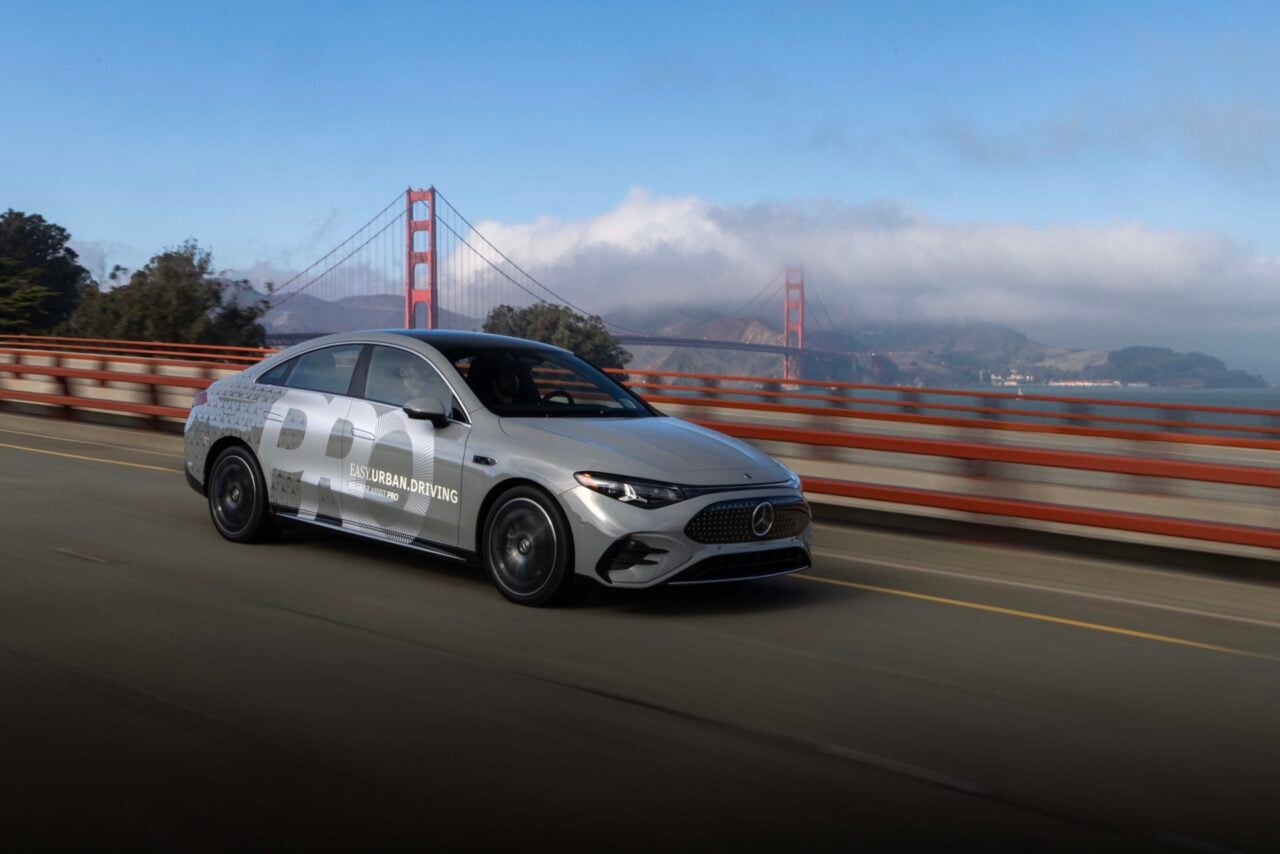
Mercedes-Benz has introduced its latest driver assistance feature, MB.Drive Assist Pro, at CES 2026. This system will be available in the all-new CLA EV starting in spring 2026. Designed to compete with Tesla’s Full Self-Driving (FSD) system, MB.Drive Assist Pro enhances the existing MB.Drive Assist technology, which has been used to drive approximately 15 million miles (24 billion kilometers) globally.
During a media event in San Francisco, representatives from Mercedes demonstrated the capabilities of Assist Pro on urban streets. Unlike other advanced driving systems, which are limited to highways, this feature operates in city environments, allowing for more complex driving scenarios. Attendees witnessed the system’s “point-to-point” driving capabilities, showcasing its performance on both highways and in dense urban settings.
Christoph von Hugo, head of active safety at Mercedes, described Assist Pro as a “Level 2++ system,” emphasizing that it enhances driver engagement while maintaining safety. He stated that drivers using Assist Pro remain in control and are more alert compared to those utilizing other systems. The technology allows for personalized commands, enabling drivers to suggest lane changes or adjust routes based on real-time conditions.
During the demonstration, participants experienced a 20-minute drive through San Francisco’s North Beach neighborhood, where the CLA EV adeptly navigated various obstacles. The vehicle successfully maneuvered around double-parked cars and patiently yielded to pedestrians. Particularly notable was its handling of a challenging intersection at the junction of North Beach and Chinatown, which the CLA navigated without difficulty.
Despite impressive performance, the system did exhibit some of the common challenges associated with automated urban driving. Participants observed that the vehicle occasionally adopted overly cautious driving behaviors, such as slow responses at four-way stops, reminiscent of experiences with Tesla’s FSD and Waymo’s autonomous vehicles. While these behaviors may not reflect typical human driving patterns, they prioritize safety.
Mercedes-Benz collaborated with Nvidia to integrate advanced software features into the new CLA, utilizing Nvidia’s Orin supercomputer. Ali Kani, head of automotive products at Nvidia, elaborated on the system’s architecture, which includes 10 cameras and five radar sensors. He referred to the CLA as an “AI-defined vehicle,” noting that the automated driving system was trained using synthetically generated data to simulate various driving scenarios.
As the automotive industry continues to evolve, Mercedes-Benz’s MB.Drive Assist Pro represents a significant step toward enhancing driver assistance technology. The company aims to combine the best aspects of automation with a focus on driver engagement, setting the stage for future advancements in vehicle technology.
Gizmodo is reporting live from CES 2026, providing ongoing coverage of the latest technological innovations unveiled at the event.