








































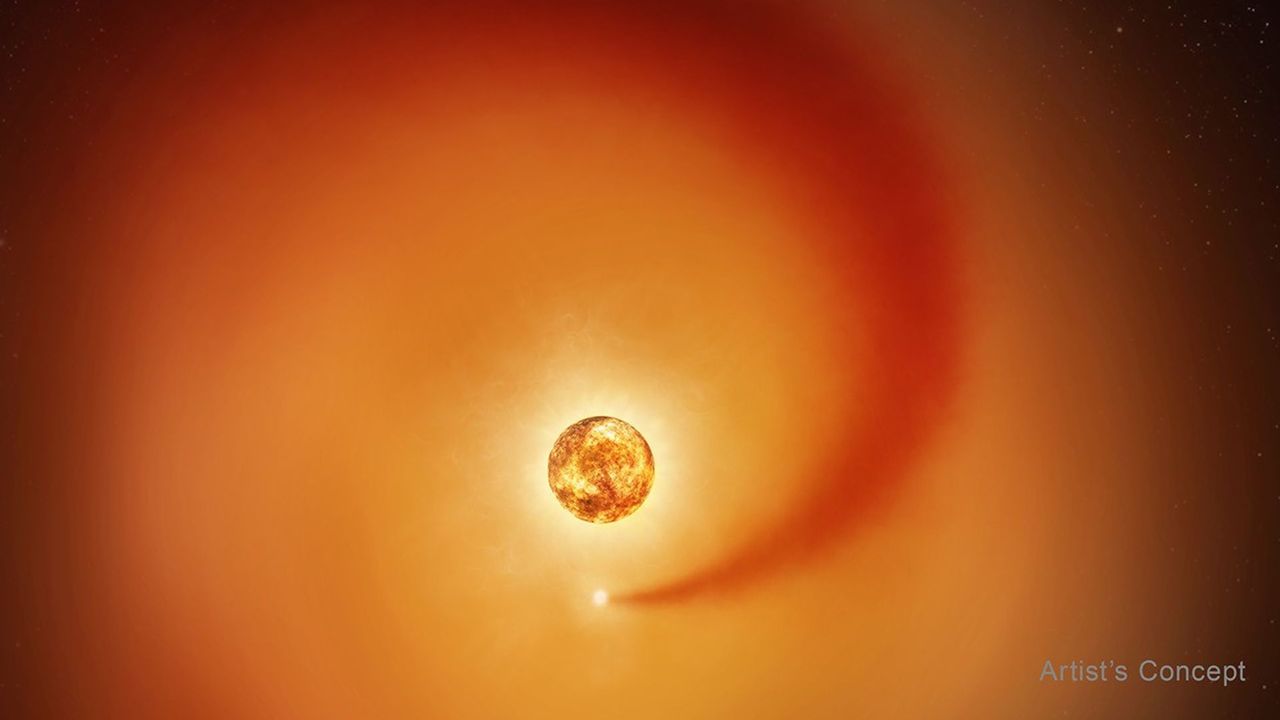
Astronomers have confirmed the presence of a hidden companion star, named Siwarha, orbiting the red supergiant star Betelgeuse. This discovery, made possible by observations from the Hubble Space Telescope and ground-based observatories, provides insight into Betelgeuse’s peculiar behavior, including its fluctuations in brightness.
Betelgeuse, one of the brightest stars in the night sky, has intrigued scientists for its unusual dimming and brightening patterns. In July 2025, initial indications suggested the existence of Siwarha within Betelgeuse’s outer atmosphere. The latest findings confirm this hypothesis, revealing the wake created by the companion star.
New Insights into Stellar Behavior
The research team, led by astronomer Andrea Dupree from the Center for Astrophysics | Harvard & Smithsonian, stated that the idea of an undetected companion star has gained traction in recent years. “Without direct evidence, it was an unproven theory,” Dupree explained in a recent NASA statement. The new data not only confirms Siwarha’s existence but also enhances understanding of how massive stars evolve, shed material, and ultimately explode as supernovae.
Utilizing data from Hubble alongside observations from the Fred Lawrence Whipple Observatory in Arizona and the Roque de Los Muchachos Observatory in the Canary Islands, the researchers identified a distinctive pattern in Betelgeuse’s light. The wake, composed of denser material than the surrounding gases, alters the spectrum of colors emitted by the star.
Dupree likens the observation to a boat moving through water, creating ripples that can be detected. “For the first time, we’re seeing direct signs of this wake, confirming that Betelgeuse really does have a hidden companion shaping its appearance and behavior,” she said.
Future Observations Planned
Siwarha will become visible again in 2027, and the research team is already planning new observations to capitalize on this event. The findings were presented during the 247th meeting of the American Astronomical Society in Phoenix, Arizona, and will be published in The Astrophysical Journal.
The confirmation of Siwarha’s wake not only reveals new aspects of Betelgeuse’s nature but also paves the way for further studies on the evolution of massive stars. As researchers continue to observe this fascinating celestial pair, the mysteries surrounding Betelgeuse and its companion are expected to deepen, offering a unique opportunity to understand stellar life cycles.
























