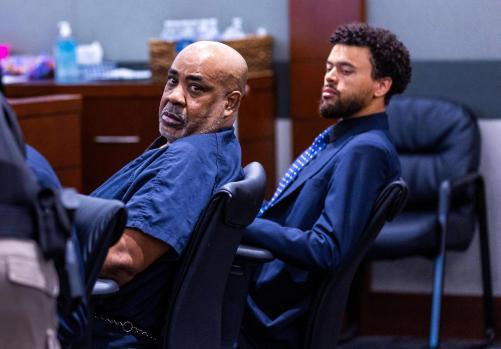
UPDATE: The legal battle intensifies as Duane “Keffe D” Davis, the man accused of murdering rap legend Tupac Shakur in 1996, seeks to suppress crucial evidence obtained during what his attorneys are calling an “unlawful nighttime search.” This motion was filed just this week, escalating the urgency of the case as it draws significant public and media attention.
Davis’ defense team, led by attorneys Robert Draskovich and William Brown, argues that a Las Vegas judge was misled about Davis’s character when approving the nighttime search warrant. They claim the court relied on a “misleading portrait” of Davis as a dangerous drug dealer, a characterization they contest as outdated and inaccurate. According to them, Davis had left the narcotics trade in 2008 and was living a quiet life as a retired cancer survivor.
The search, executed by the Las Vegas Metropolitan Police Department, resulted in the seizure of Davis’ electronic devices, purported marijuana, and numerous photographs. The police justified conducting the search at night, stating it was necessary to secure the area effectively. However, Davis’ legal team asserts that the judge was not informed of critical details, such as Davis’s stable lifestyle in Henderson, a city just outside of Las Vegas, where he lived with his wife for the past nine years.
“The court wasn’t told any of this,” his attorneys stated in their motion. “As a result, the court authorized a nighttime search based on a portrait of Davis that bore little resemblance to reality.” This assertion raises questions about the integrity of the evidence gathered during the search.
Davis was arrested in September 2023 and has pleaded not guilty to first-degree murder. His defense maintains that his arrest is based on sensationalized claims he made about being present in the white Cadillac from which Shakur was shot. They argue that Davis has never provided solid evidence to back up his statements, which his attorneys describe as fabricated for personal gain.
“Think of it this way: Shakur’s murder was essentially the entertainment world’s JFK assassination — endlessly dissected, mythologized, monetized,” his attorneys wrote, highlighting the media frenzy surrounding the case.
The implications of this case extend beyond Davis and Shakur’s legacy; they touch on broader issues of how evidence is obtained and the potential for judicial errors that can alter the course of justice. As the legal proceedings continue, the outcome could redefine perceptions around high-profile cases and law enforcement practices.
What happens next? A hearing date has not yet been confirmed, but the growing attention on the case has many following it closely. As developments unfold, the public remains eager for updates on this storied saga that has captivated audiences for decades.
Stay tuned for further updates as this situation develops in real-time.