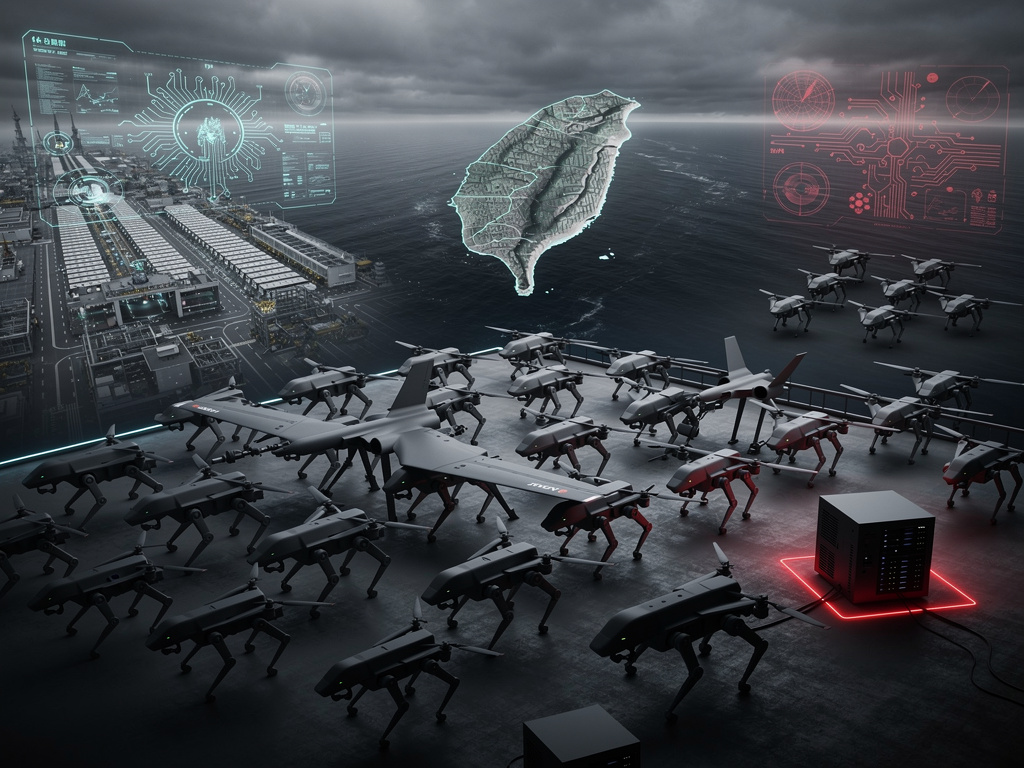
BREAKING: China’s military is accelerating its use of artificial intelligence in drone warfare, with recent tests showing a dramatic leap in autonomous capabilities. Just announced, engineers at Beihang University have unveiled a new drone swarm technology that can engage in combat with unprecedented speed, destroying targets in just 5.3 seconds during trials.
The implications are massive. The People’s Liberation Army (PLA) aims to embed nature-inspired AI into military strategies, with swarms of drones ready to overwhelm adversaries with minimal human oversight. This development comes amid rising tensions surrounding Taiwan, where these drones could play a crucial role in conflict scenarios.
Recent reports from The Wall Street Journal reveal that China is investing heavily in AI for military applications, showcasing a new era of warfare dominated by unmanned systems. With state media revealing the Swarm 1 truck system capable of launching 48 fixed-wing drones, China’s production of over 1 million drones annually outpaces U.S. output significantly.
In a significant demonstration on January 23, 2026, the PLA’s National University of Defense Technology showcased a soldier controlling over 200 autonomous drones in just 99 seconds, marking a shift towards “effect-based control” resilient against jamming. The Jiutian mothership, with an impressive 82-foot wingspan, is designed to deploy these swarms effectively in urban combat.
Experts note the urgency of these developments. Sunny Cheung, an open-source intelligence expert, stated, “There’s a growing consensus that autonomous systems have the potential to perform better than humans.” This statement underscores the PLA’s shift from traditional warfare strategies, as they address concerns about soldier competence.
With the ongoing conflict in Ukraine highlighting vulnerabilities in drone operations, China’s focus on AI-driven military solutions becomes even clearer. The PLA is reportedly pursuing a 2024 tender for a mobile cognitive warfare system that would use AI deepfakes and sound technology in combat scenarios. This ambition is reflected in a staggering number of patents, with Chinese entities filing at least 930 swarm intelligence patents since 2022, compared to only 60 in the U.S..
In addition, the PLA’s integration of DeepSeek AI into its arsenal signifies a leap in battlefield autonomy. By 2025, this technology is expected to enable rapid decision-making for drone swarms targeting low-flying threats. This capability positions China at a critical advantage as they refine their combat strategies.
As tensions rise, the implications of these advancements are profound. Analysts warn of potential risks, including untested algorithms that could lead to unintended consequences in warfare. Retired PLA colonel Zhou Bo cautioned, “AI’s military applications are burgeoning, so its consequences have yet to be fully discovered.”
With the Pentagon aiming to deploy thousands of autonomous drones by the end of 2025 to counter China’s growing capabilities, the global military landscape is on the brink of transformation. As U.S. military efforts lag behind, the urgency for innovation in drone technology has never been greater.
WHAT TO WATCH FOR: The next steps in China’s military advancements will likely focus on further integrations of AI in combat scenarios. As the world observes, the race for drone supremacy intensifies. Stay tuned for more updates on this developing story, as geopolitical tensions continue to shape the future of warfare.