








































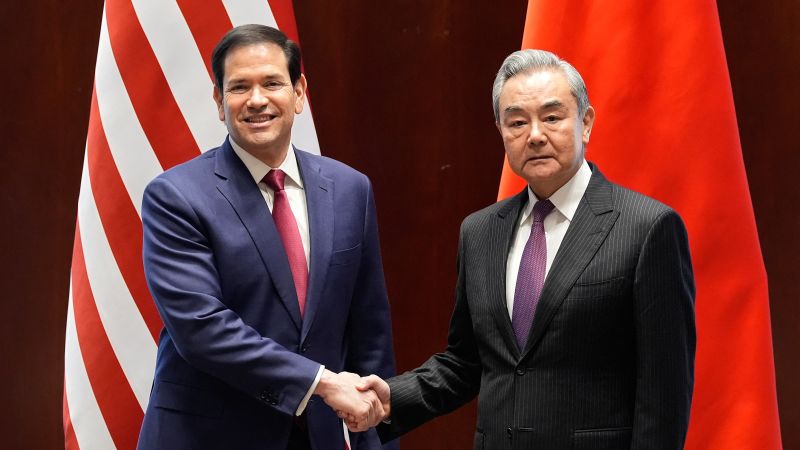
UPDATE: Tensions escalated at the Munich Security Conference today as US Senator Marco Rubio and Chinese Foreign Minister Wang Yi delivered competing visions for global alliances. Rubio emphasized that the United States and Europe “belong together,” while Wang countered that “China and the EU are partners, not rivals,” framing the discourse just moments apart.
This rare double address highlights a critical moment in international relations, with Rubio seeking to reassure European leaders of the US commitment to their alliance amidst a shifting global landscape. As the conference unfolds, both leaders are vying for influence at a time when the US-backed global security order is perceived to be crumbling.
Wang’s comments, made on March 18, 2023, stressed that collaboration between China and the EU is essential to counteract division in the international community. He asserted, “As long as we firmly grasp this point, we will be able to make the right choices in the face of challenges.” This statement comes as China looks to strengthen its ties with Europe, amidst growing unease over US foreign policy, particularly under the Trump administration.
Rubio’s conciliatory tone aimed to reassure allies that despite past rhetoric, the US is committed to rebuilding its alliances. He stated, “It would be geopolitical malpractice if two of the big powers on the planet don’t communicate.” This underlines the urgency for both nations to manage their complex relationship, especially as President Trump is expected to visit China later this spring.
The stakes are high, as Wang warned that two diverging paths lie ahead for US-China relations: a cooperative approach or a confrontational stance that could lead to conflict, particularly over contentious issues like Taiwan. He described the latter as stepping on “China’s red lines,” emphasizing the potential for escalation.
This diplomatic showdown is set against a backdrop of strained relations, particularly in Europe where leaders express concerns over China’s military assertiveness and its ties to Russia during the ongoing war in Ukraine. Taiwan’s Foreign Minister Lin Chia-lung challenged Wang’s characterization of China as a peaceful power, citing military provocations that contradict UN principles.
As Wang made his pitch to European leaders, he framed China as a stabilizing force in a world increasingly polarized by US-led policies. However, skepticism remains high as European leaders grapple with a significant trade deficit and China’s growing influence over critical supply chains.
The Munich Security Conference serves as a crucial platform for both countries to gauge European sentiment amid a shifting geopolitical landscape. With the US-led post-1945 international order facing unprecedented challenges, leaders are recalibrating their foreign policies, and Beijing hopes to capitalize on this moment to redefine global governance in its favor.
With discussions ongoing and tensions palpable, all eyes will remain on how Europe responds to these competing narratives as the conference progresses. The implications of these diplomatic exchanges could reshape alliances and influence the global order in the months to come.
Stay tuned for further updates as this story develops.
























