








































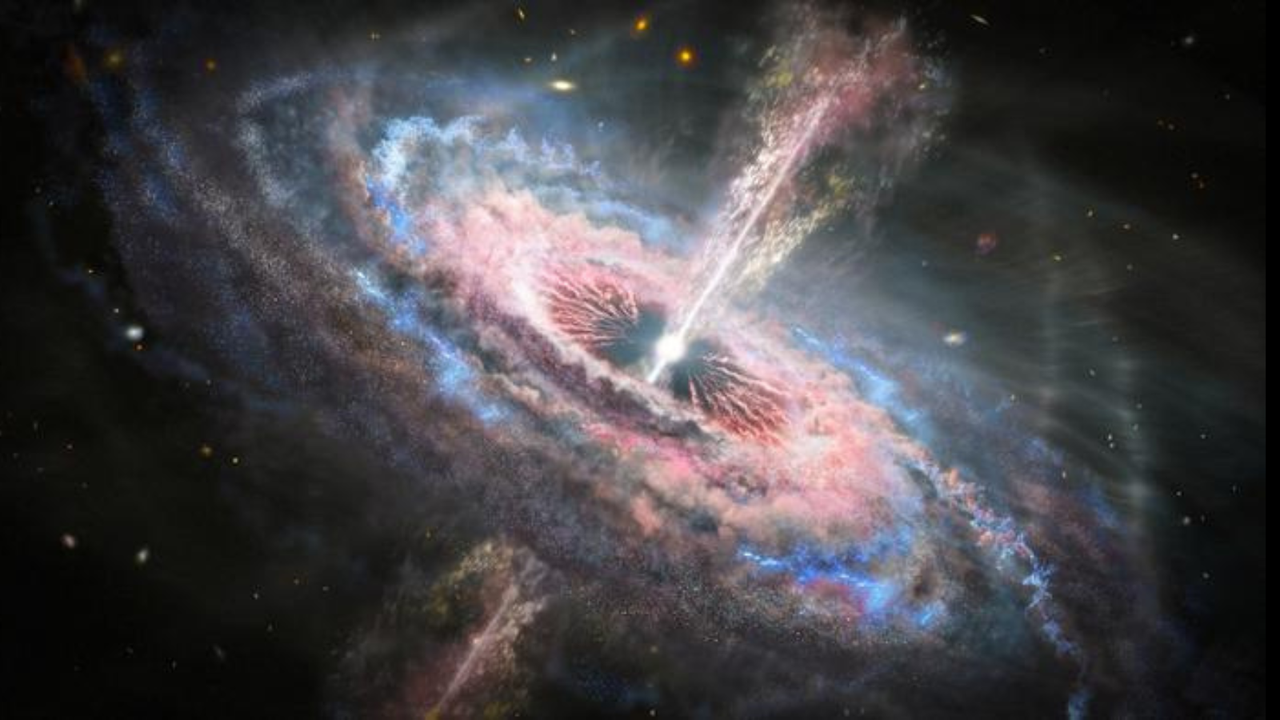
BREAKING: New research reveals that supermassive black holes are not just cosmic giants but are akin to serial killers, capable of extinguishing star formation in neighboring galaxies across vast distances. This groundbreaking study, led by Yongda Zhu from the University of Arizona, confirms that these black holes can influence galaxy evolution on a scale previously thought impossible.
The study highlights how active supermassive black holes, when feeding, emit intense radiation that can disrupt the gas necessary for star formation. This process can effectively “starve” not only their host galaxies but also those within a staggering one million light-years. Scientists have long theorized this effect, but now they have hard evidence, marking a significant leap in our understanding of cosmic interactions.
“We found that a very active supermassive black hole in one galaxy can affect other galaxies across millions of light-years,” Zhu stated. This suggests that galaxy evolution may be more of a collective phenomenon than previously believed, akin to a “galactic ecosystem” where changes in one area ripple across the cosmos.
The research employs data from the James Webb Space Telescope (JWST), focusing on one of the brightest quasars ever observed, J0100+2802, which harbors a supermassive black hole with a mass of approximately 12 billion times that of the sun. The team found that the presence of this quasar correlates with significantly reduced signs of star formation in nearby galaxies, indicating that these cosmic predators have a profound impact on their environments.
Zhu elaborated, “During their active feeding phases, these black holes not only consume matter but also emit powerful radiation that suppresses star formation in nearby regions.” This revelation opens new avenues for understanding the role of supermassive black holes in shaping the universe.
The findings, published on December 3, 2025, in The Astrophysical Journal Letters, not only shed light on how galaxies interact but also challenge long-held beliefs about their isolation in the cosmos. “We were puzzled by the apparent absence of neighboring galaxies around massive quasars. Our findings suggest they might be there but difficult to detect due to suppressed star formation,” Zhu explained.
The implications are significant. As scientists continue to investigate this phenomenon, understanding how supermassive black holes influence their cosmic neighborhoods could reshape our comprehension of galaxy formation and evolution.
The research team now aims to explore other quasar fields to further clarify the impact of supermassive black holes. “Understanding these dynamics is crucial for piecing together the history of our own galaxy and its formation,” Zhu added.
This urgent update reveals that black holes are not just passive entities but active players in the grand cosmic narrative, influencing the fate of galaxies in ways that were previously unimagined. Expect more developments as astronomers delve deeper into the mysteries of these celestial giants.
























