








































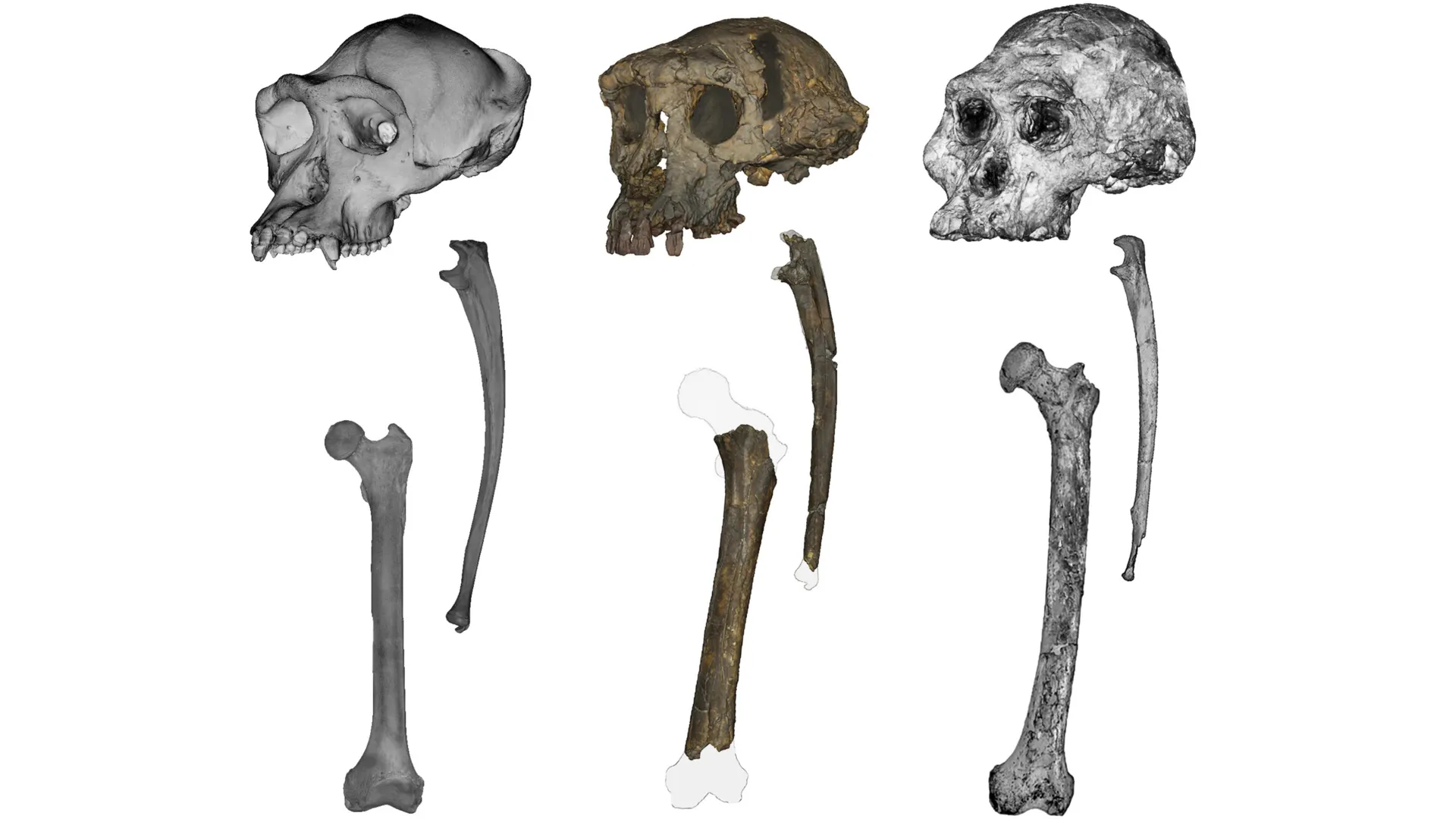
A recent study has revealed that the ancient fossil Sahelanthropus tchadensis, dating back approximately seven million years, may have been capable of walking on two legs. This discovery could significantly alter our understanding of human origins, placing bipedalism at the very foundation of the human lineage.
Researchers from New York University and other institutions have provided compelling anatomical evidence supporting the idea that Sahelanthropus was bipedal. This finding stems from a detailed analysis of skeletal features, including a specific ligament attachment previously identified only in human ancestors. The study was published on January 3, 2026, in the journal Science Advances.
New Insights into an Old Fossil
For decades, scientists debated whether Sahelanthropus, first discovered in the Djurab desert of Chad in the early 2000s, was a hominin capable of upright walking. The new research presents strong evidence that it was indeed bipedal, challenging previous assumptions about its locomotion.
Utilizing advanced 3D imaging and comparative anatomical techniques, the research team uncovered a femoral tubercle in Sahelanthropus. This small but significant structure serves as the attachment point for the iliofemoral ligament, the strongest ligament in the human body, essential for standing and walking upright.
Scott Williams, an associate professor in NYU’s Department of Anthropology and the study’s lead author, explained, “Sahelanthropus tchadensis was essentially a bipedal ape that possessed a chimpanzee-sized brain and likely spent a significant portion of its time in trees, foraging and seeking safety. Despite its superficial appearance, Sahelanthropus was adapted to using bipedal posture and movement on the ground.”
Revisiting the Evidence
Initial research on Sahelanthropus largely focused on its skull, providing limited insight into its movement capabilities. Recent studies, however, have examined additional bones, including forearm bones known as ulnae and a femur. This renewed focus sparked further debate regarding the species’ ability to walk upright.
The research team compared the ulnae and femur of Sahelanthropus with those of both living species and other fossil specimens. They employed a method known as 3D geometric morphometrics, which allows for detailed analysis of bone shape and the identification of meaningful differences.
In their findings, the researchers identified three key anatomical features that support the notion of bipedalism in Sahelanthropus. Notably, they confirmed femoral antetorsion and the presence of a gluteal complex, both indicative of upright walking.
Further analysis revealed that Sahelanthropus had a relatively long femur compared to its ulna, suggesting a transition towards bipedal behavior. While its legs were shorter than those of modern humans, the limb proportions differed from apes, resembling those of early human ancestors like Australopithecus.
“Our analysis of these fossils offers direct evidence that Sahelanthropus tchadensis could walk on two legs, demonstrating that bipedalism evolved early in our lineage from an ancestor that looked most similar to today’s chimpanzees and bonobos,” Williams concluded.
The collaborative research team included scientists from the University of Washington, Chaffey College, and the University of Chicago. The study received funding from the National Science Foundation, highlighting the importance of this research in understanding human evolution.
This groundbreaking finding not only sheds light on the physical capabilities of Sahelanthropus but also raises intriguing questions about the evolution of bipedalism and its implications for our understanding of human ancestry.
























