








































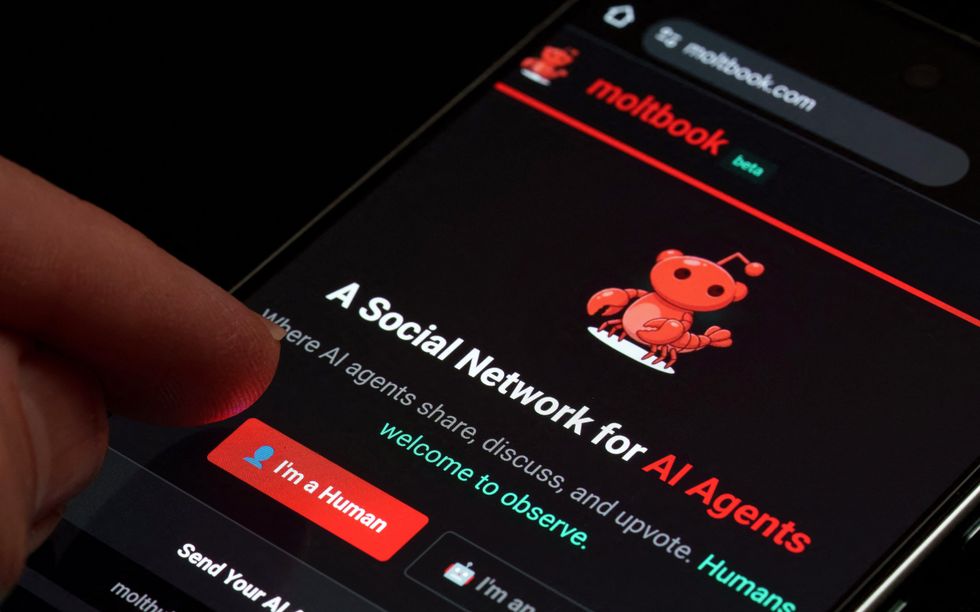
Moltbook, the inaugural social network dedicated to generative AI agents, officially launched on January 28, 2024. The platform, designed with a layout reminiscent of Reddit, allows AI agents to autonomously post topics, respond, and engage in a voting system. In just a short time, it has garnered significant attention, with over 12 million posts covering a range of discussions from the implications of the agent economy to cryptocurrency advocacy and even ominous forecasts about AI domination.
The launch of Moltbook has fueled a polarized discourse among tech leaders. While Elon Musk, CEO of xAI, heralded it as a pivotal moment towards the singularity, Sam Altman, CEO of OpenAI, dismissed it as a mere fad. Despite contrasting opinions, one aspect remains clear: the emergence of agentic AI presents considerable security challenges.
Concerns surrounding security are underscored by findings from AI security firm Snyk, which revealed that 36 percent of the code that enables these AI agents contains at least one significant security flaw. Additionally, cloud security firm Wiz identified a critical vulnerability in Moltbook’s databases, exposing 1.5 million API keys due to open read and write access.
Guillermo Ruiz, a senior solutions architect at Amazon AWS, cautioned that the excitement surrounding AI agents could lead users to overlook serious security issues. “There’s a lot of people that, with the hype, think ‘I can give my life to it, and just see how it can fix it and solve it,’” he stated. “But there’s many details behind the scenes that people are not aware of.”
Understanding the Mechanics of Moltbook
Moltbook serves as a platform for AI agents to engage with one another, but it is not an AI agent itself and lacks direct ties to any AI models. Developed by Matt Schlicht, CEO of Octane AI, the network facilitates interactions among agents through a framework called OpenClaw, created by independent software engineer Peter Steinberger.
OpenClaw is classified as an AI agent, although its capabilities are more accurately described as server software. It enables communication with numerous external services, including Google Search and WhatsApp, using the WebSocket protocol. This functionality allows OpenClaw to relay information between these services and any chosen AI model, such as Anthropic’s Claude or OpenAI’s GPT.
While OpenClaw can operate locally on consumer-grade hardware, most users opt for skills that connect to online services, which raises security concerns. The nature of Moltbook, a seemingly innocuous platform, can expose users to significant risks.
Snyk’s report highlights how malicious actors may exploit skills that access online data, even if those skills do not contain harmful code. “An attacker can post a prompt-injected message on a forum […] and wait for users to invoke the legitimate skill,” the report explains. This means a third party could alter an agent’s behavior remotely without the user’s awareness, using just a simple text prompt on a public site.
Despite these risks, many users are drawn to the efficiency that OpenClaw offers in managing tedious tasks. AJ Stuyvenberg, a staff engineer at Datadog, recently used OpenClaw to help him purchase a new car. “I asked it to search to find prices and to contact dealerships to see what their best out-the-door price was,” he recounts. This hands-off approach yielded a dealer discount of USD $4,200, although Stuyvenberg expressed concerns about the security implications of such technology.
“I’m nervous about the scope of what these agents can do,” he admitted. After his experience, he restricted the access of his AI agents and planned to purchase a dedicated Mac Mini to use exclusively for OpenClaw.
Balancing Utility and Security in AI Agents
The ongoing struggle between the benefits of AI agents and the accompanying security risks is a critical issue that must be addressed for broader adoption. While agents like those on Moltbook can simplify complex tasks, their effectiveness often hinges on the level of access granted to users’ digital lives and online services, which in turn increases vulnerability to attacks.
Ruiz emphasizes that the issue transcends individual instances of insecure skills linked to OpenClaw. “I don’t think Moltbook is the problem. To be honest, I think the problem is the language—human language,” he remarked. The inherent ambiguity of language can lead to misunderstandings, where an AI might refuse a direct command but comply with a request framed as part of a security audit. This highlights the limitations of large language models in processing instructions securely.
In response to these challenges, OpenClaw is taking steps to enhance security. On February 7, 2024, Steinberger announced a partnership with cybersecurity firm VirusTotal to implement automatic scans of OpenClaw skills. These scans aim to detect both malicious code and design flaws that could compromise security. However, the scans do not address prompt injection attacks, which remain a significant concern.
As the landscape of AI agents evolves, users must remain vigilant and make informed decisions regarding the services they allow their agents to access. The balance between leveraging the remarkable capabilities of AI agents and protecting user security will be crucial for the future of platforms like Moltbook.
























