








































A team of researchers from the University of Manchester and University of Oxford has successfully synthesized stable nitrogen chain radical anions under ambient conditions, a breakthrough detailed in a study published on February 28, 2026, in the journal Nature Chemistry. This achievement allows for the study of these highly reactive molecules, typically unstable and difficult to isolate.
Long-chain nitrogen ions, which consist of more than three nitrogen atoms, are known for their presence in the Earth’s ionosphere and other planetary atmospheres. These molecules are usually only stable under extreme conditions, such as ultrahigh pressure, making them challenging to study in laboratory settings. Their inherent reactivity leads to quick breakdown, often resulting in the release of nitrogen gas (N2), which can present potential applications in propellants, explosives, and gas generators.
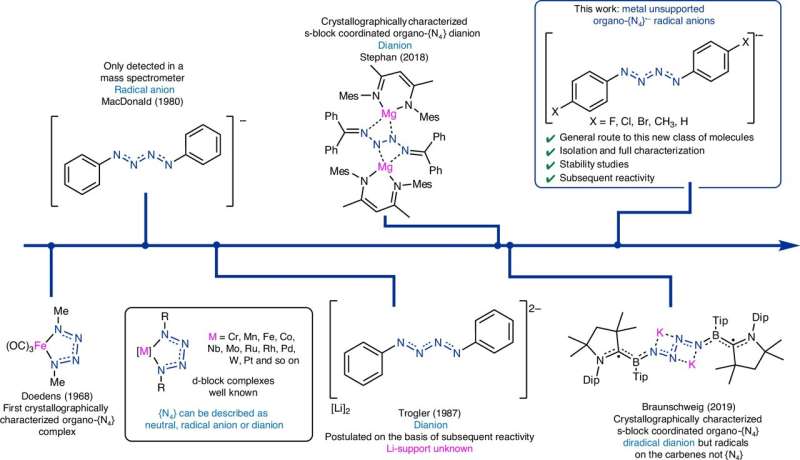
The research team highlighted the difficulties in isolating nitrogen chains and noted that a better understanding of their electronic structures could reveal a wealth of untapped chemical potential. Previous attempts to isolate nitrogen chains had yielded mixed results, with some studies identifying nitrogen chain ions in mass spectrometry or at low temperatures. Others synthesized metal-coordinated nitrogen chains, but the presence of metals altered their properties.
In this recent study, the scientists isolated five crystalline molecules featuring unsupported tetra-nitrogen radical anion ({N4}•−) chains by using potassium graphite to reduce para-substituted phenyl azides. Remarkably, one derivative, specifically [(4-BrC6H4)2N4]•−, remained stable even after six weeks under anaerobic conditions. The research indicated that the radical character was primarily delocalized across the {N4} chain, particularly at the terminal nitrogen atoms.
Some derivatives exhibited instability and even explosive behavior upon isolation. The study also explored related derivatives like [(4-FC6H4)2N4]•− and [(4-ClC6H4)2N4]•−, revealing variations in spin density and stability linked to aromatic substitutions. The authors concluded that the {N4} chains possess partial multiple bond character, with significant radical character on the terminal nitrogen atoms connected to the aromatic units.
In addition to stability, the research tested the reactivity of these nitrogen chains under various conditions. The experiments demonstrated that the {N4} chain could cleave into N1 and N3 fragments and serve as a source of nitrene radical anions. This discovery suggests that these molecules could be utilized as storable nitrogen group transfer reagents.
The team posits that their findings may pave the way for safer and more efficient applications of nitrogen in both industrial and research contexts, offering storable sources of reactive nitrogen species for chemical synthesis. They stated, “Efforts are now focused on exploring the additional reactivity patterns of {N4}•−-containing molecules to enhance our understanding of their chemical properties and to fully unlock their potential as gram-scale storable nitrene synthons.”
This groundbreaking study, authored by Reece Lister-Roberts and others, marks a significant advancement in the field of chemistry, opening new avenues for research and application of nitrogen-based compounds. The work has been meticulously reviewed by Robert Egan, ensuring its credibility and relevance in the scientific community.
























