








































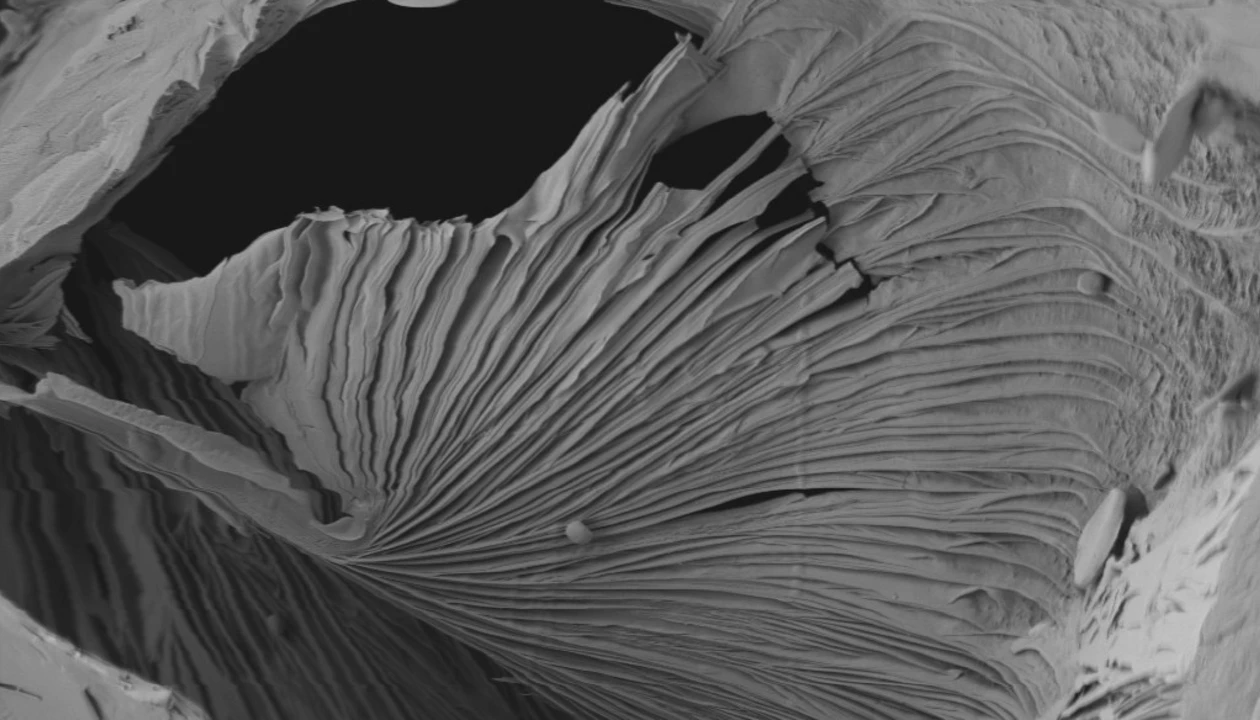
Recent advancements in tissue engineering have emerged from research at the Indian Institute of Technology (IIT) Indore. A team led by Parul Yadav has captured intriguing images using an electron microscope, revealing the complex structure of light-driven copolymerization of gelatin methacrylate and zwitterionic molecules. This work aims to enhance the development of scaffolds that can support cellular growth without relying on external growth factors.
The electron microscope images display a unique “finned texture,” reminiscent of the underside of a mushroom, while the Fibonacci spiral pattern appears similar to the shell of a mollusk. This visual representation showcases the potential of the materials involved, which exhibit a “distinct stratified, radially propagating fracture morphology,” according to Yadav.
Exploring the implications of this research, Yadav and her colleagues are focused on how these biomaterials can be utilized in tissue engineering applications. The objective is to incorporate biologically active groups into the gelatin methacrylate structure. By doing so, they hope to facilitate the growth of essential cellular features, such as astrocytes and myotubes, while minimizing the need for repeated application of exogenous growth factors.
This innovative approach could significantly impact the field of regenerative medicine, enabling more efficient and effective methods for cultivating tissues. The potential to grow cells in a controlled environment could enhance the development of therapies for various conditions, improving patient outcomes.
Yadav’s research is an example of how nature’s inherent designs can inspire scientific advancements. The patterns observed in these materials not only highlight the beauty of microscopic structures but also underline the practical applications that can arise from such studies. As the team at IIT Indore continues their investigations, they remain hopeful that their findings will lead to breakthroughs in tissue engineering and regenerative therapies.
The research has garnered attention beyond the academic sphere, demonstrating the intersection of art and science through Yadav’s captivating images. The exploration of gelatin methacrylate and zwitterionic molecules represents a promising frontier in biomedical research, reflecting the ongoing quest for innovative solutions in healthcare.
As the project progresses, Yadav and her colleagues invite further exploration and discussion within the scientific community, emphasizing the importance of collaboration in advancing knowledge and technology in the field.
























