








































Research led by Meizhen Wang from Zhejiang Gongshang University has revealed that plant-derived compounds can effectively reduce the risks posed by human bacterial pathogens in manure-amended soils. Published on November 26, 2025, in the journal Biocontaminant, this study highlights a novel approach that disrupts microbial communication rather than directly killing bacteria, offering a potential breakthrough in managing soil health and food safety.
The study addresses a significant agricultural challenge: while manure is vital for sustaining soil fertility and crop yields, it can introduce harmful human bacterial pathogens (HBPs) into farmland. These pathogens often carry antibiotic resistance genes (ARGs) and virulence factor genes (VFGs), which can be transferred through mobile genetic elements (MGEs) like plasmids. Once established, these harmful microbes can migrate into crops and the food chain, posing risks to both ecosystems and human health.
Conventional mitigation strategies, such as biochar or engineered nanoparticles, have shown effectiveness but are often costly or raise environmental concerns. In contrast, plant extracts, previously studied for their potential in soil remediation, offer a natural, cost-effective alternative. However, their specific effects on HBPs and gene transfer had not been thoroughly explored until now.
Using a combination of manure-amended soil microcosms, metagenomic profiling, targeted gene quantification, pure-culture assays, and molecular docking analyses, Wang’s team systematically evaluated how three plant-derived compounds—curcumin (CUR), andrographolide (AG), and thymol (THY)—interacted with HBPs and related risks in agricultural soils.
The research identified a total of 323 HBPs from a curated database, assessing changes in their abundance, community composition, and diversity following treatment with the selected plant extracts. The findings demonstrated that these extracts reduced the total HBP abundance by approximately 25–28%, with a selective suppression of pathogens associated with Actinobacteria and Proteobacteria.
In addition to reducing overall pathogen abundance, the study also quantified the levels of ARGs, VFGs, and MGEs. Results indicated a reduction in ARGs by 20–27%, VFGs by 6–11%, and MGEs by 25–34%. This suggests a significant decline in the pathogenicity and transmission potential of these microbes, as indicated by the positive correlations observed among these elements.
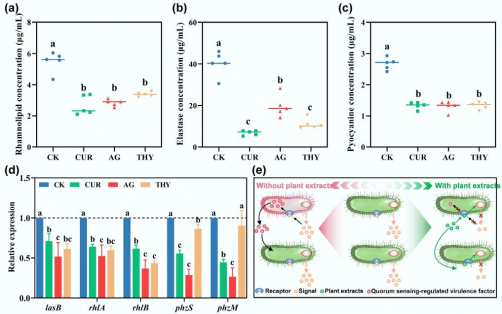
To unravel the mechanisms behind these reductions, the researchers analyzed quorum sensing (QS)-related genes and signaling molecules. They found that plant extracts effectively diminished QS gene abundance and lowered acyl-homoserine lactone signal concentrations, leading to downregulation of QS-regulated genes. This disruption translated into a reduction of virulence factor secretion, with biofilm formation inhibited by up to 40%, and conjugative transfer of ARGs and VFGs suppressed by as much as 90%.
Molecular docking studies confirmed that the plant compounds bind to the QS receptor LasR with greater affinity than native signal molecules, thereby blocking bacterial communication. This competitive inhibition highlights how plant extracts can mitigate risks associated with soil-borne pathogens by disarming them rather than resorting to direct bactericidal effects. By reducing the selective pressure for resistance, these plant extracts emerge as a promising environmentally friendly alternative to traditional antibiotics and nanomaterials.
The implications of this research are substantial for sustainable agriculture. By integrating plant-derived compounds into soil management practices, farmers may enhance soil health while minimizing the risks associated with antibiotic resistance and pathogen transmission. The study underscores the potential for innovative, nature-based solutions to safeguard food systems and promote ecological balance.
The research received support from multiple funding sources, including the ‘Leading Goose’ R&D Program of Zhejiang (Grant No. 2024C03131), the National Key R&D Program of China (Grant No. 2022YFC3704600), and the National Natural Science Foundation of China (Grant Nos 22122607, U21A20292, 22376097, and 22306164).
The findings not only contribute to the understanding of microbial interactions in agricultural soils but also pave the way for future studies on the application of plant extracts in combating soil-borne pathogens.
























