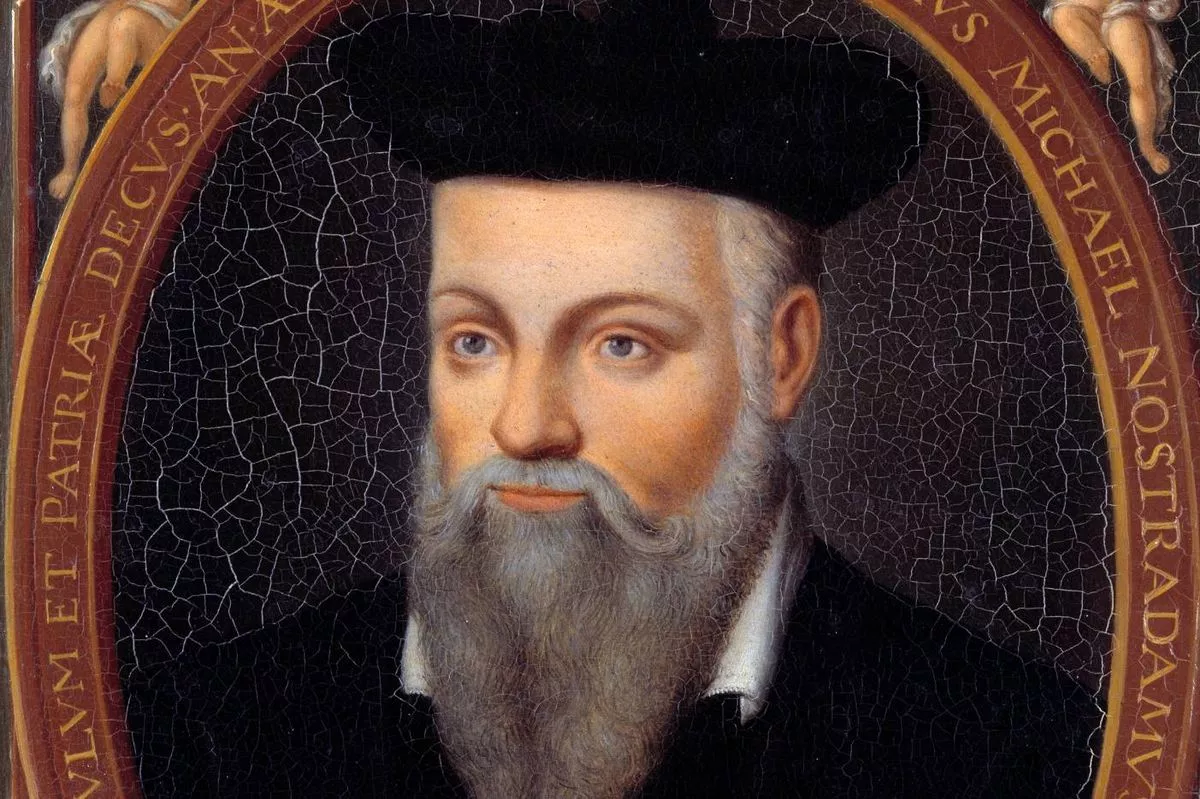
The prophecies of the 16th-century French astrologer Nostradamus continue to captivate audiences as we approach 2026. His cryptic insights, compiled in his 1555 publication ‘The Prophecies’, hint at a series of unsettling events that some interpret as predictions for the near future. Among these, one prediction suggests a significant global conflict, raising questions about its potential implications.
Nostradamus is famous for his enigmatic quatrains, which contain a total of 942 verses. One particularly chilling quatrain reads: “Seven months great war, people dead through evil / Rouen, Evreux the King will not fail.” This has led some to speculate that it may refer to the ongoing conflict between Russia and Ukraine. Additionally, his work has drawn parallels to historical events, such as the nuclear bombings of Hiroshima and Nagasaki at the end of World War II, with the line “Within two cities, there will be scourges the like of which was never seen” viewed as a prediction of that devastating moment.
Intriguing Symbols and Foreboding Events
Another of Nostradamus’ predictions hints at a mysterious event involving bees. He states: “The great swarm of bees will arise by the night ambush,” which some interpret as possibly occurring in 2026. The association with the number 26 has sparked speculation, although the meaning of the bees remains unclear. The idea of a massive swarm causing harm seems far-fetched, adding to the ambiguity of his predictions.
His predictions also encompass the potential for tragedy affecting prominent figures. In the 26th verse of Century I, Nostradamus writes, “the great man will be struck down in the day by a thunderbolt.” This has led to conjecture about whether this “great man” refers to a celebrity, a world leader, or even royalty, raising curiosity about who might face such a fate.
Nostradamus also paints a grim picture for Switzerland’s Ticino region, describing a scenario where “the Ticino will overflow with blood.” This ominous statement has prompted interpretations ranging from mass casualties to a significant natural disaster. The specific mention of a city experiencing such a fate raises concern about what events might unfold.
Evaluating Nostradamus’ Legacy
Skeptics of Nostradamus’ predictions point out that his writings were composed in Middle French and often employed ambiguous Latin phrasing. Over the centuries, various manuscripts, spelling errors, and differing interpretations have clouded the original intent of his work. This complexity makes it challenging to ascertain the true meanings behind his prophecies, leading to debates about their relevance and accuracy.
As we move closer to 2026, the fascination with Nostradamus’ predictions continues to grow. Whether viewed as mere literary curiosities or serious forewarnings, his quatrains remain a topic of discussion, reflecting humanity’s enduring quest to understand the future. Despite the uncertainty surrounding their interpretations, the cultural impact of his work persists, inviting both intrigue and skepticism.