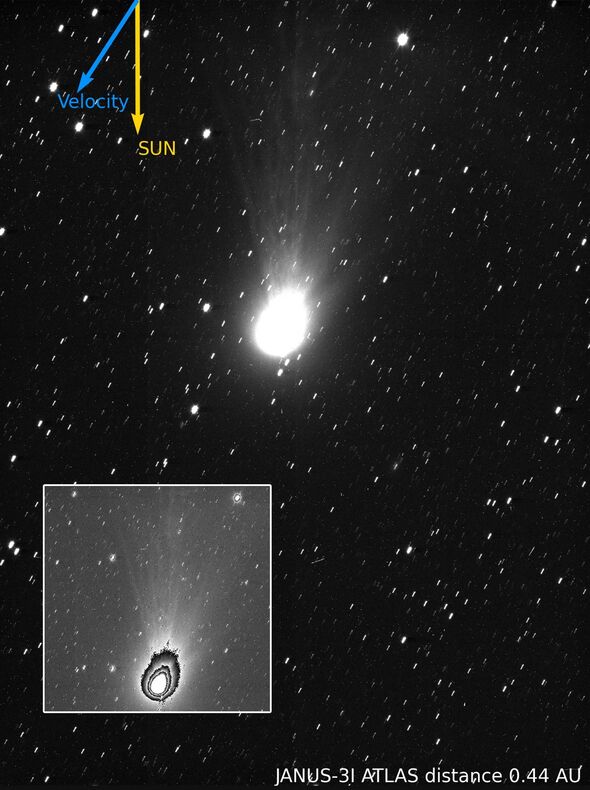
Scientists have released new images of the interstellar comet 3I/ATLAS, which has recently garnered attention for its unusual characteristics. Captured by the JANUS camera aboard the European Space Agency’s (ESA) Jupiter Icy Moons Explorer (Juice), the images show the comet expelling gas and dust. This comet, first spotted in July 2025, has become the subject of speculation regarding its potential as an alien spacecraft.
Captivating Observations from Space
The striking images reveal a bright halo of gas surrounding the tiny nucleus of the comet, which is not visible in the photographs. The ESA described the comet’s appearance, stating it features a long tail and displays hints of rays, jets, streams, and filaments. These images were taken on November 6, 2025, just a week after 3I/ATLAS made its closest approach to the Sun.
At the time of imaging, the Juice spacecraft was approximately 66 million km away from the comet. The JANUS camera has captured over 120 images of 3I/ATLAS across various wavelengths, allowing scientists to analyze the comet’s behavior in detail.
Speculations and Scientific Debate
One notable figure in this ongoing discourse is Harvard astrophysicist Avi Loeb, who has proposed that the comet might not be a typical natural object. Loeb has pointed to the comet’s unusual trajectory and brightness, suggesting it could be a probe from an advanced alien civilization. His assertions have sparked a renewed debate within the scientific community.
Loeb cautioned, “The consequences, should the hypothesis turn out to be correct, could potentially be dire for humanity.”
While Loeb acknowledges that the comet is “most likely” a natural formation, he has raised concerns over its peculiar characteristics. Among these is its trajectory, which follows a retrograde orbit aligned with the ecliptic plane. Loeb estimates the probability of such an occurrence by chance to be only 0.2%. The comet is also set to pass close to Mars, Venus, and Jupiter, raising further questions about its origin.
Another intriguing feature of 3I/ATLAS is the presence of an “anti-tail,” which extends sunward rather than away from the Sun, measuring over 310,000 miles. Chemical analyses of the comet’s gas plume reveal a composition rich in nickel but low in iron, resembling industrial alloys rather than typical cometary materials. This composition poses questions about its natural origins, especially given that it contains only 4% water, which is unusually low for a comet.
Despite Loeb’s claims, major space agencies, including NASA and ESA, continue to classify 3I/ATLAS as a natural comet. While its behavior is unusual, scientists assert that these anomalies can be explained through natural processes. Ongoing investigations and analyses will further clarify the nature of this enigmatic celestial object.
The images from the Juice mission provide a remarkable opportunity to study 3I/ATLAS, contributing to our understanding of interstellar objects and their potential implications for our knowledge of life beyond Earth. As researchers continue to analyze the data, the debate surrounding the comet’s origins and nature remains lively and unresolved.