








































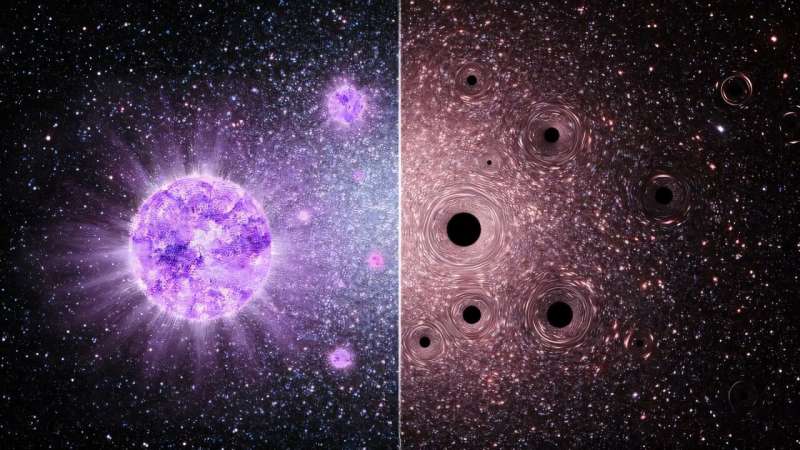
Researchers have unveiled a groundbreaking model explaining how extremely massive stars (EMS) have significantly influenced the formation and evolution of the oldest star clusters in the universe. Led by Mark Gieles from the Institute of Cosmos Sciences at the University of Barcelona, the study highlights the role of these stellar giants, which possess more than 1,000 times the mass of the sun, in shaping the chemical characteristics of globular clusters (GCs). The findings were published on November 4, 2025, in the journal Monthly Notices of the Royal Astronomical Society.
Understanding Globular Clusters
Globular clusters are dense groups of stars, often containing hundreds of thousands to millions of them, found in nearly all galaxies, including our own Milky Way. Most of these clusters are over 10 billion years old, suggesting they formed shortly after the Big Bang. Their stars exhibit unique chemical signatures that have puzzled scientists for decades, displaying unusual abundances of elements such as helium, nitrogen, oxygen, sodium, magnesium, and aluminum.
The study reveals that these “multiple populations” of stars indicate complex processes of chemical enrichment during their formation. Specifically, the presence of extremely hot “contaminants” in the early universe played a crucial role.
A New Model for Star Formation
The research team expanded on an existing model known as the inertial-inflow model, applying it to the extreme environments of the early universe. They demonstrated that turbulent gas conditions within the most massive clusters can lead to the formation of EMS, which weigh between 1,000 and 10,000 solar masses.
These massive stars emit powerful stellar winds rich in high-temperature hydrogen combustion products, which mix with surrounding pristine gas to create chemically distinct stars. “Our model shows that just a few extremely massive stars can leave a lasting chemical imprint on an entire cluster,” said Mark Gieles. He emphasized that this research establishes a connection between the physics of globular cluster formation and the chemical signatures observed today.
Research collaborators Laura Ramírez Galeano and Corinne Charbonnel from the University of Geneva noted that while it was previously understood that nuclear reactions in EMS could create specific abundance patterns, this model provides a natural pathway for their formation in massive star clusters. This process occurs rapidly, within 1 to 2 million years, before any potential supernova events can occur, thus keeping the cluster’s gas free from supernova contamination.
Implications for Early Galaxy Formation
The implications of this research stretch far beyond the Milky Way. The authors propose that nitrogen-rich galaxies identified by the James Webb Space Telescope (JWST) are likely dominated by EMS-rich globular clusters formed during the early stages of galaxy formation. “Extremely massive stars may have played a key role in the formation of the first galaxies,” stated Paolo Padoan from Dartmouth College. He added that the luminosity and chemical production of these stars potentially explain the nitrogen-enriched proto-galaxies observed in the early universe.
Furthermore, these colossal stars are expected to end their life cycles by collapsing into intermediate-mass black holes, with masses exceeding 100 solar masses. These black holes could be detectable through gravitational wave signals, providing further insights into the early universe.
This study not only advances our understanding of star formation physics and cluster evolution but also suggests that EMS were pivotal in early galaxy formation, enriching globular clusters and leading to the emergence of the first black holes. The research establishes a cohesive framework linking these various phenomena, offering a new perspective on the cosmos.
For more information, refer to the study by Mark Gieles et al., titled “Globular cluster formation from inertial inflows: accreting extremely massive stars as the origin of abundance anomalies,” published in the Monthly Notices of the Royal Astronomical Society.
























