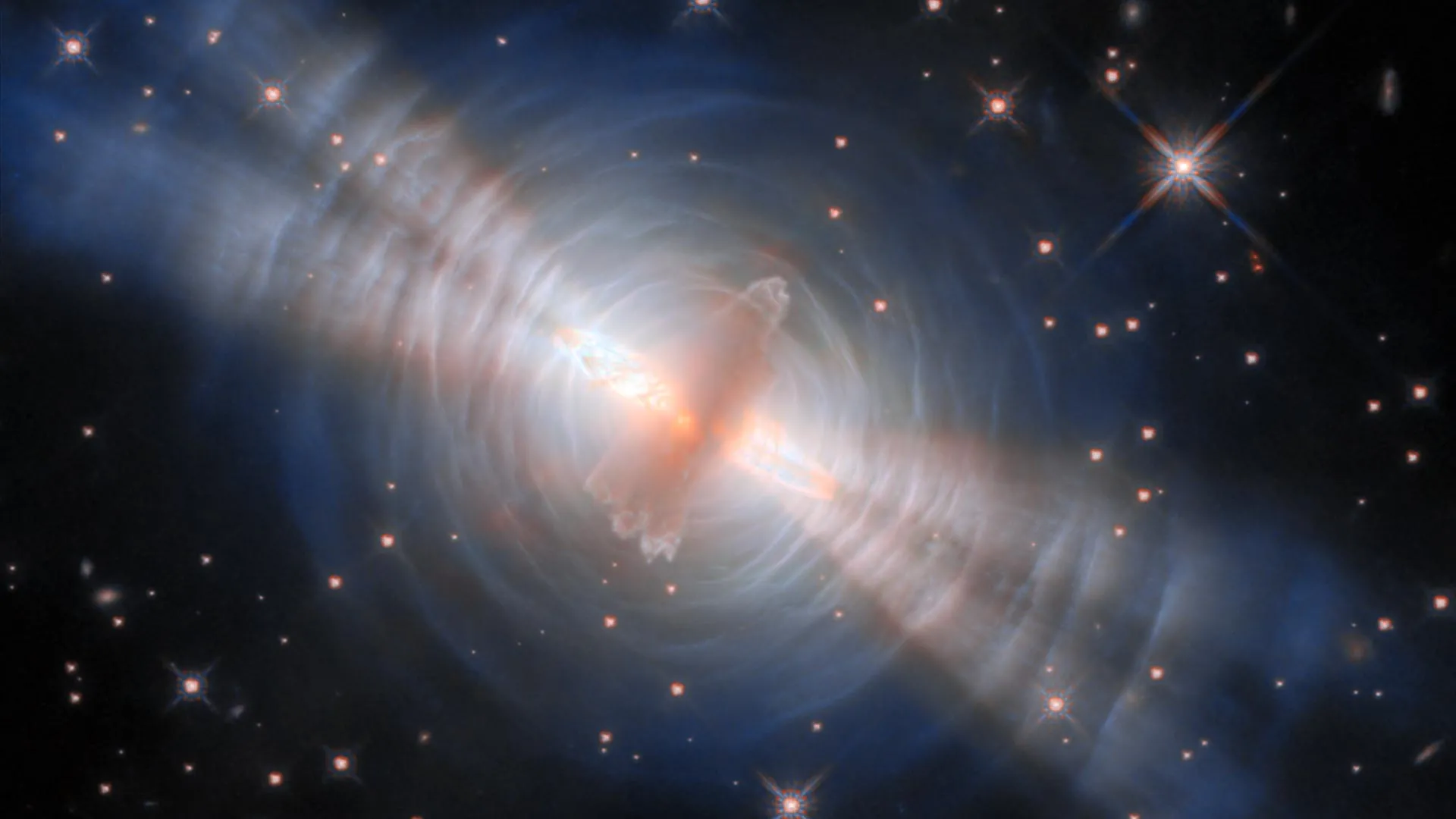
A remarkable image captured by the Hubble Space Telescope reveals the Egg Nebula, a rare phase in the life cycle of a Sun-like star located approximately 1,000 light-years away in the constellation Cygnus. This stunning photograph showcases twin beams of light emitted from a dying star, which is concealed within a dense cocoon of dust. The beams carve glowing lobes and delicate ripples into the surrounding material, suggesting that unseen companion stars may influence the formation of this cosmic spectacle.
The Egg Nebula is unique as it represents the first, youngest, and closest pre-planetary nebula identified to date. This classification refers to a transitional phase before a planetary nebula fully develops—a structure formed from the gas and dust ejected by a dying star. Despite its name, a planetary nebula is not related to planets but is instead a stage in stellar evolution.
Unveiling Stellar Secrets
The Egg Nebula offers astronomers a rare opportunity to study the processes occurring as Sun-like stars near the end of their life cycles. Currently, the nebula shines by reflecting light from its central star, which escapes through a polar opening, often described as an “eye” in the dusty veil surrounding it. The light originates from a disk of dust expelled by the star in the last few hundred years.
Hubble’s high-resolution imaging reveals two bright beams streaming outward from the star, illuminating fast-moving polar lobes that penetrate older, slower rings of material arranged in concentric arcs. The symmetrical nature of these features suggests that gravitational effects from one or more hidden companion stars may be at play, exerting influence from within the dense dust.
As stars like our Sun exhaust their hydrogen and helium fuel, they shed their outer layers. The exposed core emits intense radiation, energizing the surrounding gas and producing the glowing shells typical of planetary nebulae, such as the Helix and Butterfly nebulae. The Egg Nebula, however, remains in the fleeting pre-planetary stage, which lasts only a few thousand years. Observing it at this point allows scientists to examine the ejection process while the material is still fresh.
Insights from Hubble’s Ongoing Observations
Over the years, the Hubble Space Telescope has made multiple observations of the Egg Nebula. An initial visible light image was taken with the Wide Field and Planetary Camera 2 (WFPC2), followed by a near-infrared view from the Near Infrared Camera and Multi-Object Spectrometer (NICMOS) in 1997. Subsequent observations by the Advanced Camera for Surveys (ACS) in 2003 captured the dusty ripples surrounding the nebula, while the Wide Field Camera 3 (WFC3) focused on the dense central cloud and powerful gas outflows in 2012.
The latest image combines data from these earlier observations, resulting in the clearest and most detailed view of this intricate cosmic structure to date. For over three decades, Hubble has provided invaluable insights that have transformed our understanding of the universe.
This initiative is a collaboration between NASA and the European Space Agency (ESA). NASA’s Goddard Space Flight Center in Greenbelt, Maryland, oversees the telescope and mission operations, with additional support from Lockheed Martin Space in Denver. The Space Telescope Science Institute in Baltimore manages Hubble’s scientific operations for NASA, exemplifying the ongoing partnership that has led to significant astronomical discoveries.
As scientists continue to study the Egg Nebula, they hope to unravel the complex processes of stellar evolution and the formation of future star systems, contributing to our understanding of the cosmos.