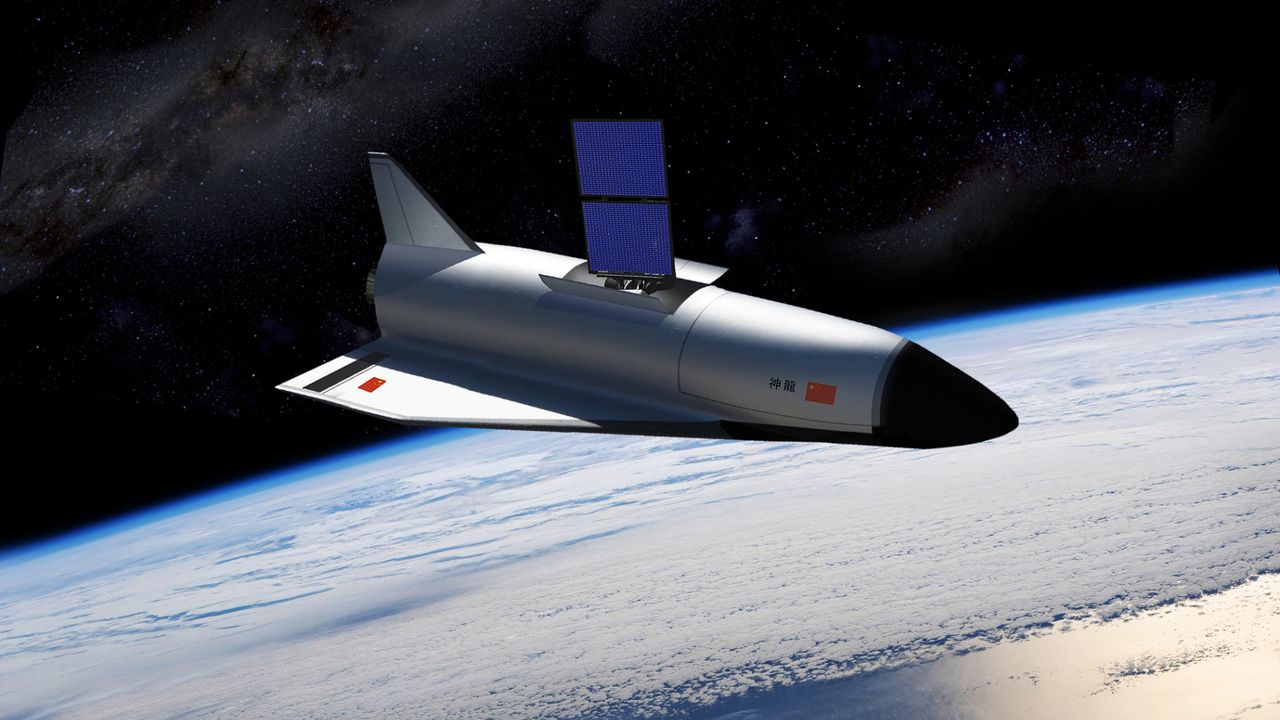
China’s reusable space plane, known as Shenlong or “Divine Dragon,” successfully launched on its fourth mission from the Jiuquan Satellite Launch Center in the Gobi Desert on February 6, 2024. This orbital mission continues to raise questions about the spacecraft’s specific objectives and capabilities, as the Chinese government has released limited information regarding its activities.
The Shenlong spacecraft previously completed three missions, with launches occurring in September 2020, May 2023, and September 2024. These missions lasted for varying durations: two days, 276 days, and 266 days, respectively. Official statements from Chinese authorities indicate that Shenlong is intended to test technologies that will facilitate more convenient and cost-effective round-trip methods for the peaceful use of space in the future. This vague description mirrors the U.S. military’s rationale for its autonomous X-37B space plane, which is believed to have similar functions.
Secrecy surrounds both vehicles, particularly regarding their payloads and specific missions. The U.S. Space Force reportedly operates two X-37B vehicles, each measuring approximately 29 feet (8.8 meters) in length and resembling smaller versions of NASA’s former space shuttle orbiters. The X-37B first achieved orbit in 2010 and is currently engaged in its eighth mission, launched aboard a SpaceX Falcon 9 rocket in August 2023.
Despite military officials asserting that the X-37B is merely a technology testbed, its operations have generated suspicion. Early in its operational history, some experts in China perceived it as a potential space weapon, though many argue such fears are exaggerated. The Secure World Foundation (SWF) noted that the X-37B has not approached or rendezvoused with other known space objects, typically orbiting significantly below most operational satellites.
While the X-37B’s limited payload capacity and operational characteristics suggest it is not suited for weaponization, the same reasoning applies to Shenlong. Analysts believe Shenlong is similarly sized to the X-37B, which alleviates concerns about it being used for offensive military purposes. Nonetheless, unlike its American counterpart, Shenlong has previously engaged in rendezvous and proximity operations (RPOs) with other objects in space. Each of its preceding missions involved deploying one or more satellites into orbit, a fact uncovered not through official channels but by the U.S. military, private space monitoring companies, and amateur astronomers.
The SWF highlighted that the satellite deployed during Shenlong’s first mission showcased transmission broadcast capabilities, while the second mission’s payload demonstrated independent propulsion capabilities. These operations may indicate that RPOs are a priority for the Shenlong program, aligning with broader Chinese interests in space technology.
Victoria Samson, chief director of space security and stability at SWF, noted, “This is a skill set that they’re obviously interested in, as is Russia, as is the United States.” Mastering RPO technology could allow operators to refuel, refurbish, upgrade, and deorbit their satellites, as well as potentially inspect or manipulate adversary spacecraft.
Concerns regarding Shenlong’s potential anti-satellite capabilities have been voiced by experts, fueled by its secretive nature. While the extent of these concerns remains a subject of debate, the lack of transparency surrounding both the Shenlong and X-37B programs contributes to speculation and unease. Samson emphasized, “I think a little more transparency would help fill in some of the blanks, because otherwise, people tend to just imagine the worst-case scenario.”
As China continues to develop its space capabilities through missions like Shenlong’s, the implications for international space security remain significant, prompting calls for greater clarity and communication about such programs.