








































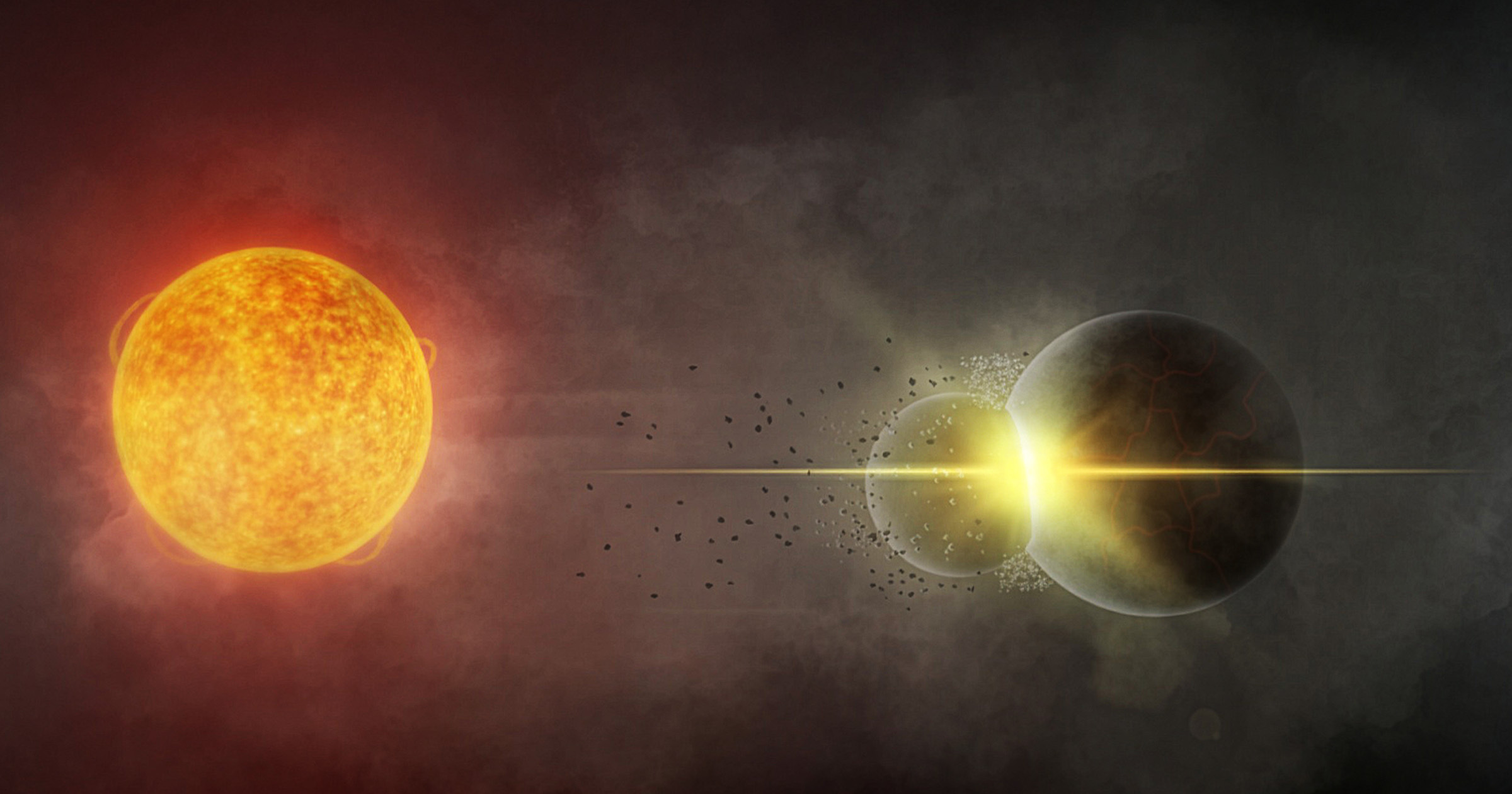
Astronomers have discovered compelling evidence of a cataclysmic collision between two distant planets, a finding that may shed light on the evolution of our solar system and the formation of the Moon. The study, published in The Astrophysical Journal Letters, reveals the dramatic aftermath of this collision, which was observed from a star designated as Gaia20ehk.
Initially appearing as an ordinary main sequence star, Gaia20ehk began exhibiting unusual behavior in 2016. According to lead author Anastasios Tzanidakis from the University of Washington, “The star’s light output was nice and flat, but starting in 2016 it had these three dips in brightness. And then, right around 2021, it went completely bonkers.” This unexpected fluctuation in brightness suggested that something extraordinary was taking place.
Upon further investigation, astronomers determined that the fluctuations were not due to the star itself but rather caused by large streams of rock and dust passing in front of it. The sheer volume of debris indicated that it likely originated from a planetary collision. Observations from another telescope provided additional confirmation of this theory. The infrared data showed a spike in brightness, indicating that the material blocking the star was extremely hot, consistent with the aftermath of a massive collision.
Tzanidakis elaborated on the nature of this planetary interaction, explaining, “At first, they had a series of grazing impacts, which wouldn’t produce a lot of infrared energy. Then, they had their big catastrophic collision, and the infrared really ramped up.” The event marks a significant finding in the study of planetary collisions, as only a handful of similar occurrences have been documented.
The discovery bears striking similarities to a significant event in Earth’s history. About four and a half billion years ago, the planet is believed to have suffered a massive impact from a body named Theia, estimated to be about the size of Mars. This collision is thought to have led to the formation of the Moon, as debris from Theia coalesced in Earth’s orbit.
Interestingly, the dust cloud surrounding Gaia20ehk orbits at a distance comparable to that of Earth from the Sun—approximately one astronomical unit. This positioning opens up the possibility that similar processes could occur, potentially leading to the formation of a new rocky satellite. Tzanidakis noted, “If we can observe more moments like this elsewhere in the galaxy, it will teach us lots about the formation of our world.”
The implications of these findings extend beyond mere curiosity about planetary dynamics. They may have significant consequences for astrobiology, particularly regarding the conditions that foster life. The Moon’s unusually large size relative to Earth is believed to play a crucial role in creating a stable environment conducive to life, influencing tidal patterns and offering protection from asteroids.
Tzanidakis emphasized the rarity of such collisions, suggesting that if planetary impacts leading to large moons are uncommon, then the emergence of life itself may also be relatively rare. “Right now, we don’t know how common these dynamics are,” he stated. “But if we catch more of these collisions, we’ll start to figure it out.”
This groundbreaking research not only enhances our understanding of planetary systems but also invites further exploration into the origins of our own celestial neighborhood. As telescopes continue to capture such cosmic events, the scientific community hopes to unravel more mysteries that lie beyond our world.
























