








































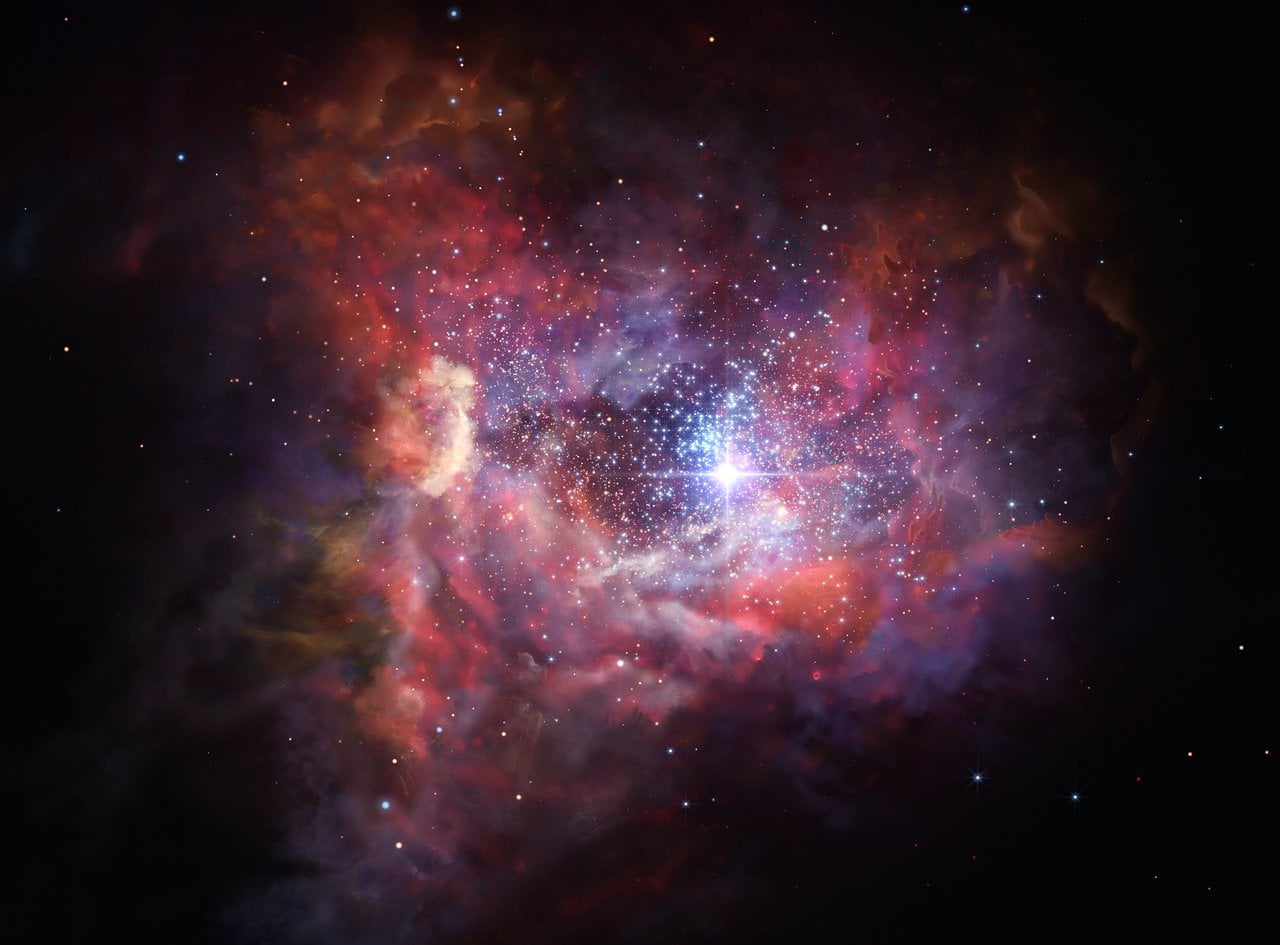
A recent study led by Andreas Faisst from Caltech has revealed that early galaxies are evolving much faster than previously thought. This research, presented at the American Astronomical Society Meeting and published in The Astrophysical Journal Supplement, examines eighteen early galaxies and indicates that they are acquiring metals more rapidly than expected.
The findings are significant as they challenge existing models of galaxy development during a period approximately 12.5 billion years ago. Traditionally, these galaxies were believed to be metal-poor due to their age, existing in an era when stars had not yet formed enough metals through fusion processes. The study found that there was minimal increase in metallicity between galaxies from the “Post-Reionization” epoch and those from the subsequent “Cosmic Noon” epoch. This suggests a need for a reevaluation of how quickly these early galaxies transformed their initial hydrogen and helium into heavier elements like carbon and oxygen, which are essential for forming planetary systems.
Active Galactic Nuclei and Bursty Star Formation
Another noteworthy aspect of this research is the identification of Active Galactic Nuclei (AGN) within these galaxies. AGNs are regions surrounding supermassive black holes that are actively consuming gas and dust. The James Webb Space Telescope (JWST) has uncovered numerous AGNs in the early universe, indicating they may be prevalent in star-forming galaxies during the Post-Reionization epoch. Notably, the galaxies selected for this survey originally showed no obvious AGNs, making them ideal for monitoring.
The presence of these AGNs not only sheds light on the growth of supermassive black holes but also offers an explanation for the mysterious Little Red Dots observed by the JWST, which are believed to be AGNs actively accreting matter.
Additionally, the study highlights a “bursty” nature of star formation in these early galaxies. Researchers observed that star formation rates varied significantly, with periods of intense star creation followed by lulls with minimal activity. This variation can be tracked through different indicators, such as the H-alpha line for recent star formation and ultraviolet/infrared spectra for activity over the past hundred million years. Discrepancies between these indicators provide insights into the intermittent star formation patterns typical of early galaxies.
Future Implications for Astronomical Research
This paper is part of a broader effort to understand the evolution of galaxies, with future studies planned to explore various aspects, including galaxy rotation and the distribution of metals. As telescopes become more advanced, the ability to analyze such distant cosmic events will likely yield even more groundbreaking findings.
The combination of data from multiple telescopes, including the Hubble Space Telescope and the Atacama Large Millimeter Array, has proven invaluable in constructing a comprehensive picture of these early galaxies. As astronomers continue to unravel the complexities of the universe’s formative years, discoveries like these underscore the dynamic nature of cosmic evolution and offer new perspectives on the origins of the galaxies that shape our universe today.
























