








































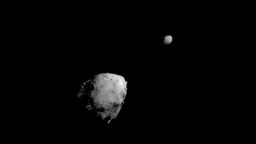
New observations indicate that asteroid 2024 YR4, once considered a potential threat to the moon, will safely pass by at a distance of approximately 14,229 miles (or 22,900 kilometers) on its trajectory. Initially discovered in late December 2024, this asteroid was identified as having a 3.1% chance of impacting Earth on December 22, 2032. Subsequent assessments ruled out this possibility, but concerns shifted to a potential lunar collision, with estimates rising to a 4.3% chance of impact.
Should 2024 YR4 have struck the moon, it would not have posed a significant threat to Earth itself, but any astronauts or infrastructure on the lunar surface could have faced risks. Furthermore, the collision could have jeopardized vital satellites essential for navigation and communication. The scientific community awaited further assessments until the asteroid reappeared in Earth’s view in 2028, but a recent breakthrough allowed for earlier observations.
Dr. Andy Rivkin, a planetary astronomer at the Johns Hopkins University’s Applied Physics Laboratory, and Julien de Wit, associate professor of planetary science at the Massachusetts Institute of Technology, took the initiative to utilize the James Webb Space Telescope (JWST) for earlier analysis. Their observations on February 18 and 26, 2025, provided crucial data that confirmed the asteroid’s trajectory.
The advanced capabilities of JWST, the most powerful space telescope, were instrumental in this endeavor. Rivkin and de Wit faced the challenge of detecting an object as faint as 2024 YR4, which is about 60 meters (approximately 200 feet) in diameter. Previous observations had only hinted at the asteroid’s characteristics, but the recent analysis revealed it appeared remarkably dim, reflecting light comparable to a solitary almond viewed from the moon’s distance.
Innovative Techniques for Detection
The JWST has previously captured images of distant galaxies and cosmic structures, but the task of identifying a rapidly moving asteroid required innovative techniques. Rivkin and de Wit adapted JWST’s instruments to track 2024 YR4, overcoming the challenge of differentiating it from the background of bright stars.
The team had limited observation windows, as they only had a couple of five-hour opportunities to capture images of the asteroid. Dr. Artem Burdanov, also part of the team and a research scientist at MIT, pinpointed the optimal timing for these observations. The strategy involved a combination of pre-planned techniques and real-time adjustments, as the scientists had to react quickly to the incoming data.
“We designed an observing strategy that allowed JWST to track a fast-moving target while preserving highly accurate astrometry,” said de Wit. This meticulous approach allowed the researchers to detect the asteroid, which was 20 to 30 times fainter than the smallest asteroids typically observable with other telescopes.
Significance of the Findings
As a result of these observations, the team has effectively reduced the uncertainties regarding the asteroid’s orbit. This is crucial for future assessments, as understanding an asteroid’s trajectory helps astronomers predict its path with greater precision. “Every time we observe an asteroid, we reduce the range of possible trajectories,” de Wit explained. The current data indicates that a lunar impact can now be confidently ruled out.
Dr. Paul Wiegert, a professor of astronomy and physics at Western University in Ontario, commented on the findings, noting, “Though a little disappointed not to get to study a large asteroid impact on the Moon, it’s amazing what science and technical know-how can do to help us navigate the future.”
The research team’s findings underline the importance of using advanced technology like JWST in planetary defense. As new observatories, such as the Near-Earth Object Surveyor and the Nancy Grace Roman Space Telescope, are developed by NASA, these tools will enhance capabilities to identify and monitor potentially hazardous asteroids like 2024 YR4.
In summary, the latest observations confirm that asteroid 2024 YR4 will safely pass by the moon without incident. The innovative approaches adopted by Rivkin, de Wit, and their team exemplify the ongoing efforts in planetary defense and the importance of continuous observation in reducing the unknowns associated with near-Earth objects.
























