








































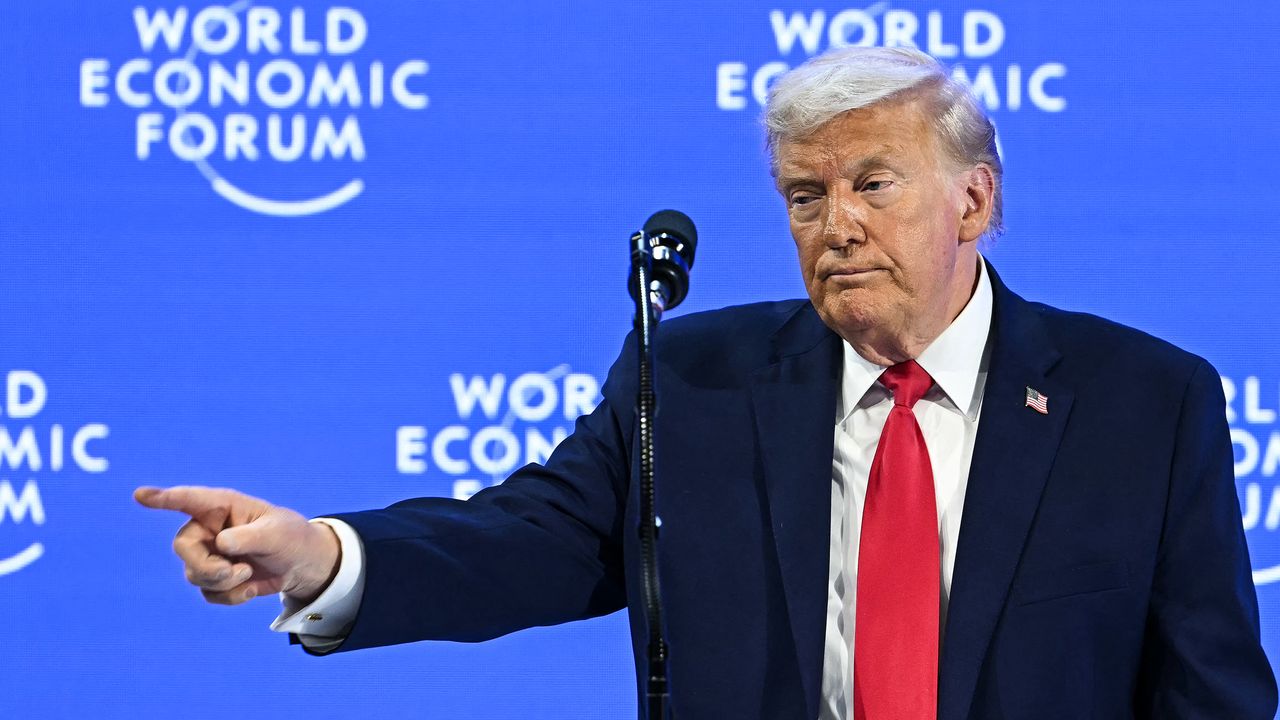
A year into his second term, President Donald Trump has sparked significant controversy with military actions and aggressive foreign policy statements. Just weeks into 2026, Trump ordered a military strike on Venezuela and threatened the Iranian regime in response to ongoing protests. These developments come alongside his remarks regarding potential military action against Greenland, raising concerns among NATO allies and prompting a letter to the Prime Minister of Norway where he stated, “I no longer feel an obligation to think purely of Peace.”
At the World Economic Forum in Davos, Trump noted that the United States would refrain from using military force to gain control of Greenland. Additionally, he announced a halt on tariffs against European allies, indicating a possible shift in his administration’s approach to international trade. The rapid changes in Trump’s foreign policy have left many observers struggling to keep up with his administration’s direction.
As Amy Davidson Sorkin reflected on the anniversary of Trump’s inauguration, “There’s an undercurrent of political violence that wasn’t present in the same way a year ago.” While Trump’s ambitions appear to have intensified, his public approval ratings have declined, posing challenges ahead of the upcoming midterm elections.
The current administration’s immigration policies have also drawn significant criticism. Michael Luo, executive editor, highlighted a disconnect between the harsh realities of Trump’s deportation agenda and the public’s level of outrage. “Every day, by caprice, the lives of ordinary, law-abiding people—our neighbors—are being destroyed,” Luo stated. Polls indicate that a majority of Americans oppose Trump’s immigration stance, yet the response has not reached the level of urgency many believe is necessary.
Contrasting this sentiment, Susan B. Glasser, a staff writer, noted that Trump’s actions since returning to office have largely been predictable. “The surprise this time is that so many who knew better stood by and let it happen,” she remarked. Without the support of certain political figures, Trump could have remained a retired individual rather than a sitting president.
From an economic standpoint, John Cassidy, a staff writer, pointed out that markets have surprisingly thrived despite Trump’s tumultuous governance. The decisive moment occurred in April 2025 when Trump introduced high tariffs that initially prompted a sell-off in stocks and bonds but were later reduced. This backtrack led to the creation of the acronym “TACO”—Trump Always Chickens Out—coined by a columnist for the Financial Times. Despite current threats regarding NATO and Greenland, Wall Street appears to be more focused on technological advancements than on Trump’s rhetoric.
The complexities of the Trump administration’s approach to governance have also raised questions. E. Tammy Kim, a contributing writer, described the non-linear destruction of federal agencies, noting that not all departments have experienced the same level of turmoil. Some employees have been reinstated after being fired multiple times, demonstrating a chaotic environment. Federal unions have stepped forward to push back against the administration’s aggressive immigration enforcement and war strategies.
The audacity of the Trump family’s financial dealings while in office has drawn scrutiny. David D. Kirkpatrick observed that the Trump family has broadened their business ventures internationally, tapping into opportunities that extend beyond real estate. They have sought to capitalize on their presidential status, including launching cryptocurrency projects linked to the presidency. This level of self-enrichment raises ethical questions about the use of presidential power for personal gain.
Reflecting on the first year, Ruth Marcus remarked on the speed and ambition of Trump’s agenda. The administration’s pivot towards imperialism and aggressiveness in foreign relations was unexpected. “I did not see the ‘Donroe Doctrine’ coming,” she noted, highlighting the administration’s significant shift in policy direction.
As the year progresses, the implications of Trump’s actions are likely to unfold further, influencing both domestic and international landscapes. The ongoing dynamics of his presidency continue to evoke a range of reactions, from concern to resignation, as the nation watches closely.
























