








































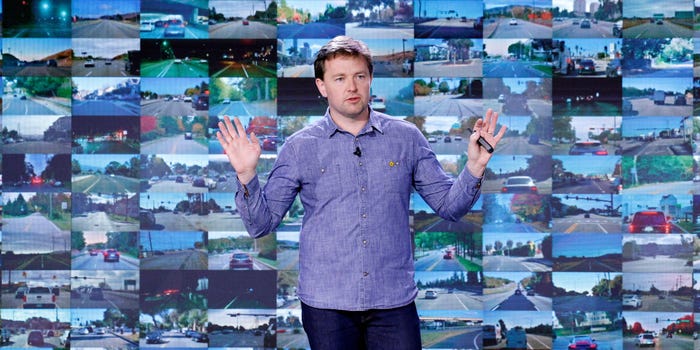
Rivian’s Vice President of Autonomy and AI, James Philbin, announced that the integration of lidar technology into the company’s upcoming R2 model is a strategic move driven by cost reductions in the sensor’s production. In an interview with Business Insider, Philbin emphasized that lidar has become “very affordable,” making it a “no-brainer” decision for enhancing the vehicle’s autonomous capabilities.
Over the past decade, the price of lidar has dropped significantly, transforming it from a luxury component into a viable option for mass-production vehicles. Philbin noted that what was once deemed unimaginable—equipping consumer vehicles with lidar—is now becoming standard. “It’s been on this incredible cost curve, where 10 years ago, it would be just unimaginable that you could put a lidar on a consumer vehicle,” he stated, highlighting its decreasing cost, which is approaching that of radar technology commonly found in modern vehicles equipped with advanced driver-assistance systems (ADAS).
Lidar, which employs laser light to measure distances, has gained prominence in the automotive sector, especially with the rise of self-driving technology. Rivian’s announcement aligns with the company’s roadmap to achieve fully autonomous driving. The R2 model will initially launch without lidar in early 2026, priced at approximately $45,000, but a version featuring the sensor is expected to follow later that year.
Philbin, who previously held positions at Zoox and Waymo, expressed confidence in the performance benefits that lidar brings to autonomous systems. He argued that the inclusion of this technology can expedite Rivian’s journey toward achieving self-driving capabilities. “The performance it gives you for that cost is really amazing,” he added, underscoring the importance of additional sensors for safety-critical functions.
This approach contrasts sharply with that of Rivian’s main competitor, Tesla, which has adopted a camera-only strategy for its self-driving technology. Tesla’s CEO, Elon Musk, has previously referred to lidar as an expensive “crutch,” indicating a clear divergence in philosophy between the two companies.
While the specific cost of the lidar unit for the R2 remains undisclosed, Philbin indicated that it was “not a significant consideration” in the decision-making process. As Rivian continues to develop its technology and product offerings, the integration of lidar represents a pivotal step toward enhancing vehicle safety and autonomy.
In summary, Rivian’s commitment to incorporating lidar technology in its R2 model exemplifies the company’s forward-thinking approach in an increasingly competitive electric vehicle market. The anticipated launch of the R2, along with its adoption of advanced sensor technologies, positions Rivian as a serious contender in the race toward fully autonomous vehicles.
























