








































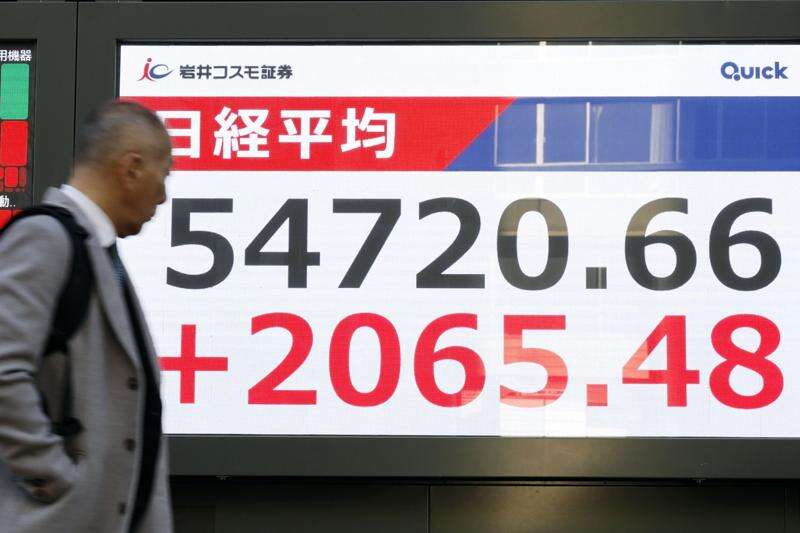
Global stock markets experienced a significant surge on Tuesday, with notable gains led by South Korea and Japan. The South Korean benchmark index, the Kospi, soared by nearly 7%, while the Nikkei 225 in Tokyo jumped 3.9% to reach a record closing of 54,720.66. This upward momentum was largely fueled by strong demand for technology-related shares.
In Europe, early trading reflected positive sentiment as well. France’s CAC 40 climbed 0.6% to 8,232.71, while the German DAX rose 1.0% to 25,053.90. The UK’s FTSE 100 also saw a modest increase of 0.2%, reaching 10,361.21. Futures for the S&P 500 and the Dow Jones Industrial Average indicated a positive opening, with increases of 0.3% and 0.1% respectively.
Investors are closely watching upcoming earnings reports from major companies to assess the impact of various economic pressures, including U.S. President Donald Trump’s tariffs and potential restrictions on rare earth exports from China. The recent climb in Japan’s Nikkei was particularly notable, with shares of equipment manufacturer Disco Corp. increasing by 7.4% and testing equipment maker Advantest rising by 7.1%.
Expectations surrounding the upcoming parliamentary elections in Japan on February 8 have also contributed to positive market sentiment. Analysts predict that Prime Minister Sanae Takaichi‘s Liberal Democratic Party could secure a significant majority, leading to more investor-friendly policies. Nonetheless, some market observers caution that an increase in government spending could devalue the Japanese yen, potentially causing difficulties for consumers and certain businesses.
In South Korea, the Kospi’s remarkable rise to 5,288.08 marked another record high. The recovery in investor confidence followed concerns regarding a potential bubble in the artificial intelligence sector. Notably, shares of Samsung Electronics surged by 11.4%, while chipmaker SK Hynix saw a dramatic gain of 9.3%.
The Hong Kong market also enjoyed gains, with the Hang Seng index increasing by 0.2% to 26,834.77. The Shanghai Composite added 1.3%, closing at 4,067.74. In Australia, the S&P/ASX 200 edged up 0.9% to 8,857.10, reflecting the overall positive trend across the Asia-Pacific region.
The Australian central bank raised its benchmark policy rate for the first time in two years, attributing the decision to inflation levels that surpassed previous expectations. In the U.S., the S&P 500 recorded a 0.5% increase on Monday, ending a three-day losing streak, with the Dow industrials rising 1.1% and the Nasdaq composite up by 0.6%.
Market fluctuations in precious metals were notable on Tuesday, with gold prices increasing by 6.7% and silver rebounding nearly 14%. This rise comes amid growing investor interest in safer assets due to uncertainties surrounding the Federal Reserve, which may be poised to reduce its independence. The recent volatility in precious metals included a significant 31.4% drop in silver prices last Friday, attributed to the nomination of Kevin Warsh as the next chair of the Federal Reserve.
As global markets react to these developments, investors remain vigilant about the economic landscape and the potential implications for future growth and stability. In other market movements early Tuesday, benchmark U.S. crude prices fell slightly to $62.10 per barrel, while Brent crude declined to $66.17. The U.S. dollar weakened against the Japanese yen, trading at 155.52 yen, while the euro increased to $1.1819 from $1.1791.
























