








































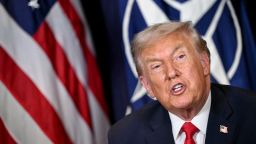
Tensions have escalated between Denmark and the United States, leaving Danish veterans feeling betrayed. Recent comments from US President Donald Trump regarding Greenland have sparked outrage among those who served alongside American forces. Danish veteran Gerth Sloth Berthelsen, who participated in a peacekeeping mission in North Macedonia, expressed his dismay over what he describes as disrespectful behavior from a longtime ally.
Berthelsen, who is half Greenlandic and currently serves in a non-combat role in the Danish army, described a growing sense of fear and unease within the military community. He is among several veterans reacting to Trump’s past demands to “acquire” Greenland, a territory owned by Denmark, which the president later retracted. Hours after asserting rights to the autonomous region, Trump announced he had “formed the framework of a future deal” on Greenland following discussions with NATO Secretary-General Mark Rutte.
While European allies welcomed this announcement, they cautioned that the damage to the EU-US relationship may have already been inflicted. The Danish military has a storied history of cooperation with US forces, including participation in NATO missions and conflicts in Iraq and Afghanistan. Denmark has mandatory military service for both men and women, but the number of Greenlandic soldiers serving in the Danish defense forces is limited to volunteers.
Denmark’s involvement in Afghanistan began in 2001 following the September 11 attacks. Over the years, nearly 20,000 Danish personnel served under the International Security Assistance Force (ISAF), with at least 41 Danish soldiers killed in combat, a high casualty rate considering Denmark’s population of around 6 million. The nation also suffered eight casualties in the Iraq War, according to data from the Danish Defence Medical Command.
In light of Trump’s remarks, Berthelsen stated, “Many of our veterans that we work with have served alongside Americans, and there’s no – absolutely no – respect for their service and their office.” He co-chairs Veteranprojekt Grønland, an organization supporting veterans through social connections and nature rehabilitation. This group facilitates annual trips to Greenland, where veterans meet with current Greenlandic soldiers.
Another Greenlandic soldier, Salik Augustinussen, expressed his sentiments in an open letter to the American public, emphasizing the contributions made by Denmark and its territories in the aftermath of 9/11. He described potential threats to Greenland as akin to a “blue on blue” attack on NATO allies, reinforcing the bond forged through shared sacrifice in military operations.
In a recent interview, Augustinussen stated, “If the US president decides to let the military to go invade Greenland, you are attacking me and my family. You are attacking the brothers and sisters who stood side by side with you when you were attacked.”
This sentiment resonates deeply, as the only instance in history when NATO invoked Article 5, which considers an attack against one member an attack against all, was after the September 11 terrorist attacks on the United States.
Despite Trump’s retraction of military force to take Greenland, his rhetoric regarding the Arctic territory and NATO allies continues to reverberate across the alliance. In a recent Fox News interview, he made unfounded claims that NATO troops had remained “a little off the front lines” in the Afghan war, igniting outrage among nations that suffered significant losses in the conflict.
His earlier remarks at the Davos summit questioned the loyalty of NATO allies, stating, “What we have gotten out of NATO is nothing.” This prompted a wave of responses from European soldiers who shared their experiences in Afghanistan, highlighting their contributions alongside US forces.
Greenlandic veteran Kununguak Iversen echoed similar feelings of betrayal, stating, “It’s about the fact that we picked up the phone when they called. The fact that they then treat us the way they are doing now is not okay.” Iversen served in Iraq as part of a US-led coalition in 2006.
An emergency summit of EU leaders convened to address Trump’s threats against Greenland took place, with Sweden’s Deputy Prime Minister Ebba Busch cautioning, “We’re not out of the woods.” As details of the framework deal on Greenland remain vague, discussions continue regarding a 1951 agreement between the US, Denmark, and Greenland that governs the US military presence on the island.
Sources familiar with the discussions indicate that the framework aims to prevent investments from Russia and China in Greenland while enhancing NATO’s role in the region. Proposals have surfaced regarding the possibility of establishing additional US military bases there, a significant consideration given the existing Pituffik Space Base established through the defense agreement.
As the situation evolves, the long-standing relationship between Denmark and the US hangs in the balance, with veterans and citizens alike grappling with the implications of political rhetoric on their shared history and future.
























